Categories
Community Journalism Journal Volume 11

Beyond the Crime Report: How Local News Coverage Falls Short on Human Trafficking

Local news plays an important role in providing communities the information needed to address problems. This qualitative study employed framing theory to examine human trafficking coverage in South Carolina newspapers, TV, and radio outlets to understand how well local news coverage equipped communities to solve this local issue. We found that local outlets’ use of national and state coverage of high-profile cases undermined the potential to recognize and address trafficking in one’s own community. Yet, local news provided more ways for audiences to act, signaling potential for outlets to aid in community problem-solving if they produced more local, original content.

Local news media have unique responsibilities toward the communities they serve. In particular, they should help facilitate democratic practices, warn the community about threats, and to provide enough information to equip communities to address problems (Knight Commission on the Information Needs of Communities in a Democracy, 2009). By all accounts, however, local news production has declined precipitously, with fewer journalists producing local news and fewer communities having access to news about their immediate surroundings (Local Journalism Index, 2025; Metzger, 2025). These declines have made it more difficult for communities to find out about important issues, including pollution, political scandals, and even who their representatives are (Hayes, 2025; Hayes & Lawless, 2021; Wang et al., 2025). When the main source of local news in a town disappears, residents further feel less connected to their communities and less community pride (Mathews, 2022), which could affect their interest and ability to solve problems. But problems and potential threats to communities do not disappear or decline when local journalism does. One such problem that affects all communities is human trafficking, the exploitation of individuals for sex or labor using force, fraud, or coercion  (State Department, 2021).

Since 2000, human trafficking has been prohibited by federal law (Victims of Trafficking and Violence Protection Act, 2000); and all 50 states have laws against trafficking, although they vary in scope and enforcement, as well as in the protections they afford victims (NCLS, 2026). Human trafficking is a global phenomenon with local dimensions, providing a valuable test case for community problem-solving. While trafficking can occur anywhere, traffickers operate with an understanding of specific contexts of a local community (Johnstone, 2018), taking advantage of conditions that make trafficking more likely (Henderson, 2019), such as tourist destinations, highway rest stops, and upheaval caused by political instability and natural disasters (Hoogesteyn et al., 2024). Furthermore, community-specific responses harness strengths for more effective coordination to fight trafficking and provide aid to victims (Alejano-Steele et al., 2024). Whereas the impacts of human trafficking are experienced most profoundly by its victims, the well-being of communities is also impacted by trafficking, which can strain police and public health resources, and encourage or intensify organized crime and illicit economies. Trafficking is a crime that “touches every layer of local infrastructure” and its economic effects are felt throughout a community (Safe House Project, 2025). The presence of trafficking in a community may further be indicative of systemic issues, such as poverty, food scarcity, homelessness, racism, or corruption (Henderson, 2019)—issues that have long been of concern to journalism.

News is a primary way that the public learn about issues like trafficking, and how the issue is framed in coverage can shape public understanding and response to the issue. Therefore, this study examined news frames in coverage of labor and sex trafficking published by local news outlets. Studies of news coverage of human trafficking have tended to focus on national media (i.e., Gulati, 2011; Sanford, Martinez, & Weitzer, 2016); our site of inquiry is South Carolina, a state with social, economic, and geographic characteristics that lend increased vulnerability to both types of trafficking, and one that has been affected by newspaper closures in ways similar to other states, leaving areas without substantial coverage (Underwood, 2022). We found locally published coverage failed to meet its responsibility to equip communities with the context required to address this pervasive issue, illuminating gaps in local news coverage that could undermine community members’ grasps of the complexities of human trafficking without context about what causes trafficking, the effects on individuals and communities, and potential solutions outside of law enforcement, leaving them ill-equipped to engage leaders to effectively address the problem. We argue ultimately that although local news outlets did publish news about trafficking, coverage failed to fulfill the information needs of South Carolina communities regarding a pernicious problem.

This study and its implications emphasize the interconnectedness of local news and community well-being. In the following section, we trace the role of local news in community problem-solving, situate human trafficking as a local problem, provide detailed rationale for South Carolina as the site of analysis, and synthesize studies of news framing in coverage of trafficking.

Literature Review

The role of local news in community problem-solving
To function effectively, information about the community must be available, and community members must engage with the information: “Informed communities can effectively coordinate activities, achieve public accountability, solve problems, and create connections” (Knight Commission, 2009; p. xiv). Healthy information flow in a community further requires “original and verified reporting” (Knight Commission, 2009, p. xv). One way journalism does this is through coverage alerting the community to problems and risks, one of eight information needs deemed essential for communities to function (Friedland, 2023). Citizens must be able to discuss problems they face and take part in finding solutions—an essential part of democracy. They could conceivably help address problems that are not receiving media attention if they have life experience with them, but other members of the community require media to help fill in gaps (Friedland, 2001). Local news can provide an understanding of local issues, shared even among those at opposite ends of the political spectrum (Wenzel, 2018). Indeed, the most involved and connected in communities tend to be avid local news consumers (Barthel et al., 2016). Yet meeting information needs is a tall order for local outlets, which tend to have smaller staffs and budgets than national news organizations and have faced unprecedented cuts in the past decade (Hayes & Lawless, 2021).

Evidence suggests that news outlet closures decrease community members’ civic and political engagement (Shaker, 2014), making them less likely to be able to address issues of concern. Even before the shrinkage, evidence suggests that news coverage did not always help solve societal problems but instead privileged the status quo (Usher, 2021). It follows, then, that for local news coverage to be of benefit to community problem-solving, it must go beyond mere existence and provide particular context. For example, thematic coverage that includes context and interconnection of societal problems is considered more conducive to problem-solving than event-centered, episodic coverage. “The portrayal of recurring issues as unrelated events prevents the public from cumulating the evidence toward any logical, ultimate consequence” (Iyengar, 1991, p. 143).

Scholars have studied news framing to understand whether coverage of community problems prioritized problem-solving through its definition of the problem, causes of the problem, moral evaluation, and/or treatment possibilities (Entman, 1993). Sometimes, local news coverage has failed to do so. In a study of local news framing of community risk, a community’s growing petrochemical industry was framed as a vital source of the region’s economic success rather than a source of potential environmental disaster, despite multiple industrial accidents (Castelló, 2010). A study of news coverage on systemic problems, including poverty, found that outlets failed to provide adequate information for readers to act, potentially fostering apathy (Kensicki, 2004). Most stories on Philadelphia TV news about gun violence failed to provide enough information for audiences “to prevent gun violence or better deal with its effects” (Midberry & Walters, 2025, p. 15). Another study found that news coverage on air pollution focused mostly on threat at the expense of potential solutions (Ramondt & Ramirez, 2020). Yet local news coverage does have the potential to help communities understand and respond to problems close to home when it provides its audience with contextual depth. In covering the Jena Six controversy, a racially charged assault case in Louisiana, newspapers used thematic framing more often than episodic, with local outlets framing the event as more than an isolated crime. Including context and causal factors underlying the crime “may have opened a window for deeper discussions on issues of race and societal change” (Holt & Major, 2010, p. 593).

Human trafficking as a local problem

Although a global issue, human trafficking is also a local problem that takes many forms, each with “its own business model, trafficker profiles, recruitment strategies, victim profiles, and methods of control that facilitate human trafficking” (Polaris Project, 2017, p. 5). Trafficking occurs in multiple settings, including private homes, hotels, health and beauty services, bars and restaurants, farms, and construction, to name a few. Populous locations tend to be better equipped to identify trafficking and intervene (Freedom Network, 2025). Rural communities, on the other hand, create vulnerabilities due to isolation (and corresponding lack of detection), fewer employment opportunities, and a lack of services. Immigrants who arrive to rural communities as part of the United States’ H-2 visa program—forestry and seasonal agricultural workers, for example—have been subjected to abuse that rises to the level of human trafficking (Garrison et al., 2015). The economic principle of supply and demand for cheap goods and commercial sex, paired with the low risk of punishment or legal consequence, incentivizes the exploitation of individuals. “Human trafficking is fueled by a high reward, low risk dynamic,” wrote Gould (2017, para. 6).
There is no prototypical trafficking victim (Hume & Sidun, 2017), yet certain groups are more vulnerable than others. Knowing who is most vulnerable aids productive allocation of resources. Multiple studies have found disproportionately higher sex trafficking victimization of Black, Indigenous, and People of Color (BIPOC), sexual and gender minorities, and people with disabilities (Nichols & Preble, 2025). Groups at exceptionally high risk for poverty, homelessness, and sexual violence are likewise at risk of becoming trafficked (Farley et al., 2011). Girls and women are more likely to be in forced sexual exploitation and domestic work, while men and boys are disproportionately represented in other economic activities (ILO, 2014). Historic and intergenerational trauma are additional risk factors for human trafficking (Tibaduiza et al., 2025).
Traffickers, who may act as individuals or as part of an organized criminal enterprise, identify and exploit existing vulnerabilities, such as homelessness, poverty, addiction, and prior abuse or neglect. Involvement in the child welfare system, recent migration, or relocation, are other significant risk factors (Human Trafficking Collaborative, 2021). A trafficker may pose as a potential romantic partner to lure a victim into commercial sex (Johnston & Friedman, 2019); provide an unhoused individual with food and shelter, then demand “repayment” through unpaid labor (US Department of Justice, 2023); or entrap an immigrant with false promises of work and security, for example. Traffickers control their victims through subtle and overt means; coercion can be psychological and/or physical. Service providers and scholars have identified a trafficker-substance use dynamic, in which traffickers take advantage of a person’s existing substance-use disorder or facilitate addiction to coerce labor or sex (Koegler et al., 2022). News coverage documenting the range of traffickers’ methods could help potential victims recognize and resist them.

South Carolina and human trafficking

South Carolina offers a compelling location to examine media coverage of trafficking. The state’s media ecosystem, established anti-trafficking infrastructure, and social and economic characteristics create conditions that increase vulnerabilities while constraining public awareness and institutional responses.
South Carolina’s news media ecosystem has faced significant challenges in recent years, mirroring constrictions and closures nationwide. The number of newspapers has declined in the past two decades, with 10 newspapers closing during the COVID-19 pandemic alone (Underwood, 2022), so that by 2025, South Carolina had only 72 newspapers (Metzger, 2025). The geographic distribution of news outlets reveals concerning gaps in coverage. Out of 46 counties, three counties had zero news outlets, and 24 had only one news outlets (Metzger, 2025). South Carolina is home to the most populous county without at least one local journalist covering the area and is ranked 43rd in the number of local journalist equivalents (Local Journalist Index, 2025). This pattern of limited news access is particularly pronounced in the state’s rural and economically disadvantaged communities, where geographic isolation and resource constraints have long affected information access. Without local news outlets, residents of the state lack geographically specific coverage of important news and information, a problem that could disproportionately affect communities most vulnerable to human trafficking.

The state’s anti-trafficking efforts are centered on the South Carolina Human Trafficking Task Force, which aligns with a model that leverages partnerships between law enforcement, prosecutors, service providers, mental health professionals, labor professionals, and other stakeholders at the local, state, and federal levels. Over 50 such task forces at the city, county, and state levels were funded by the federal government in 2023 (NORC, 2023).

The South Carolina Law Enforcement Division investigated 305 human trafficking cases from counties across the state in 2023 and 2024. In total, 43% of all cases involved sex trafficking, while 42% involved labor trafficking, and 8% involved both forms. (SC Human Trafficking Task Force, 2023; Office of the SC Attorney General, 2024). Although differences in detection capabilities, reporting mechanisms, and law enforcement priorities between states can impact statistics and create interpretative challenges, available data from neighboring states provides some context. According to the National Human Trafficking Hotline, which compiles information reported by callers, South Carolina recorded 64 trafficking situations involving 111 potential victims in 2023. During the same period, neighboring states reported varying levels of trafficking: Florida documented 680 calls involving 1,172 potential victims, North Carolina documented 235 calls involving 394 potential victims, and Georgia documented 263 calls involving 499 potential victims (National Human Trafficking Hotline, undated). While population differences account for much of this variation, differences in transportation networks, reporting systems, or labor-specific needs may also explain disparities. Since human trafficking is more likely to be underreported in rural areas, South Carolina’s rate is likely higher than available data suggest. South Carolina has been relatively successful in securing funds for its efforts, with the legislature allocating $1.7 million in recurring funds and a $6.5 million appropriation in 2024 (South Carolina Attorney General, 2024).

South Carolina’s social, economic, and geographic characteristics create structural conditions that increase vulnerability to trafficking. South Carolina’s tourist destinations and interstate highway network create conditions that are conducive to trafficking operations. The I-95 corridor passes through the state’s most rural and diverse areas, where approximately 21% of residents live below the federal poverty line (Mandelbaum et al., 2022). The state’s position between major metropolitan areas allows traffickers to strategically use transportation routes to move victims between exploitation sites. Rural isolation is another risk factor for human trafficking. Out of 46 counties across the state, 22 have a population below 50,000, which the United States Census Bureau defines as “rural” (U.S. Census, 2024). Rural areas have fewer employment opportunities and limited access to social services, while geographic isolation itself can allow trafficking activities to go undetected. Rural counties in South Carolina have higher socioeconomic vulnerability scores relative to urban and suburban counties (Mandelbaum et al., 2022), indicating fewer protective factors against trafficking and other harms.

Constriction of local news media intensifies rural counties’ vulnerabilities by creating information gaps where trafficking coverage is most needed. Poverty, unemployment, and seasonal employment cycles lead to economic precarity, which makes populations susceptible to human trafficking. Migrant workers are uniquely vulnerable due to language barriers, cultural isolation, and a lack of familiarity with legal protections. Traffickers capitalize on these vulnerabilities through debt bondage mechanisms, confiscating personal documents, and threatening deportation to maintain control over victims (Polaris Project, 2019).

Framing in news coverage of human trafficking

Multiple studies have applied framing theory to identify patterns in coverage and changes over time. News coverage has not typically increased public understanding and holistic policy solutions about trafficking, yet “media framings of human trafficking are consequential for countering it more effectively” (Foot, 2024, p. 316). News coverage generally tends to frame human trafficking episodically as singular crime events (Gulati 2011; Johnston et al., 2015) delinked from broader themes such as human rights (Demeke, 2024), immigration (Bonilla, 2018), or public health (Sprang et al., 2022). Although trafficking takes many forms, news coverage is dominated by sex trafficking, to the exclusion of forced labor. The “dominant [media] narrative does not reflect the full reality and diversity of human trafficking” (D’Adamo & Albright, 2017, p. 364).
Furthermore, when news coverage identifies the causes, consequences, and solutions of trafficking, it struggles to do so in a comprehensive manner.

In a study of news frames in coverage of human trafficking, Gulati (2011) analyzed The New York Times and The Washington Post coverage from 1980 to 2006, noting that “the news media mostly echo the narratives presented by the major participants in the policy process and, thus, help support the dominant views” (p. 367). The crime frame was the narrative used most often to indicate the cause of trafficking, and more than half did not mention a solution to the problem of trafficking. For those that did, the most cited solution was enhanced law enforcement (Gulati, 2011). In a framing study on sex trafficking coverage in 140 U.S. news outlets, Johnston et al. (2015), found a similar emphasis on official sources and law-and-order solutions. Sex trafficking coverage was most often framed episodically as individual cases or isolated events to be handled by police and the courts. News coverage rarely took up the root causes of trafficking, and more than half of the stories analyzed had no discussion of remedies. Moreover, cases focused on those involving women and girls, to the neglect of boys, men, and members of the LGBTQ+ community. News frames often mimic official positions on trafficking, with outlets unable to convey the complexity of trafficking, and official responses inadequate to eradicate trafficking (Farrell & Fahy, 2009).

Consequences of trafficking impact the individual trafficking victim, and groups who are at highest risk of exploitation. The impact is also felt at the community level, undermining safety, stability, public health, and economic prosperity. Indeed, “all of society suffers, as well as principles of democratic freedom, principles of democratic society, rule of law and human rights” (McCormack, 2011). Many anti-trafficking initiatives involve more policing and harsher penalties for traffickers, but as understandings of trafficking increase, so too, do calls for solutions not solely reliant on the criminal justice system (Alejano-Steele, et al., 2024, p. 406). “Ending human trafficking requires engagement in interrupting the factors that increase vulnerability to human trafficking, including racism and ethnic bias,” argue Bryant-Davis and Tummala-Narra (2017, p. 152). Cockbain and Bowers (2019) call for “finely-targeted responses” (p. 9) based on the local environment and contingencies of specific trafficking types. “A one-size-fits-all approach developed primarily to combat the trafficking of women and girls for sexual exploitation is insufficient” (p. 27).

Although media coverage is often cited as an obstacle to anti-trafficking efforts because of its tendency to favor sensationalized accounts and its preoccupation with sex trafficking over other forms of human trafficking, media can identify the causes and consequences of trafficking, and explore possible solutions. As Foot (2024) argued, “media framings of human trafficking are consequential for countering it more effectively” (p. 316). As such, news reporting on trafficking can boast successes, as Gulati (2011) observed, investigative journalism was more likely to reject dominant policy views and “analyz[e] stories from a broader and more comprehensive perspective” (p. 368). Examples of award-winning newsroom initiatives include an Associated Press exposé on labor trafficking in Southeast Asia’s fishing industry (Associated Press, 2016); a Washington Post series on child sex trafficking (Eastman, 2022), and the Miami Herald’s prolonged reporting of the Jeffrey Epstein case (Ocasio, 2020). Such examples engage with the complexity of trafficking to report its root causes and effects, using a broad range of sources and reporting techniques, but require a commitment of resources that increasingly eludes newsrooms.

Framing as an effective framework to analyze news

Analyzing news frames is one way to understand the usefulness of news stories in helping communities solve problems. By highlighting certain information in news articles, frames “define problems,” “diagnose causes,” “make moral judgments,” and “suggest remedies” for those problems, determining whether people understand and remember a problem, as well as whether they act on it (Entman, 1993, p. 52). Framing for journalists is a tool for making complex issues more comprehensible to audiences (Scheufele & Tewksbury, 2007) by accessing constructs audiences already hold, often shared across the culture (Tewksbury & Scheufele, 2020).

At the same time, interest groups and policymakers can impact the amount of coverage and the nature of the messages involved (Scheufele & Tewksbury, 2007). Previous framing studies of news coverage of trafficking have found a tendency toward episodic coverage of individual cases that neglect the complex issues involved with trafficking (Gulati, 2011; Johnston et al., 2015), with coverage gaining contextual depth and source diversity as journalists became more knowledgeable about trafficking (Sobel et al., 2019). Providing context and a thorough explanation of issues is considered one way to identify quality in journalism. A story can be considered to provide depth in coverage of an issue if, for example, stories go beyond episodic event coverage, include multiple viewpoints, and were the result of enterprise reporting by the journalists rather than a pre-arranged event such as a press conference or an announcement by official sources such as a press release (Lacy & Rosenstiel, 2015).

Research questions

This study posed the following research questions:

RQ1: How did local news outlets in South Carolina frame the problem of human trafficking in the coverage they published for local audiences?
RQ2: Based on previous research on community information needs, how well did news coverage published by local news outlets equip audiences to address trafficking in their communities?

Method

To answer these questions, this qualitative content analysis used framing theory to examine stories about trafficking in South Carolina newspapers and broadcast stations over a 20-month period in 2023 and 2024.

Data collection

Print and digital stories were collected via America’s News (NewsBank) database using the search terms, “human trafficking” or “sex trafficking” or “labor trafficking.” The search was filtered by location (South Carolina), type of source (newspaper, which included selected digital-only stories) and date range (January 1, 2023–August 31, 2024, when coding and analysis began). A total of 393 newspaper stories were collected for analysis (174 stories from 2023, and 219 from 2024).

No digital-native news outlets operated in the state at the time of analysis (Institute for Nonprofit News, n.d.; LION Publishers, n.d.).

Local broadcast stations were selected by identifying the top stations in South Carolina’s four local news markets. The following stations were included in our data collection: South Carolina Public Radio, WISTV (Columbia), WCSC-TV (Charleston), and WMBF (Myrtle Beach-Florence). Broadcast stories for the same period were collected using the search terms “human trafficking or “sex trafficking” or “labor trafficking.” A total of 163 broadcast stories were collected for analysis (65 stories from 2023, and 98 from 2024). After removing duplicates, a total of 500 stories remained.

We organized the 500 stories in a spreadsheet by outlet name, publication date, headline, and byline. We read each story to determine whether trafficking was the focus of the story. A story for which a reporter attended the opening of a new shelter for trafficking survivors and interviewed stakeholders was considered to have trafficking as its focus. Items with incidental mentions of trafficking, such as a simple calendar listing of speaker events at a local library, were eliminated from our analysis. Of the 500 stories collected for analysis, trafficking was the focus of approximately half (251). These stories, published in South Carolina news outlets, became the sample for analysis (Table 1).

Table 1. News Story Distribution by Outlet

 Outlet

Number of Stories

Aiken Standard

8

Bluffton Today

6

Index-Journal

5

Island Packet

9

Morning News

12

South Carolina Public Radio

13

The Columbia Star

1

The Goose Creek Gazette

2

The Herald

28

The Horry Independent

3

The Journal

5

The Lancaster News

1

The Newberry Observer

11

The News Kingstree

3

The Post and Courier

25

The State

12

The Summerville Journal-Scene

2

The Sun News

5

The Times and Democrat

8

WCSC

25

WIS10

22

WMBF

20

WYFF

25

Total

251

Local, original news compared to republished state or national news

Coverage about trafficking, even if not local to a community, could provide helpful context about trafficking as a societal problem that audiences could then use to address the problem in their own community. For this reason, our analysis includes local and nonlocal stories to address this research question. However, because solutions to trafficking are dependent on local contexts, and because institutional contexts are relevant to framing decisions (Entman, 1993; Reese & Lee, 2012), we wanted to know how many of the 251 stories in our sample constituted local coverage of the issue. We anticipated this distinction would be valuable to our interpretation of framing techniques within the corpus.

“Truly local news,” according to Mahone et al. (2019) provides “community members with news and information about, and directly relevant to, their communities (p. 8). In their seminal study of news in 100 U.S. communities, Mahone et al. (2019) used a geographic definition of community, holding that a news story is local if its subject was about an issue or event in the municipality. Following their example, we considered locality as an event or issue within the same county of the publication. We also considered whether stories were original to the news outlet or re-published from another news outlet, deeming stories that were republished to not be local, original stories. These nonlocal, republished stories encompassed coverage published by outlets in other states or communities within the state.

Among the 251 stories in our analysis, 122 were local and original, and 129 were neither local nor original.

Coding for news frames

We returned to the 251 news stories and engaged in a “long preliminary soak” (Hall, 1975, p. 15), a method that allowed us to “examine text with the intention of letting the content speak for itself” (Rodriguez and Blumell, 2014, p. 347). This helped us gain familiarity with the stories as we began the coding process of our framing analysis. Coding for qualitative research involves the systematic organizing of texts to identify patterns. The authors acted as the coders and engaged in an active process of re-reading, revision, and discussion to improve transparency and trustworthiness in the results (Reyes et al., 2021).

We adopted the coding scheme used in Johnston et al.’s (2014, 2015) analyses of frames in U.S. news coverage of sex trafficking. The 251 stories were coded for length, type of story (news, feature, opinion), and what triggered the story, or “what made the issue or event news in the first place” (Project for Excellence in Journalism, 2009, p. 2). Story triggers include “an action, event, or editorial decision,” and are evident in a story’s narrative and sourcing (Pew Research Center, 2009). For example, Gulati (2011) found that 60% of articles about trafficking in the New York Times and the Washington Post 1980-2006 were triggered by “some official government action or event.” Among the 605 stories Gulati analyzed, one-fifth were the result of newsroom initiatives (p. 370).

Stories were also analyzed for the type of trafficking featured in the stories, if a definition of trafficking or statistics were provided, and how trafficking persons were described, if at all.
We further coded stories for the presence of episodic and/or thematic frames (Iyengar, 1991) to understand whether human trafficking was reported in broader contexts. Trafficking is a crime, and crime stories, especially, have been found to veer toward episodic (Iyengar, 1991), reporting a specific event without situating it within its broader impacts (Callaghan & Schnell, 2005).

Next, we examined the news stories for context that might have been used to help audiences understand and respond to trafficking. For example, was the issue of trafficking framed in coverage as one related to human rights, public health, or legislation or policy issues, for example? We analyzed the type of sources cited in the stories. Throughout the coding and analysis process, researchers met multiple times to discuss and resolve differences among perspectives and unique cases to prevent the loss of data (Reyes, et al., 2021).

Framing techniques lend power to a communicating text (Entman, 1993, p. 51) and can convey to news audiences the causes, consequences, and solutions to a problem. In this analysis, we used prior studies (Gulati, 2011; Johnston et al., 2014, 2015) to consider the language in news stories about trafficking causes, consequences, and solutions, including whether any information was given to audiences to support victims of trafficking or to take action against trafficking in their communities. We have included counting where it is relevant to increase “the richness of information” in our qualitative analysis (Christou, 2025, p. 3090).

Findings

This study found that the news coverage about trafficking that local news outlets in South Carolina published failed to equip local audiences with the resources to address this pressing social issue. Audiences in South Carolina were more likely to encounter stories that reported human trafficking in a national context, mostly surrounding celebrity cases, rather than contextualizing news about trafficking as a local concern. Trafficking was framed most often as a crime or to a lesser extent, a problem of a lack of awareness, rather than a byproduct of systemic issues such as poverty. When systemic issues were present in the coverage, such as immigration, they were contextualized nationally rather than as a community issue, which could make problem-solving less accessible to audiences. Stories furthermore neglected context useful for addressing the problem of trafficking in communities: the omission of complex causes, effects of trafficking, and potential remedies, groups most affected, and perspectives from community members who are not law enforcement.

As a bright spot, local news provided more context about trafficking than nonlocal coverage did, suggesting the higher potential for locally produced and focused news to help communities solve problems—if the identified gaps were addressed. The local stories with the most depth and content tended to be produced by newspaper outlets, reinforcing concerns about the demise of local newspapers and replicating previous studies that newspapers continue to be a keystone medium in communities (Mahone et al., 2019; Nielsen, 2015; Usher & Hagman, 2025). Furthermore, the disproportionate focus on sex trafficking compared to other forms of trafficking failed to put the state’s trafficking problem in accurate context. These overarching findings are described in detail in the following sections.

Differences between local and nonlocal coverage

We first found that a majority of trafficking coverage provided to communities by local outlets was not, in fact, local. A little more than half of the stories published by local news outlets were not local to the community, meaning they were not produced by the outlet and about a local community. Non-local stories included those produced outside South Carolina, such as the Los Angeles Times; coverage about national and international trafficking cases by wire agencies such as the Associated Press; and stories published by local outlets within South Carolina that had been syndicated to run in newspaper and TV coverage elsewhere in the state that were about trafficking cases from a different community without locally specific context to relate the case to the local community. These findings were consistent with those of Usher and Hagland (2025), who found multiple local outlets would publish the same stories, amplifying their effect.

Remaining open to the possibility that nationally focused stories could provide context about the problem of human trafficking, we included non-local stories in the sample. Yet our analysis found the smaller amount of local original coverage about trafficking was offset not by rich, contextual national or state-level coverage, but by episodic trafficking cases involving celebrities or high-profile crimes, rather than stories reflecting how human trafficking occurs or other contextual information that could help communities address human trafficking.
We also found differences in the local, original news coverage published by media type. The 146 newspaper stories about trafficking surpassed the 105 stories published by broadcast TV and radio, accounting for more than half of stories in both local and nonlocal categories. These findings echo previous accounts that local newspapers, although declining in coverage and number, provide more local coverage than broadcast outlets (Mahone et al., 2019; Usher & Hagland, 2025).

With the exception of an audio story that included as sources a survivor and members of the state’s task force to debunk misconceptions about trafficking in South Carolina, most public radio coverage consisted of stories focused on national high-profile cases that provided little context about human trafficking as a problem outside of those specific cases. TV coverage about trafficking was more locally focused by comparison, but stories captured only a handful of cases in South Carolina as they moved through the judicial system, rather than providing necessary context that would help audiences understand trafficking. Newspapers, too, focused on prominent national and international cases with reprints from other news organizations, but they tended to offer comparably more in-depth coverage on local cases through the use of more sources and more thematic framing rather than episodic.

Disproportionate focus on sex trafficking and high-profile cases
We next sought to understand the type of trafficking presented to audiences in coverage. A disproportionate majority of both local and nonlocal coverage focused on sex trafficking, a finding consistent with previous research (i.e., Johnston et al., 2015; Sobel et al., 2019) showing news coverage tends to fixate on sex trafficking to the neglect of other typologies. When compared to cases in the state of South Carolina, labor trafficking was under-represented, while sex trafficking was over-represented, with 67% of local coverage focusing on sex trafficking, compared to that being the nature of 43% of cases in the state. Conversely, labor trafficking was the focus of just 5% of local coverage, compared to 42% of cases (South Carolina Human Trafficking Task Force, 2023; Office of the South Carolina Attorney General, 2024).
Local and nonlocal coverage alike tended to spotlight high-profile criminal cases of trafficking.

At the national level, the focus was on a handful of cases with celebrity defendants, such as content creator Andrew Tate, WWE head Vince McMahon, and musician Sean “Diddy” Combs, with coverage tracking their cases as they made their way through the justice system. Similarly, at the local level, a handful of cases appeared multiple times as they traversed local courts over 20 months of analysis. These local cases did not involve celebrities but emphasized unusualness in cases involving minors, such as a mother accused of trafficking her children for sex, and traffickers using a popular ride-share service to transport children being trafficked for sex. While trafficking of children is particularly reprehensible, the focus on several high-profile cases involving minors highlighted the absence of more comprehensive coverage of trafficking in communities, and the resource limitations that make such coverage challenging.

Mostly episodic coverage framed trafficking as a crime

We found that the coverage published by local outlets framed trafficking as a crime through the preponderance of episodic news stories focused on new, singular, and routine events as they were announced by arms of the justice system, and a reliance on sources within the justice system and government. Most stories, local and nonlocal, were prompted by an event, such as an arrest, court date, or press conference, rather than enterprise reporting, measured by whether the first few paragraphs of a story mentioned a pre-arranged event or a public announcement of some kind. Out of these events, most were related to law enforcement and the justice system: About 62% of story triggers arose through court cases, police announcements of arrests or charges, and an annual report published by the state attorney general’s office.

The episodic coverage made up nearly 88% of original local stories, considered to be episodic if prompted by a news event. For example, a story reporting the timely arraignment of a person in South Carolina on trafficking charges was episodic if it provided no additional context with which to understand the event or connect it to others (Clifford, 2024). We considered stories thematic if they connected isolated events to broader societal issues, such as a Post and Courier story that explained the complicity and legal liability of the hospitality industry in facilitating trafficking (Paul, 2024). Beyond police reports, original local news stories about trafficking tended to be triggered by organized events held by nonprofit organizations, mostly with short stories that appeared to have been derived from press releases. While this is a common practice to raise awareness about trafficking, this could result in attention and funds going toward organizations that lack financial transparency or efficiency. It was unclear from the stories if organizations had been vetted before publishing.

When stories contextualized human traffic within a broader issue, the largest proportion—37% of local stories and 32% of nonlocal stories—were focused on trafficking as a crime. We found some differences between additional themes in local and nonlocal stories. Original, local news stories included few themes outside of crime, whereas themes such as human rights, immigration, and the combined theme of power, influence, and money, were more likely to emerge in nonlocal stories. The second largest proportion of original, local stories, about 20%, presented trafficking as a problem of awareness. Few stories regarded trafficking as a problem related to public health, human rights, immigration, the foster care system, or poverty. Although trafficking is illegal and undoubtedly should be viewed as a criminal issue, coverage that focused on trafficking as a crime ignored systemic issues related to trafficking. Similarly, focusing on awareness alone omitted the context required to understand the full extent of how trafficking affects the community, including victims. For example, an Index Journal story about the lack of safe house space viewed trafficking through the lens of public awareness (Holdman, 2024).

The selection of voices to include in news coverage can prioritize some perspectives over others and contribute to how a story is framed. In this area, too, perspectives prioritized trafficking as a criminal issue. When stories included sources, they were more likely to be from law enforcement, which half of local stories included, or the government, which nearly half of local stories included, and a majority of nonlocal stories. The state attorney general’s office representatives were quoted in nearly a quarter of original, local stories. Conversely, victims of trafficking were rarely included, nor were regular community members without official titles. Advocacy group representatives and social workers, who would offer perspectives outside of law enforcement, were included slightly more often.

Audiences ill-equipped to solve the problem of trafficking in their communities

Although coverage considered original and local to a community performed better than republished news from outside the community in providing context and ways for audiences to engage, all coverage published by South Carolina outlets fell short of providing adequate information for the community to address trafficking. To address societal problems, community members require contextual information to understand the issue, including the affected individuals and groups, a definition of the problem, as well as the causes, consequences, and potential solutions. Context in local stories was most often about victims, which appeared in 82% of stories. Concerning other types of context, a majority of both national and local stories failed to provide a definition of trafficking or offer data to illuminate the scope of the problem, although local stories were more likely to provide these kinds of information. Local news stories were more likely to provide context in five of the seven areas: a definition, data, ways to take action, remedies, and consequences. However, fewer than half of the local stories included a definition, data, and ways to take action; and nearly half did not provide suggested causes of trafficking, consequences or remedies in news stories. To solve a problem, communities need this vital information.

Context about victims

Victims of trafficking in original, local stories were characterized as children most often (68%), and as female (45%), which fit with majorities of trafficking victims in the state in 2023 and 2024 (South Carolina Human Trafficking Task Force, 2023; Office of the South Carolina Attorney General, 2024), although male and adult victims were underreported, appearing in 5% and 33% of stories, respectively. The full spectrum showing the diversity in groups affected by trafficking was not made evident in news content, with few victims identified by ethnicity or race, nationality, or presence of disability or LGBTQ+ affiliation, although these groups may be at greater risk (Johnston et al., 2015).

Causes and consequences of trafficking

When causes are identified, problems are more readily addressed. Nearly half of stories did not attribute trafficking to any particular cause, consistent with previous studies, although neither did stories blame for their circumstances, an improvement from previous findings (Johnston et al., 2015). When the original, local stories did mention causes, however, they were more likely to blame a lack of public awareness and suggest increased public awareness as a remedy. Lack of awareness indeed makes individuals more vulnerable to trafficking and less likely to recognize and report it. Systemic issues linked to trafficking such as poverty and rural isolation were rarely explored.

Reporting the consequences of trafficking tells audiences the impact and magnitude of the issue; that is, who and what suffers, and how severely. Half of original, local stories did not report consequences from trafficking, consistent with prior studies. In contrast to causes, individual consequences of trafficking in local stories were emphasized, with nearly half of local stories noting harms inflicted by traffickers to control their victims. Some stories recounted these in graphic detail: “He beat them with his fists, pans, plates and handguns until their ears rang, their faces were bruised and misshapen and their mouths were full of loose teeth,” a State reporter cited victim accounts (Clifford, 2024). Other stories acknowledged long-term effects of harm, such as a source in an Aiken Standard story that described trauma as contents of an “invisible suitcase” that survivors carry with them (Moorman, 2023). Impacts to the community were absent in coverage.

Solutions to trafficking and resources to take action

More than half of local stories included one or more solutions to trafficking. About 85% of local stories were episodic and not thematic in nature. Solutions mentioned appeared to correspond to the most common issue frames in South Carolina news coverage of human trafficking: crime and public awareness/education. This overall finding is not surprising, as earlier studies have found that remedies are dependent on story type and frames. The solution cited most often was the development of campaigns for public awareness/education, followed by the passage of new laws or changes to existing ones. Increased punishment for specific groups was mentioned in news coverage–for traffickers and for people who pay for sex, sometimes framed as targeting demand. Some of the solutions directly related to helping victims of trafficking; for example, providing increased housing/shelter space and comprehensive support services. Notably, there were few explicit calls for increased funding for organizations that provide these services. On the other hand, there was more support for funding of state agencies, including police. Other solutions called for improved coordination of efforts among policy, law, and advocacy groups.

At the conclusion of some stories, journalists provided their audience with resources to take action against trafficking, including how to report instances of trafficking and sources where they could learn more about the issue. Local news stories were more likely to provide resources to inform community members how they can address trafficking, suggesting another bright spot for local coverage over national, with 43% of local stories, compared to 11% of nonlocal stories providing audiences with resources for taking action to fight trafficking. When stories offered audiences resources for taking action, the most-often cited resource was the National Human Trafficking Hotline for reporting suspected trafficking and connecting victims to services. The second most-cited resource was the South Carolina Human Trafficking Task Force or regional task forces, followed by South Carolina Law Enforcement Division (SLED) or local police.

As public awareness was most often presented as a solution, the only engagement asked of the community was to be vigilant about their own children and to report people who appeared suspicious. The omission of ways to engage other than alerting law enforcement reinforces the overall findings of trafficking presented as a crime and not a societal issue. This distribution is consistent with prior studies of news coverage of trafficking, which have found that consequences and solutions are closely linked with story frames and the sources of knowledge that a story’s author has consulted (Johnston et al., 2015). Although local news content produced by the outlets and not republished, provided slightly more context to help the community solve the problem of trafficking than content they republished from outlets outside the community, framing trafficking as a criminal issue rather than a societal problem with systemic causes and consequences left communities with little information to address trafficking outside of law enforcement.

Discussion

This study found that most news coverage published by South Carolina news outlets framed human trafficking as a crime or celebrity story, not as a complex problem for communities to address, thereby failing to fulfill its responsibility to communities to provide the information necessary to address local problems. This study contributes to literature about local news, providing additional evidence that local news coverage lacks the context necessary to solve community problems (i.e., Castelló, 2010; Kensicki, 2004; Midberry & Walters, 2025; Ramondt & Ramirez, 2020). Coverage about trafficking provided law enforcement-based solutions to the exclusion of intersectional and interprofessional efforts, with adequate information about trafficking missing, such as definitions, who is likely to be trafficked, the causes, consequences, and potential remedies of trafficking. In framing trafficking mostly as an episodic crime story, local news outlets might have been, on the surface, filling the audience’s critical information need to be alerted of threats, but the lack of context and framing hinders community action to address trafficking.

Locally produced news focused on the local community outperformed republished state and national news in providing context about trafficking in more stories and information for the audience to act on, even amid shrinking newsrooms and a lack of additional digital native outlets in the state, suggesting potential for local news to aid in local civic engagement (Holt & Major, 2010; Shaker, 2014), but we argue locally produced stories still did not provide enough information about the issue to help communities address the problem. These findings support earlier research showing local news coverage does not adequately meet people’s information needs (Mahone et al., 2019)—not only were local news audiences deluged with national coverage about high-profile, and not necessarily representative, cases about sex trafficking, but stories about local trafficking cases also replicated the tendency toward sensational cases.

Findings identified an inadequate number of local stories about trafficking for communities to comprehend the problem, as the majority of trafficking-related coverage presented the issue to South Carolina news audiences as an issue existing outside the community. Attributing this fully to the shrinking and closures of local newspapers in the state is beyond the scope of this study; however, based on the majority of duplicated wire and nationally focused stories, locally produced stories would be insufficient to fill the news hole, suggesting the need for more locally focused content. Examining multiple mediums, we found that newspapers—even amid declines measured in the state—provided the bulk of local news stories about trafficking, replicating trends identified in other studies (i.e., Mahone et al., 2019; Usher & Hagland, 2025) and providing further evidence of the medium as a keystone source of local information (Nielsen, 2015). The lack of digital-native outlets in the state could also contribute to the disproportionately national focus of trafficking news, as the presence of these newer outlets have shown promise in addressing newspaper declines (Mahone et al., 2019).

The findings also emphasized the replication of stories by multiple outlets, either focusing on more sensational trafficking cases elsewhere in the state or national celebrity cases. In Usher and Hagland’s (2025) study, this replication helped amplify the rhetoric of an extremist politician. In this study, the amplification meant that a few high-profile cases dominated coverage, which would not help local communities understand trafficking in their own communities. Instead, the content could encourage fear of strangers, providing just two options for addressing trafficking—increased surveillance of children and funding more law enforcement—that came at the expense of locally-specific context such as potential remedies, effects that differ based on circumstances, age, or gender, or the prevalence of familial-based trafficking.

The framing of trafficking as a crime hindered a thorough understanding of trafficking. Similar to previous studies, this study found an overreliance on official sources with a prioritization of government viewpoints (Sanford et al., 2016), suggesting local outlets relied on information provided by official sources, including news releases, that could more efficiently be turned into news content. The overuse of official sourcing created a conduit for official viewpoints, as most sources came from police departments and the office of the state’s Attorney General. The official narrative of the state told was that the crime of trafficking was best addressed by raising public awareness and in turn, increasing rates of reports of suspected trafficking to police.

Framing trafficking as a crime through episodic coverage dilutes the societal causes and the interconnection of social issues like poverty (Iyengar, 1991). Instead of approaching the problem as a societal issue with root causes and consequences, audiences instead were provided details of the most extreme cases with calls for increased supervision of children. While one could argue the news outlets are fulfilling the critical information need of alerting the public to danger, the omission of broader context hinders the public’s ability to address trafficking at the community level. Episodic framing also serves to “preserve the image of public officials” by “divert(ing) attention from societal responsibility” (Iyengar, 1991, p. 137).

This framing, therefore, could hinder local media from fulfilling their promise to the public of holding those in power accountable and providing enough information about societal problems for audiences to respond in productive ways. Thematic coverage, on the other hand, gives audiences more information to act on and the context necessary to understand issues in their community (Damanhoury et al., 2022). The focus on sensational cases that do not reflect the scope of local trafficking could further restrain the community from applying appropriate remedies. Some journalists have turned to solutions-based stories to encourage action on social problems (McIntyre & Lough, 2021), and indeed, stories about trafficking that focused on solutions did make readers feel better than stories that aimed to shock them (McIntyre & Sobel, 2017).

Journalists covering multiple stories on tight deadlines rely on established story angles and forms, and such was the case with the trafficking coverage we examined. Despite the need for efficiency, this practice does not help community members understand trafficking in ways that inspire novel or collaborative solutions. There are, however, some ways to amend and disrupt normative practices to better provide the content, beyond expanding nonexistent reporting resources to this area. For example, to address gaps in trafficking coverage identified in this study, journalists should prioritize thematic framing, forging partnerships with other news organizations to offset resource shortages, and thereby fulfilling ethics guidelines to provide context in news stories (SPJ, 2014), similarly to an effort by The Post and Courier, a newspaper based in Charleston, in which the outlet partners with other news organizations to investigate potential abuses of power, misuse of taxpayer dollars, and reports of misconduct in communities that no longer have access to robust reporting of their own (Harris, 2021; The Post and Courier, 2025). Furthermore, including a diversity of survivors in coverage would show audiences the universality of the problem in their communities, fitting with journalists’ ethical responsibilities to seek out news sources whose voices are not always included (SPJ, 2014).

Engaging with survivor-led organizations would contextualize the reporting in meaningful ways, and encourage framing that focuses more on impact and solutions, and less on trafficking as crime events delinked from broader issues, such as poverty, homelessness and addiction. Providing definitions of trafficking, incorporating the spectrum of trafficking typologies and victims, and linking to previous in-depth stories about trafficking when covering criminal cases as they move through the system would add further context and depth, aiding audiences in better understanding—and ultimately, addressing—the problem.

Conclusion

This study found that locally produced news coverage provided more context about the problem of human trafficking than republished news from outside the community, but overall, very little of the news coverage about trafficking that local news outlets disseminated to South Carolina audiences provided the adequate information and context to fully understand how trafficking affects local communities. Without this knowledge, communities are ill-equipped to address the problem.
Furthermore, framing trafficking as a criminal issue alone, with the only remedy available to support law enforcement efforts overlooks co-existing systemic problems that make communities and individuals more vulnerable to trafficking. We argue that to fully serve critical information needs in a community in a way that helps people act, local news coverage should better equip audiences to address problems such as trafficking in a multitude of ways. These findings supported previous studies finding that trafficking coverage is typically framed as a crime story by news outlets and often omits important context (Napoli, 2017).

Findings also support previous literature in local news research finding a lack of depth in local coverage, and inadequate critical information provided by resource-strapped local outlets (Mahone et al., 2019). Our findings reinforce the need to study the content of local news in depth, specifically, through framing, to understand the gaps in critical information needs to be able to offer clear guidelines when supporting local news.

Limitations of this study include scope and location—including only one state’s coverage allowed for understanding coverage in depth, but it is also not representative of other locations, with varying levels of media availability and infrastructure in the justice system to combat trafficking. Furthermore, trafficking is just one issue affecting local communities; future research should expand to analyzing coverage about other societal issues, which differ by community, to continue to ask how well local news is serving communities to help solve problems, a core function of local news.

References

  • Abernathy, P. (2020). South Carolina. The expanding news desert. https://www.usnewsdeserts.com/states/south-carolina/
  • Associated Press. (2016, April 18). AP wins Pulitzer Prize for Seafood from Slaves investigation. Associated Press. https://www.ap.org/media-center/press-releases/2016/ap-wins-pulitzer-prize-for-seafood-from-slaves-investigation/
  • Barthel, M., Holcomb, J., Mahone, J., & Mitchell, A. (2016, November 3). Civic Engagement Strongly Tied to Local News Habits. Pew Research Center. https://www.pewresearch.org/journalism/2016/11/03/civic-engagement-strongly-tied-to-local-news-habits/
  • Bonilla T., Mo, C. H. (2018).  Bridging the partisan divide on immigration policy attitudes through a bipartisan issue area: The case of human trafficking. Journal of Experimental Political Science, 5(2):107-120. doi:10.1017/XPS.2018.3
  • Callaghan, K., & Schnell, F. (Eds.). (2005). Framing American politics. University of Pittsburgh Press. https://doi.org/10.2307/j.ctt6wrbqk
  • Castelló, E. (2010). Framing news on risk industries: Local journalism and conditioning factors. Journalism, 11(4), 463–480. https://doi.org/10.1177/1464884910367592
  • Clifford, T. (2024, April 25). SC sex trafficker sentenced to 40 years in federal court. The State. https://www.thestate.com/news/local/crime/article287998375.html
  • A. Christou, P. (2025). Looking beyond numbers in qualitative research: From data saturation to data analysis. The Qualitative Report, 30, 3088–3100. https://doi.org/10.46743/2160-3715/2025.7560
  • Damanhoury, K. E., Coppini, D., Johnson, B., & Rodriguez, G. (2024). Local news in Colorado: Comparing journalism quality across four counties. Journalism Practice, 18(5), 1059–1080. https://doi.org/10.1080/17512786.2022.2083003
  • de Vreese, C. H. (2005). News framing: Theory and typology. Information Design Journal, 13(1), 51–62. https://doi.org/10.1075/idjdd.13.1.06vre
  • Demeke, S. (2024). A human rights-based approach for effective criminal justice response to human trafficking. Journal of International Humanitarian Action, 9(1), 4. https://doi.org/10.1186/s41018-023-00143-4
  • Eastman, K. (2022, March 28). Washington Post report on child sex trafficking wins 2022 Anthony Shadid Award for Journalism Ethics. Center for Journalism Ethics. https://ethics.journalism.wisc.edu/2022/03/28/washington-post-report-on-child-sex-trafficking-wins-2022-anthony-shadid-award-for-journalism-ethics/
  • Entman, R. M. (1993). Framing: Toward clarification of a fractured paradigm. Journal of Communication, 43(4), 51–58. https://doi.org/10.1111/j.1460-2466.1993.tb01304.x
  • Friedland, L. A. (2001). Communication, community, and democracy: Toward a theory of the communicatively integrated community. Communication Research, 28, 358–391. doi:10.1177= 009365001028004002
  • Friedland, L. A. (2023). Taking it to the States: The origins of critical information needs. The ANNALS of the American Academy of Political and Social Science, 707(1), 21–28. https://doi.org/10.1177/00027162231208301
  • Gulati, G. J. (2011). News frames and story triggers in the media’s coverage of human trafficking. Human Rights Review, 12(3), 363–379. https://doi.org/10.1007/s12142-010-0184-5
  • Harris, L. B. (2021, December 21). How the Post and Courier supports accountability reporting across South Carolina. Columbia Journalism Review. https://www.cjr.org/business_of_news/post-and-courier-uncovered.php
  • Hayes, D. (2025). The Local News Crisis and Political Scandal. Political Communication, 42(6), 992–1014. https://doi.org/10.1080/10584609.2025.2498533
  • Hayes, D., & Lawless, J. L. (2021). News hole: The demise of local journalism and political engagement. Cambridge University Press.
  • Holdman, J. (2024, June 17). Hundreds of girls in SC are trafficking victims. A Columbia nonprofit offers help for survivors. Index-Journal. https://www.indexjournal.com/news/hundreds-of-girls-in-sc-are-trafficking-victims-a-columbia-nonprofit-offers-help-for-survivors/article_057186e2-2cdf-11ef-a4df-67a6754213c9.html
  • Holt, L. F., & Major, L. H. (2010). Frame and blame: An analysis of how national and local newspapers framed the Jena Six controversy. Journalism & Mass Communication Quarterly, 87(3–4), 582–597. https://doi.org/10.1177/107769901008700309
  • Institute for Nonprofit News. (n.d.). Institute for Nonprofit News. Retrieved from https://inn.org/
  • Iyengar, S. (1991). Is anyone responsible? how television frames political issues. University of Chicago Press. https://doi.org/10.7208/chicago/9780226388533.001.0001
  • Johnston, A., Friedman, B., & Sobel, M. (2015). Framing an emerging issue: How U.S. print and broadcast news media covered sex trafficking, 2008–2012. Journal of Human Trafficking, 1(3), 235–254. https://doi.org/10.1080/23322705.2014.993876
  • Kensicki, L. J. (2004). No cure for what ails US: The media-constructed disconnect between societal problems and possible solutions. Journalism & Mass Communication Quarterly, 81(1), 53–73. https://doi.org/10.1177/107769900408100105
  • Knight Commission on the Information Needs of Communities in a Democracy. (2009). Informing communities: Sustaining democracy in the digital age. The Aspen Institute. https://knightfoundation.org/reports/informing-communities-sustaining-democracy-digital/
  • Lacy, S., & Rosenstiel, T. (2015). Defining and measuring quality journalism. Rutgers School of Communication and Information New Brunswick, NJ. https://wp.comminfo.rutgers.edu/mpii-new/wp-content/uploads/sites/129/2015/04/Defining-and-Measuring-Quality-Journalism.pdf
  • Lawrence, R. G., & Tabor, C. (2025). Conceptualizing local news “ecosystems” in the United States: An assessment of local news census research. Journalism Studies, 1–21. https://doi.org/10.1080/1461670X.2025.2536288
  • LION Publishers: Local Independent Online News. (n.d.). LION Publishers. Retrieved from https://lionpublishers.com/
  • Local Journalist Index. (2025). A Joint Project of Muck Rack and Rebuild Local News. Muck Rack. Retrieved from: https://muckrack.com/research/local-journalist-index
  • Mahone, J., Wang, Q., Napoli, P. M., Weber, M., & Mccollough, K. (2019). Who’s producing local journalism? Assessing journalistic output across different outlet types. News Measures Research Project. https://dewitt.sanford.duke.edu/wp-content/uploads/sites/9/2019/08/Whos-Producing-Local-Journalism_FINAL.pdf
  • Mandelbaum, J., Almeda, J., Blackwell, S., Hopkins, J. W., Myers, K., Hicks, S., & Daguise, V. G. (2022). An analysis of the social determinants of health in South Carolina’s I-95 corridor. Health Promotion Practice, 25(3), 335–345. https://doi.org/10.1177/15248399221142517
  • Mathews, N. (2022). Life in a news desert: The perceived impact of a newspaper closure on community members. Journalism, 23(6), 1250–1265. https://doi.org/10.1177/1464884920957885
  • McIntyre, K. E., & Lough, K. (2021). Toward a clearer conceptualization and operationalization of solutions journalism. Journalism, 22(6), 1558–1573. https://doi.org/10.1177/1464884918820756
  • Metzger, Z. (2025). The State of Local News: The 2025 Report. Local News Initiative. Medill School of Journalism. Retrieved from: https://localnewsinitiative.northwestern.edu/projects/state-of-local-news/2025/report/
  • Midberry, J., & Walters, P. (2025). Broadcasting solutions: A textual analysis of Philadelphia local television news coverage of remedies for gun violence. Journalism & Mass Communication Quarterly, https://doi.org/10.1177/10776990251318639
  • Moorman, B. (2023, September 24). Bridge 2 Home Gala raises funds for safe house for teenage girl sex trafficking victims in Aiken. The Post and Courier. https://www.postandcourier.com/aikenstandard/news/local/bridge-2-home-gala-raises-funds-for-safe-house-for-teenage-girl-sex-trafficking-victims/article_ebca908e-5afd-11ee-ab50-73522681b586.html
  • Napoli, P. M., Stonbely, S., McCollough, K., & Renninger, B. (2017). Local journalism and the information needs of local communities. Journalism Practice, 11(4), 373–395. https://doi.org/10.1080/17512786.2016.1146625
  • National Human Trafficking Hotline. (n.d.). https://humantraffickinghotline.org/en/statistics
    NCSL. (2026). Judicial Protections, Remedies, and Restitution for Human Trafficking. https://www.ncsl.org/civil-and-criminal-justice/judicial-protections-remedies-and-restitution-for-human-trafficking
  • Nielsen, R. K. (2019). Local journalism: The decline of newspapers and the rise of digital media. I.B. Tauris. https://doi.org/10.5040/9780755695171
  • NORC at the University of Chicago. (2023). Multi-Site evaluation of the enhanced collaborative model to combat human trafficking. https://www.norc.org/research/projects/multi-site-evaluation-of-the-enhanced-collaborative-model-to-combat-human-trafficking.html
  • Ocasio, B. P. (2020, November 30). Miami Herald journalists receive Open Government Reporting award for ‘Perversion of Justice.’ Miami Herald. https://www.miamiherald.com/news/local/article247507220.html
  • Office of the South Carolina Attorney General. (2023). South Carolina Human Trafficking Task Force annual report. South Carolina Human Trafficking Task Force. https://www.scag.gov/media/tctchxqn/2023annualreport_final.pdf
  • Office of the South Carolina Attorney General. (2024). South Carolina Human Trafficking Task Force annual report. South Carolina Human Trafficking Task Force. https://www.scag.gov/media/omifjvat/2024_annualreport_cover.pdf
  • Paul, J. (2024, July 26). Sex trafficking in North Charleston motels is an open secret. Here’s why they can’t be held to account. The Post and Courier. https://www.postandcourier.com/news/north-charleston-sex-trafficking-hub-east-coast/article_55a18e54-49b4-11ef-bc6c-c33a11e0f75b.html
  • Pew Research Center. (2009). Methodology. Retrieved from: https://www.pewresearch.org/journalism/2009/10/05/methodology-2-6/
  • Polaris Project. (2019). The typology of modern slavery: Defining sex and labor trafficking in the United States. https://polarisproject.org/wp-content/uploads/2019/09/Polaris-Typology-of-Modern-Slavery-1.pdf
  • Project for Excellence in Journalism. (2009). Framing the News: The Triggers, Frames, and Messages in Newspaper Coverage. Retrieved from: https://www.pewresearch.org/wp-content/uploads/sites/8/legacy/framingthenews.pdf
  • Ramondt, S., & Ramírez, A. S. (2020). Media Reporting on Air Pollution: Health Risk and Precautionary Measures in National and Regional Newspapers. International Journal of Environmental Research and Public Health, 17(18), 6516. https://doi.org/10.3390/ijerph17186516
  • Reese, S. D., & Lee, J. K. (2012). Understanding the content of news media. In H. Semetko & M. Scammell (Eds.), The SAGE handbook of political communication (pp. 253–263). SAGE Publications. https://doi.org/10.4135/9781446201015.n21
  • Rosas-Moreno, T. C. (2023). How gendered mediation affects local news framing of trafficking victims: A call for ethics-of-care journalism. Journal of Human Trafficking, 1–19.  https://doi.org/10.1080/23322705.2023.2225390
  • Safe House Project (2025). The Economic Cost of Human Trafficking. Retrieved from https://www.safehouseproject.org/blog/the-economic-cost-of-human-trafficking-why-it-affects-everyone/
  • Sanford, R., Martínez, D. E., & Weitzer, R. (2016). Framing human trafficking: A content analysis of recent U.S. newspaper articles. Journal of Human Trafficking, 2(2), 139–155. https://doi.org/10.1080/23322705.2015.1107341
  • Shaker, L. (2014). Dead Newspapers and Citizens’ Civic Engagement. Political Communication, 31(1), 131–148. https://doi.org/10.1080/10584609.2012.762817
  • Sobel, M., Friedman, B., & Johnston, A. (2019). Sex trafficking as a news story: Evolving structure and reporting strategies. Journal of Human Trafficking, 5(1), 43–59. https://doi.org/10.1080/23322705.2017.1401426
  • Society of Professional Journalists. (2014). SPJ Code of Ethics. https://www.spj.org/ethicscode.asp.
  • Sprang, G., Stoklosa, H., & Greenbaum, J. (2022). The public health response to human trafficking: A look back and a step forward. Public Health Reports, 137(1), 5S-9S. https://doi.org/10.1177/00333549221085588
  • State Department. (2021). Trafficking in Persons Report. U.S. Department of State. Retrieved from: https://www.state.gov/wp-content/uploads/2021/09/TIPR-GPA-upload-07222021.pdf
  • Tewksbury, D., & Scheufele, D. A. (2020). News framing theory and research. In M. B. Oliver, A. A. Raney, & J. Bryant (Eds.), Media effects: Advances in theory and research (pp. 51–68). Routledge.
  • The Post and Courier. (2025, March 9). Uncovered | Investigative Reporting on Corruption. The Post and Courier. https://www.postandcourier.com/uncovered/
  • U.S. Census Bureau. (2024). County population totals and components of change: 2020-2024. Census.Gov.
    https://www.census.gov/data/tables/time-series/demo/popest/2020s-counties-total.html
  • Underwood, T. (2022, February 23). Shrinking printed newspapers are changing to survive. South Carolina Public Radio. https://www.southcarolinapublicradio.org/sc-news/2022-02-23/shrinking-printed-newspapers-are-changing-to-survive
  • Usher, N. (2023). The real problems with the problem of news deserts: Toward rooting place, precision, and positionality in scholarship on local news and democracy. Political Communication, 40(2), 238-253. https://doi.org/10.1080/10584609.2023.2175399
  • Usher, N., & Hagman, J. C. (2025). Amplifying extremism: Small town politicians, media storms, and American journalism. Cambridge University Press. https://doi.org/10.1017/9781009668798
  • Victims of Trafficking and Violence Protection Act of 2000, 22 U.S.C. § 7101 et seq. (2000).
  • Wang, S., Xu, F., Shan, Z., & Yu, M. (2026, February 7). When the press falls silent: The impact of local newspaper closures on corporate greenwashing. European Accounting Association Annual Congress. https://www.research.ed.ac.uk/en/publications/when-the-press-falls-silent-the-impact-of-local-newspaper-closure/
  • Wenzel, A. (2020). Red state, purple town: Polarized communities and local journalism in rural and small-town Kentucky. Journalism, 21(4), 557-573. https://doi.org/10.1177/146488491878394

About the Authors

Dr. Andrea Lorenz is an assistant professor at School of Media and Journalism, Kent State University – arlorenz@gmail.com,  https://orcid.org/0000-0002-2483-3475

Dr. Barbara G. Friedman, a professor at the Hussman School of Journalism and Media, University of North Carolina-Chapel Hill, can be contacted at bfriedman@unc.edu, https://orcid.org/0000-0002-9960-0430

Alison Miller, a Ph.D. student at the Hussman School of Journalism and Media, University of North Carolina-Chapel Hill, can be contacted at ammille7@email.unc.edu, https://orcid.org/0009-0008-8327-2322

This research was financially supported by the South Carolina Human Trafficking Task Force.

Correspondence concerning this article should be addressed to arlorenz@kent.edu.

Loading Viewer...
Categories
Community Journalism Journal Volume 11

Understanding Reader Attachment to Community Papers: An In-Depth Look at How Virtual Spaces Have Redefined ‘Local’

Local news organizations have long been recognized as vital organs in the corporal community. They help their members establish meaning, a shared value system, and develop a shared identity. Community newspapers and their accompanying digital counterparts are often cited as media artifacts that help develop and reinforce this sense of community while its readers are active participants. Sense of place is also a factor, with perceptions of its people and proxemic environment influencing how they feel about their community. This research explores community identity and place maintenance via engagement with digital community news artifacts after a person has relocated away from that place. It uses the Bucyrus Telegraph-Forum, a local community newspaper in Bucyrus, Ohio, and semi-structured interviews of 12 of its former residents as a case study. Findings suggest perceptions of past ties to the community, as well as place maintenance, are motivating factors for continuing consumption of the Telegraph-Forum. In addition, a preference for stories involving community members rather than the place itself, as well as the opportunity to engage with stories and others via website comments or by sharing, liking, or commenting on social media posts, helps maintain a sense of place. Implications for community journalists are discussed.

Introduction

The experience of place is inexorably intertwined with the experience of human existence. Physical places and the physical, psychological, emotional, and sociocultural roles they play in the multidimensional way community is both individually perceived and socially constructed, help establish meaning-making, shared identity, and shared values among community members (Gatti & Procentese, 2021; McMillan & Chavis, 1986; Raymond, Kytta, & Stedman, 2017; Vick & Perkins, 2013). For community journalists, place can refer to a geographic coverage area, a physical location where a news event takes place, or a psychological sense of place – an abstract concept where the members of a community act, interact, and develop symbolic meaning as well as the attachments and emotional bonds between themselves and the physical or virtual locations they inhabit (Raymond, Kytta, & Stedman, 2017; Lewicka, 2011). Community and local journalists observe, contextualize, and report on these community members who operate within these physical places, and those who read, view, or listen to journalists’ reports are connected to these places through, among other things, their developed sense of place (Usher, 2019).

For community and local news organizations, place has often been linked to the town, county, or city where the organization’s base of operations or coverage area is located, and where their readers are physically located and connected to the spaces they occupy. However, with the rise of the digital world and the transition of many traditional organizations’ physical spaces into the virtual, community and local journalists found the disconnect between their physical news products and their increasingly online readers challenging they found their online readers didn’t have the same connection to sense of place as their print readers once did (Rodgers, 2018; Weiss, 2018). According to Weiss (2018) and Rodgers (2018), it’s difficult to know where a reader lives geographically in an age where they can inhabit both physical and virtual spaces and can interact with their online news stories from anywhere in the world. This transition was exacerbated by the COVID-19 pandemic, which presented economic, logistics, and personnel challenges, among others. It forced many news organizations to close shop entirely or close their physical spaces and transition to remote work, which also may have forced many traditional print readers online. However, whether this exacerbated transition influenced the sense of place is unclear.
A study conducted in 2019 (Pew Research Center) found that readers prefer reading news about people rather than places. In part, the study argued that this change in habit may be a result of social migration. A 2023 study (Pew Research Center) found that most of the American public (86%) gets most of their news, including local news, online. Weiss (2018) suggests readers feel connected to stories about groups of people – who they may interact with in both their virtual and physical space – whereas location-based stories no longer carry the same appeal.

Usher (2019) suggests that place-based journalism “leads insight into the evolving business of news, highlights questions of trust … and flags the role and responsibility of journalists in creating for the public larger social imaginaries and narratives about place” (p. 94). Further, the digital reader may be geographically disconnected from the specific locale for which they have developed a sense of place, yet that sense of place remains a part of their identity. It is the social element, then, that may connect or keep connected geographically disconnected readers to a place or community, or to local news coverage centered on the people who act within them. A story about a familiar baseball team might carry more weight than a story about the weather or an anonymous traffic accident. As such, Weiss (2018) and Usher (2019) argue journalists and researchers alike need to reconsider how they define the concept of proximity relative to local and community news coverage. Weiss argues that to understand the terrain that local journalists cover, it may be beneficial to review how to conceptualize geographic location and how it intersects in the digital and mobile environment. Usher argues that sense of place is pivotal, that “sustained engagement with the role of place in structuring knowledge about the world” (p. 132) is necessary to understand its impact on lived experience.

Similarly, this study seeks to further what community journalism scholars have already written about the importance of sense of place and community-building by examining the relationship community papers have to online readers separated from the geographic location but still feeling a sense of place regarding said location. Many have suggested that community building is an essential ingredient for a local paper to survive (Beaudoin & Thorson, 2004; Lowrey et al, 2008; Reader, 2012; Min et al, 2022), so it would be in a researcher’s best interest to understand how to serve their audience in both spaces. As such, this research will take a qualitative case study approach to examine how local audiences form attachments with their local and community newspapers when they no longer reside in the area. This study reinforces the idea that community journalism is more than being about scale, but about quality and supporting community relations. Community journalists may benefit from knowing that they have a wider audience, and potential subscribers, that reside outside the geographic area.

Literature Review

Community Journalism

Scholars have long suggested that community journalists operate differently because community news organizations tend to be smaller but have stronger ties to the people within their coverage areas. This level of intimacy helps local reporters do their jobs because, essentially, a local paper is a forum of conversation as much as it is a vehicle for information. Indeed, even in the digital age, they still serve as valuable resources for what Lasswell called traditional functions of surveillance of surroundings, societal correlation, and the transmission of sociocultural heritage (1948).
To be considered a local paper, some scholars suggest a total coverage area population under 30,000 serving communities outside densely populated metro areas, primarily in rural areas (Atkins, 2016; McNeil, 2015).

Some suggest it should only apply to dailies, others say weeklies. Others suggest the very concepts of local or community journalism are often arbitrarily defined by scholars (Usher, 2019). For example, The New York Times is considered an international newspaper, although arguably its primary focus is on the city of New York as the local paper of record, whereas The Washington Post and Chicago Tribune, although with international audiences, are considered regional, metro, and local. Conversely, very few identify small city newspaper The Sheridan Press as anything but a local, community daily, despite the size of its physical coverage area. This argues that size, publication frequency, and geography aren’t the most important attributes. Local or community papers are an integral resource in daily life and conversation for the community and form a place where its members may express thoughts and ideas, help forge social identity, develop social capital, and help create and maintain a shared sense of belonging (Mersey, 2010; Atkins, 2016).

In part, this is facilitated because local papers are micro-focused on news that concerns the community in which they serve and eschew regional or national coverage whenever prudence allows (Reader, 2012). By micro-focusing on local issues, local papers can foster the perception of community identity and sense of place where journalists write dialogues to increase the perception of commonality and shared values (Reader, 2012). Studies have shown that people who read their community newspaper tend to feel more in touch with the community and involved in community life and public discourse (Atkins, 2016; Beaudoin & Thorson, 2004; Yamamoto, 2011). For instance, Bobkowski et al. (2019) found that local news readers were more likely to attend neighborhood events and get to know their neighbors. Participants also enjoyed sharing news with others, which suggests local news may be more likely to be a conversation topic in a way that national news may not. Scholars have already said newspapers can provide a forum where people share information and, in turn, become involved in the community decision-making process via involvement in public discourse (Lowrey et al., 2008).

For instance, some researchers have suggested that local news has more influence on the results of local elections (Min et al., 2022). People who read local news are more likely to be aware of political issues and follow political debates (Hayes & Lawless, 2018). Nagel and Broersma (2023) said local journalists are like cultural brokers in that they bridge gaps in the social structure to allow information to flow. Journalists create connections between the policy actors and the public that may otherwise not exist. In turn, this may inspire action.

Beyond providing critical information necessary to make voting or other civic decisions, local news connects people to each other. It also fosters and maintains a sense of shared community value, a sense of social connectedness, and feelings of mutual or reciprocal influence (Atkins, 2016; Davidson and Cotter, 1997). The level of intimacy allows local journalists to become more connected with their readers and view their work through an ethical lens that prioritizes responsibility to the community over responsibility to advancing professional reputation and reach (Reader, 2006). People often feel the need to be a part of a community, to develop a social identity alongside others, and to fulfill the psychological need of belonging (McMillan & Chavis, 1986). People often feel the need to belong and be accepted, and this acceptance can strengthen the feeling of connectedness. McMillan (1996) suggests that for a community to form, its members need to feel comfortable telling their truth. Members are more emotionally connected when they feel safe being heard by others in the group, and this feeling of intimacy can help foster and strengthen a community.

Sense of Virtual Community and Imagined Communities

It is important to point out additional theoretical lenses that may help researchers understand sense of place, particularly in the context of people who may no longer reside but still identify with and are influenced by a physical location. Sense of virtual community extends McMillan and Chavis’ seminal 1986 work on community into digital spaces where people engage in social interactions with one another online, building connections with others regardless of physical proximity (Jones, 1997; Abfalter, Zaglia, & Mueller, 2012; McMillan & Chavis, 1986; Koh & Kim, 2003). As local newspapers increasingly publish online and share news stories on social media, it increasingly reaches former community members who have moved on. Guo and Zhou (2025) refer to it as a framework of locality in digital public spheres, allowing for translocal publics to engage with geographies they may no longer reside in but continue to share an interest in. While people may use virtual communities to socially interact with others in online places, research investigating those who choose to engage with others in the virtual world to maintain a sense of place centered on a physical location in which they no longer reside is lacking. Future researchers might investigate.

Imagined communities is another theoretical lens that may be useful in studying this phenomenon in future research (Anderson, 1983). It has been used to investigate NPR listeners (Reader, 2007), magazine readerships (Jenkins, 2014), and newspaper website banners (Funk, 2016). Anderson argues that place identity is, at least in part, constructed, defined, and maintained by local print newspapers (Anderson, 1983). These concepts intersect with the sense of place phenomenon when people use virtual environments to discuss or share profound thoughts, feelings, memories, and news regarding a specific physical place with significant personal connection. This suggests an “imagined community” where individuals delocated from one another use digital environments to act as if they are connected to one another, whether through shared interest or identity, former shared geography or connection to a formerly occupied physical space (Coles & West, 2016), also referred to as a “hybrid community” (Dai & Liu, 2024) or “media space” as a fusion of physical and digital spaces (Wu & Ye, 2024), blurring the line between the traditional understanding of what comprises space and place. Additionally, local and community news engagement, in person and online, help a news audience maintain sense of community, belonging, and community attachment regardless of geographic proximity (Atkins, 2016; Gulyas & Hess, 2023; Park, Lee & Fisher, 2021; 2023; Osborne & Jones, 2022; Rosenberry, 2010).

As proximity indeed does not define or shape a community, nor is it a guarantee that those residing in shared proximity will also share affinity for the location or community, an imagined community may be useful for future researchers to study this phenomenon.

Dislocated Readership and Sense of Place

Bott, Cantrill, and Myers succinctly state that relationships to place are a fundamental feature of human existence (2003). They distinguish between natural vs. built places, but do not integrate digital spaces or artifacts as facilitating or maintaining connections once a person has vacated a place. Lewicka (2011) argues that despite an increasingly mobile and global evolution of societies, the construct of place continues to hold a significant perch in a person’s identity. Hidalgo and Hernandez (2001) suggest that attachment consists of a positive, affective link to a specific place, which motivates an individual to maintain a close relationship with it. With the ongoing evolution of digital technology and its effect on longstanding local and community journalism norms, it is important to consider the relationships between newspapers and their readers in terms of helping them maintain those relationships. It has been established that readers of both print and digital versions of local newspapers feel more connected to their communities. This connection can go beyond physical or geographical location. Many community papers have an audience composed of locals within a specific coverage area, as well as migrants who traverse through it. It is also comprised of people who once resided in a specific community who have since left, yet still identify as, and maintain social or relational ties with, said community. Indeed, community-oriented digital content, such as a newspaper’s website, e-edition, or shared articles on social media, can help maintain connections to coverage areas of which they are no longer a part (Atkins, 2016; Hess, 2012) by fostering a sense of place (Hess, 2012; Hess & Waller, 2014).

Lowrey, Brozana, and Mackay (2008) argue that the very act of the formation of a community is both inclusive and exclusionary by nature, that contemporary community has become complex and fractured, and community journalism is subject to influence from power structures. However, they still foster a connection and sense of place maintenance for both those residing within its physical coverage area as well as for those who have moved on. Historically speaking, and relevant to this paper, in the early 19th century, community newspapers were a way to connect immigrants and transient workers in each geographic area to one another, but over time, the definition of what comprises a community has changed as society became more mobile, yet connected through digital media (Lowrey et al., 2008).

Contemporarily, as more people migrate to other areas yet utilize traditional, digital, and social media to maintain a sense of place, community newspapers may help people feel that they never left (Olsen, 2020). However, motivational factors as well as publication factors may present barriers – the readers must view the newspaper as credible and relevant to maintain motivation to continue to read, regardless of proximity (Olsen, 2020).
Rodgers (2018) argues that the idea of place has evolved because of an increase in digital technology, which largely eliminates geographic barriers to readership. The internet opened another dimension, which he calls field space, where social and technological worlds exist. He says journalists have a dualistic mission: while their activities are rooted in a geographic location, a part of their audience also connects in the field space. The concept of place was once used to define the area in which a person lives, but a person may communicate with people who live in a geographic location and interact in a field space. This concept was also applied in a study by Weiss (2018), who argued that place is a construct that has evolved to include virtual and geographic location. The researchers examine a case study, looking specifically at whether and how community newspaper readers, once geographically located within a community, use the digital versions of the publication to help maintain a sense of place after they have physically removed themselves from the environment.

Research questions

  • RQ 1: What factors motivate dislocated readers to continue engaging with community newspapers?
  • RQ 2: How does engagement with community newspapers through digital platforms contribute to a sense of place and identity among dislocated readers?

Method

Case Study Design and Context

This study draws on reader interview data collected as part of a larger case study examining community journalism, paywalls, and relationships between local news organizations and their audiences. The larger project used multiple sources of evidence, including interviews with journalists and readers, newspaper content, circulation information, and organizational and social media data. The present study focuses specifically on the complete set of 12 reader interviews collected for the larger project to examine how readers’ geographic relationships to a community intersect with their continued engagement with its local newspaper and their sense of connection to place.

A case study approach was appropriate because the study sought to understand reader attachment within the real-world social, geographic, and journalistic context in which relationships between community newspapers and their audiences develop. Case studies are particularly useful for examining contemporary phenomena that cannot be separated easily from their contexts and for addressing questions concerning how and why social processes occur (Stake, 1994; Yin, 2018). Rather than seeking statistical generalizability, the present study uses a bounded community newspaper case to provide an in-depth examination of how local journalism may contribute to readers’ sense of place and community, including among readers who no longer reside within the newspaper’s immediate geographic area.

The larger study was geographically bounded to Ohio, where the researchers lived or had previously lived and had familiarity with the state’s communities and local news environment. The Bucyrus Telegraph-Forum was initially identified through an Associated Press report about news organizations that removed paywalls from COVID-19 coverage (Bauder, 2020, March 20). The newspaper’s editor subsequently agreed to participate in the larger study. The Telegraph-Forum provided an analytically useful case for examining community journalism because it combines longstanding ties to a small geographic community with the ownership and digital subscription infrastructure of a national newspaper chain.

The Bucyrus Telegraph-Forum

The Bucyrus Telegraph-Forum is based in Bucyrus, Ohio, a city of approximately 12,000 residents. The newspaper has served the community for approximately a century, dating to 1923, when two Bucyrus newspapers, the Daily-Forum and News-Forum, merged. At the time of data collection, the Telegraph-Forum was part of the USA Today Network owned by Gannett. Its print circulation was approximately 4,000 copies, and it published a print edition every day except Sunday (Ohio Newspaper Association, 2017). Its circulation and emphasis on serving a geographically defined community are consistent with definitions of small-market community newspapers (Ali et al., 2019).

The newspaper operated within a small but varied local media environment that also included radio and digital news organizations serving Bucyrus and Crawford County. At the time of the larger study, the Telegraph-Forum maintained a small newsroom and operated under Gannett’s broader subscription-focused and digitally oriented business model. An annual digital subscription to the paper was $9.99 a month. The newspaper used a metered digital paywall that provided readers with a limited number of free articles within a 30-day period. These characteristics make the Telegraph-Forum a useful bounded case for examining how a long-established community newspaper functions as a connection to a geographic community while simultaneously reaching readers through digital platforms beyond that community’s physical boundaries.

Participants and Recruitment

All 12 reader interviews collected as part of the larger case study were included in the present analysis. Participants were originally recruited as readers of the Bucyrus Telegraph-Forum rather than specifically on the basis of whether they currently lived in or outside Bucyrus. Potential participants were identified through comments they posted in response to news content published on the Telegraph-Forum’s official Facebook page. This recruitment strategy provided a means of identifying individuals who demonstrated active engagement with the newspaper’s content.
More than 300 potential participants were contacted through Facebook Messenger and invited to participate in an interview. Because initial participation was limited, a $10 Amazon gift card was subsequently offered to individuals who completed an interview. Institutional Review Board approval was obtained for the research, and participants were anonymized to protect their identities.

The interviews included readers with different geographic relationships to Bucyrus. Of the 12 participants, 4 currently lived in or near Bucyrus, while 8 had relocated outside the area. Participants were asked about their current geographic location, their perceptions of the Telegraph-Forum’s coverage, whether they subscribed to the newspaper, and how frequently they read its content. Because the present analysis examines the relationship between geography and attachment to a community newspaper, participants’ current location and their continued relationship with the Telegraph-Forum were particularly relevant to the analysis.

Recruitment through Facebook should be considered when interpreting the findings. Because participants were identified through comments on Telegraph-Forum news posts, the sample consists of readers who demonstrated some degree of digital engagement with the newspaper. The recruitment strategy was useful for locating active readers, including those who might no longer reside in the newspaper’s geographic community, but it may also privilege readers with stronger or more visible relationships with the newspaper than readers who consume its content without interacting with it on social media.

Interviews

Data were collected through one-on-one, semi-structured interviews. Interviews were conducted by telephone or Facebook video chat and lasted approximately 30 to 45 minutes. Semi-structured, open-ended questions were used to allow participants to describe their relationships with the newspaper and community in their own terms while ensuring that common topics were addressed across interviews.
Participants were asked about their perceptions of the Telegraph-Forum’s coverage of the area, their current geographic location, whether they subscribed to the newspaper, and how frequently they read its articles. These questions provided information about participants’ news-consumption practices while also allowing them to discuss their relationships with the newspaper and the community more broadly. Because the interviews were originally conducted within the larger case study, geographic relocation was not used as an eligibility criterion for recruitment. Instead, participants’ geographic relationships to Bucyrus emerged as analytically important when examining the complete set of reader interviews for the present study.

Data Analysis

The interview transcripts were analyzed using an inductive thematic approach (Braun & Clarke, 2024). Following transcription and anonymization, the researcher read each interview multiple times to become familiar with the data and to identify recurring ideas and experiences across participants. Rather than beginning with predetermined categories of reader attachment, the analysis sought to identify patterns within participants’ accounts of their relationships with the newspaper, Bucyrus, and the broader community.

The transcripts were manually coded, with relevant passages identified and color-coded during repeated readings. Initial codes and patterns were then compared across the 12 interviews to identify commonalities as well as differences in participants’ experiences. Related codes were grouped into broader patterns and refined through continued comparison with the interview data. Through this inductive process, themes concerning nostalgia, sense of community, and sense of place emerged from participants’ accounts rather than being imposed as predetermined coding categories. The themes were subsequently examined in relation to the study’s broader question of how engagement with community journalism may help readers maintain connections to a place, particularly when physical proximity to that community changes.

This approach prioritizes contextual depth and the interpretation of recurring patterns within the bounded case rather than statistical generalization to all community newspaper readers. The analysis therefore provides insight into how the relationship among local journalism, geographic location, and community attachment was experienced by readers of the Bucyrus Telegraph-Forum, while recognizing the particular characteristics of the case and the digitally engaged sample.

Findings

The interviews demonstrated that readers’ relationships with the Bucyrus Telegraph-Forum were closely connected to their relationships with the community the newspaper serves. Across the interviews, three interrelated themes emerged: community and identity, a sense of virtual community, and dislocated readership and sense of place. Participants described the community in terms of shared characteristics, relationships, institutions, and experiences, while their use of local news provided a means of remaining aware of those elements of community life. This connection was particularly apparent among readers who had moved away from the area but continued to consume Telegraph-Forum content. Of the 12 participants, 4 lived in or near Bucyrus/Crawford County and 8 had relocated outside the area. The accounts of relocated readers demonstrate how access to community news can allow a relationship with place to continue after geographic proximity has been lost.

Community and Identity

Participants’ descriptions of community frequently emphasized characteristics they believed distinguished the area and contributed to its identity. For some, those characteristics centered on the rural and traditional nature of the community. Reader 5, who had lived in the area for 49 years, described it as “conservative and faith oriented,” while another participant characterized the community as “rural and traditional.” These descriptions suggest that participants understood community as more than a geographic boundary; it encompassed shared characteristics and experiences through which they made sense of the place and the people who lived there.

Local news provided one way of seeing that community represented. Participants described the Telegraph-Forum as a source of information about people, institutions, events, and civic affairs that were specific to the area. For Reader 5, regular newspaper use included reading obituaries and coverage of community events, as well as following issues involving wind turbines and city council. The newspaper had also profiled the participant’s grandson during his sports season, coverage that the participant said “meant a lot to me” because it chronicled that period of his life. Such accounts demonstrate how community journalism can connect readers not only to events occurring within a geographic area but also to the people and experiences through which they understand that community.

For some participants, this connection continued after they had left the area. Reader 10, for example, grew up in Bucyrus but was living in Michigan at the time of the interview. Despite the distance, the participant remained a digital subscriber and reported reading approximately one article per day: “I grew up in Bucyrus. I no longer live in Ohio. I live in Michigan now. But I’m always interested in what’s going on in my hometown.” The participant also explained that subscribing was a way to read the articles while supporting local journalism. This connection was not entirely nostalgic; the participants continued to follow contemporary issues affecting Bucyrus, including local politics, employment, economic conditions, and the future of the community.

The persistence of these relationships was also evident among other former residents. Reader 4 had lived in Bucyrus for 22 years before moving elsewhere but continued to read several Telegraph-Forum articles each week, explaining simply that Bucyrus was their hometown. The participant identified community events, civic organizations, high-school sports, courts, politics, and obituaries as important forms of local information. Thus, continued readership provided former residents with access to the people, organizations, and civic life of a community that remained meaningful even after relocation.

Sense of Virtual Community

Participants’ accounts also showed how digital access enabled connections with the community to continue beyond its geographic boundaries. Readers encountered Telegraph-Forum content through the newspaper’s website, digital subscriptions, email, and Facebook. These channels were especially important for participants who no longer lived in Bucyrus because they made community-specific information accessible regardless of physical location.

Reader 8 offered one of the clearest examples. The participant grew up in the community but had subsequently lived in California for 23 years and was living in Philadelphia at the time of the interview. Rather than reading a physical newspaper, Reader 8 accessed the Telegraph-Forum online and described doing so as “a way for me to keep up with my hometown.” The participant’s description of Bucyrus also remained strongly connected to memory and identity: “It’s home,” the participant explained, associating the community with “great memories of growing up.”

For Reader 8, however, digital access provided more than memories of a former home. It allowed the participant to continue following people and institutions with which they had longstanding connections. The participant described reading about an old high school and following local sports from afar, explaining that local news had been “very vital for me to stay connected with friends” while living far from Bucyrus. In this way, online access allowed community ties established through earlier experiences to remain active despite geographic distance.
Facebook provided another pathway to local information. Reader 11 explained that Telegraph-Forum articles appeared in their Facebook feed and that headlines concerning local government, city and county affairs, and local elections prompted them to read the stories. Other participants similarly described Facebook and online local-news sources as routine means of learning what was happening in the community. Digital platforms therefore extended the circulation of community news beyond the physical distribution of the newspaper and allowed readers to encounter local reporting as part of their everyday online media use.

The experience of Reader 6 further illustrates how digital and interpersonal channels can overlap in sustaining connections with a former community. Reader 6 lived in Arizona but had grown up in Bucyrus and retained family and personal ties to the area. The participant did not regularly subscribe to the Telegraph-Forum but encountered newspaper material through Facebook and through information shared by a sister who still lived in Ohio. The participant also recalled a longstanding family relationship with the newspaper—the participant’s mother had worked as a proofreader for the Telegraph-Forum. Digital circulation, family connections, and memories of the newspaper thus intersected in maintaining access to the former community.

These accounts illustrate how community newspaper readership can extend beyond the geographic boundaries traditionally associated with a local publication. For geographically distant readers, websites, email, Facebook, and interpersonal sharing provided mechanisms through which local information remained accessible. The community represented in local news could therefore remain part of readers’ everyday information environments even when they no longer physically inhabited that community.

Dislocated Readership and Sense of Place

The relationship between local news and place was most apparent among participants who had moved away but continued to follow Bucyrus and the Telegraph-Forum. Their accounts suggest that continued readership helped preserve a connection not simply to the physical location but to the people, institutions, events, and civic affairs that made the place recognizable to them.

The kinds of stories participants chose to follow were particularly revealing. Reader 2, who had moved away after living in the community from 2017 to 2020, remained a digital subscriber and read approximately three to five articles per week. The participant explained that the Telegraph-Forum did a particularly good job of covering local organizations and “showcasing the local happenings.” Having previously worked at the local library, Reader 2 continued to follow stories involving the library, theater, and other community organizations, as well as stories involving familiar people. The participant explained:
“If it’s a local thing, especially with people that I know from there, or … anything with the library or the theater or any of the other groups that do things I pay attention to.”

The participant contrasted this with state or national news, which could be obtained from numerous other sources. This distinction illustrates the particular function of community journalism for relocated readers: the value of the Telegraph-Forum was tied to information that was difficult to obtain elsewhere because it concerned specific people and institutions with which the reader had an established relationship.
The connection also extended to ongoing civic affairs. Reader 2 continued following a city council controversy after relocating, explaining that “there’s like some drama and stuff with the city council. So … I’ve been kind of following that since I moved away.” This suggests that dislocated readership was not limited to remembering a previous version of the community. Former residents could remain interested in the community as a changing, contemporary place, including its politics and civic debates.

Reader 4 similarly continued reading about community organizations and events after moving away and reported recognizing people appearing in Telegraph-Forum stories—”somebody’s brother or sister, whatever the case may be.” The familiarity of people within local coverage connected newspaper content to existing social knowledge. Local journalism therefore provided a continuing window into the social fabric of the former community.

For other participants, local news connected present-day readership with longer personal histories. Reader 6, who had lived in Arizona for decades, recalled Bucyrus schools, churches, community festivals, downtown spaces, childhood activities, and family members who had remained in or returned to the area. The participant described Bucyrus simply by saying, “I loved it.” Although the participant’s current Telegraph-Forum use was less regular than that of some other relocated readers, newspaper and Facebook content provided points of contact with a place embedded in personal and family memory.

The relationship between distance and newspaper use was not identical for all relocated readers. Continued attachment to Bucyrus did not always result in a paid subscription. Reader 8, for example, said that living outside the community influenced the decision not to subscribe, even though the participant continued using the newspaper to follow the hometown. The participant explained that digital technology, texting, and information shared by others made it easier to “keep up with everybody” from a distance and added, “If I was living in a community, I’d probably subscribe.” In contrast, Reader 10 maintained a digital subscription despite living in Michigan. These differences suggest that geographic relocation may alter the form of the reader-newspaper relationship without necessarily eliminating the underlying connection to the community.

Taken together, the interviews show that a sense of place can persist through continued engagement with community news after readers relocate. The Telegraph-Forum provided access to information about familiar people, obituaries, community organizations, schools and sports, local events, government, and civic controversies. For readers who had moved away, these were not interchangeable with state or national news. They were forms of information tied specifically to a place with which readers had prior social and personal relationships. Digital access allowed those relationships to continue across distance, positioning community journalism as one mechanism through which geographically dispersed readers could remain connected to the ongoing life of a former home.

Discussion and Implications for Future Research

Industry professionals may consider these findings when they select content to promote. Our findings suggest that readers prefer having a connection with the paper, via physical copies or via stories shared online. Stories about community members and those others knew were the stories that people remembered.
However, case studies are based on just one example, but can help explicate or suggest future research into an observable phenomenon. This research examined the sense of place and sense of community within a small group. Future research may extend this research into a larger population, and may integrate theoretical perspectives from the sense of virtual community or imagined communities, or may extend into diaspora communities using news media from their places of origin to maintain a sense of place.

Future studies may be expanded to include more participants with more diverse relationships to their communities. Readers interviewed in this study said they were all active in the community when they resided there, but talking to more readers in the community who were not involved in politics or other organizations might render different results.

Scholars have found that community-oriented digital content can help maintain connections to coverage areas of which they are no longer a part (Atkins, 2016; Hess, 2012) by fostering a sense of place (Hess, 2012; Hess & Waller, 2014). Most of our participants were removed from the location, yet they still felt drawn to the paper. The connection they had to the people with whom they interacted, and the memories of past interactions, made them feel connected to their hometown, and the articles shared online helped facilitate that connection. Hidalgo and Hernandez (2001) say it’s the positive memories that are the most powerful, which makes leaving a place difficult. Like other journalism scholars (Reader, 2012; Beaudoin & Thorson, 2004; Lowrey et al., 2008; Min et al., 2022) have said, we found that community journalism may be defined by more than just proximity. This has become apparent in the digital age.

Readers interviewed for this study said they appreciated hyperlocal content because the local paper lets them know what is going on in the community. Even when residents moved from the community, they said they followed the paper. These findings are in line with what Weiss (2018) suggested, in that many participants said they read the paper to keep in touch with people rather than places. Readers said the paper served a purpose to provide information, but when asked about the stories they remembered, most readers talked about times the paper covered issues they felt personally connected to. Readers who lived in Bucyrus wanted to read about what was going on in their neighborhood, while readers who had moved away wanted to read about people they knew. Furthermore, people indicated that this connection was a part of their identity, their hometown identity.

References

  • Abfalter, D., Zaglia, M., Mueller, J. (2012). Sense of virtual community: A follow-up on its Measurement. Computers in Human Behavior, 28(2), 400-404. doi.org/10.1016/j.chb.2011.10.010
  • Anderson, B. R. (1983). Imagined Communities: Reflections on the Origin and Spread of Nationalism. London: Verso.
    Atkins, A. (2016). Sense of community, political participation, and civic engagement: An examination of the relationships between local daily newspapers, news websites, and their communities. [master’s thesis]. Retrieved from the Virginia Tech library.
  • Beaudoin C. and Thorson E. (2004). Social Capital in Rural and Urban Communities: Testing Differences in Media Effects and Models. J&MC Quarterly 81(2), 378-399.
  • Bobkowski, P. S., Jiang, L., Peterlin, L. J., & Rodriguez, N. J. (2019). Who Gets Vocal About Hyperlocal: Neighborhood involvement and socioeconomics in the sharing of hyperlocal news. Journalism Practice, 13(2), 159–177.
  • Braun, V., & Clarke, V. (2024). Thematic Analysis. In N. K. Denzin, Y. S. Lincoln, M. D. Giardina, & G. S. Cannella (Eds.), The SAGE handbook of qualitative research (Sixth edition, pp. 385–402). SAGE.
  • Bott, S., Cantrill, J. G., & Myers, O. E. (2003). Place and the promise of conservation
    psychology. Human Ecology Review, 10(2), 100–112. http://www.jstor.org/stable/24706959
  • Coles, B. A., & West, M. (2016). Weaving the internet together: Imagined communities in
    newspaper comment threads. Computers in Human Behavior, 60, 44-53.
  • Dai, J., Liu, F. (2024). Embracing the digital landscape: enriching the concept of sense of
    place in the digital age. Humanities and Social Sciences Communication, 11, p. 724. doi.org/10.1057/s41599-024-03200-4
  • Davidson, W.B., & Cotter, P.R., (1997). Psychological sense of community and
    newspaper readership. Psychological Reports, 80, 659-665.
  • Funk, M. (2013). Imagined commodities? Analyzing local identity and place in American community newspaper website banners. New Media & Society, 15(4), 574-595. https://doi-org/10.1177/1461444812458433
  • Hayes, D., & Lawless, J. L. (2018). The decline of local news and its effects: New evidence from longitudinal data. The Journal of Politics 80(1): 332-336.
  • Hess, K. (2012). Breaking Boundaries: Recasting the local newspaper as geo-social news in a digital landscape. Digital Journalism, 1(1) p. 48-63. doi: 10.1080/21670811.2012.714933
  • Hess, K. & Waller, L. (2014). Geo-social Journalism. Journalism Practice, 8(2), p. 121-136. Doi: 10.1080/17512786.2013.859825
  • Hidalgo, M. C., & Hernandez, B. (2001). Place attachment: Conceptual and empirical questions. Journal of Environmental Psychology, 21, 273–281.
  • Gatti, F., & Procentese, F. (2021). Experience urban spaces and social meanings through social media: Unraveling the relationships between Instagram city-related use, sense of place, and sense of community. Journal of Environmental Psychology, 78. doi.org/10.1016/j.jenvp.2021.101691
  • Gulyas, A., & Hess, K. (2024). The three “Cs” of digital local journalism: Community, Commitment and Continuity. Digital Journalism, 12(1), 6–12. doi-org/10.1080/21670811.2023.221163
  • Guo, Y., & Zhou, L. (2025). (Trans)Locality in social media news engagement: Geographic effects on the quality of online discussion. Digital Journalism, 1–22. doi.org/10.1080/21670811.2025.2554246
  • Jenkins, J. (2014). The Good Life: The construction of imagined communities in city magazines. Journalism Studies. doi: 10.1080/1461670X.2014.982942
  • Jones, Q., (1997). Virtual-Communities, Virtual Settlements & Cyber-Archaeology: a Theoretical Outline, Journal of Computer-Mediated Communication, 3(3). doi.org/10.1111/j.1083-6101.1997.tb00075.x
  • Kvale, S. (1996). Interviews: an introduction to qualitative research interviewing. Thousand Oaks, CA: Sage Publications.
  • Koh, J., & Kim, Y.-G. (2003). Sense of Virtual Community: A Conceptual Framework and Empirical Validation. International Journal of Electronic Commerce, 8(2), 75–93. http://www.jstor.org/stable/27751097
  • Lasswell, H.D., (1948). The structure and function of communication in society. The
    Communication of Ideas, ed. By Lyman Bryson, Institute for Religious and Social Studies, New York, 37-51.
  • Lewicka, M. (2011). Place attachment: How far have we come in the last 40 years? Journal of Environmental Psychology, 31(3), p. 207-230. doi:10.1016/j.jenvp.2010.10.001
  • Lowery, W.; Brozana, A. & Mackay, J. (2008). Toward a measure of community journalism. Mass Communication and Society 11: 275-299.
  • McMillan, D.W., & Chavis, D.M., (1986). Sense of community: A definition and theory. Journal of Community Psychology, 14. 6-23.
  • McMillan, D. (1996) Sense of Community. Journal of Community Psychology 24(4): 315-25.
  • McNeill, B., (2015, May 11). U.S. Dailies with 2014 Circulation Under 30,000 (e-mailed data file). Newspaper Association of America.
  • Mersey, R.D., (2009). Online news users’ sense of community: Is geography dead? Journalism Practice, 3(3), 347-360. doi: 10.1080/17512780902798687
  • Min, B., Bai, Y., Wang, R. Y., Grzeslo, J., & Jayakar, K. (2022). Voting in local and national elections: the role of local and national news consumption and news media preference. Atlantic Journal of Communication, 3 (2): 159-171.
  • Nagel, T. W. S., & Broersma, M. (2024). Local Journalists as Brokers: Conceptualizing Information Relationships in Rural Communities. Journalism Studies, 25(10), 1205–1227.
  • Ohio Newspaper Association (2017). 2016-17 Directory of Ohio Newspapers and Websites. Columbus. www.ohionews.org/member_directory.
  • Olsen, R. K. (2020). Understanding the relationship people in their early adulthood have to small-town news and paywalls. Journalism Studies, 21(4), 507-523.
  • Osborne, t., & Jones, P. (2022). Embodied virtual geographies: Linkages between bodies, spaces,
    and digital environments. Geographic Compass, 16(6), 12648. doi.org/10.1111/gec3.12648.
  • Park, S., Fisher, C., & Lee, J. Y. (2022). Regional news audiences’ value perception of local news.
    Journalism, 23(8), 1663-1681.
  • Park, S., Lee, J. Y., & Fisher, C. (2025). News closures, trust, and community attachment among
    regional news audiences: A case study of Australia. Journalism Practice, 19(6), 1239–1253.
  • Pew Research Center (2019, March 26). “For Local News, Americans Embrace Digital but Still Want a Strong Community Connection.” Retrieved from
    https://www.pewresearch.org/journalism/2019/03/26/for-local-news-americans-embrace-digital-but-still-want-strong-community-connection/.
  • Pew Research Center (2023, Nov. 15) “News Platform Fact Sheet 2023.” Retrieved from https://www.pewresearch.org/journalism/fact-sheet/news-platform-fact-sheet/
  • Raymond, C. M., Kyttä, M., & Stedman, R. (2017). Sense of Place, Fast and Slow: The potential
    contributions of affordance theory to sense of place. Frontiers in Psychology, 8, 1674. https://doi.org/10.3389/fpsyg.2017.01674
  • Reader, B. (2006). Distinctions the matter: Ethical differences at large and small newspapers. J
    & MC Quarterly 83(4): 851-864.
  • Reader, B. (2007). Air Mail: NPR sees “community in letters from listeners. Journal of Broadcasting & Electronic Media, 51(4), 651-662.
  • Reader, B. (2012a). Community journalism: A concept of connectedness. In B. Reader & J. Hatcher (Eds.), Foundations of Community Journalism (pp. 3-20). Los Angeles, CA: SAGE.
  • Rodgers, S. (2018). Roots and fields: Excursions through place, space, and local in hyperlocal media. Media. Culture & Society 40(6), 856-874.
  • Rosenberry, J. (2010). Virtual community support for offline communities through online newspaper message forums. Journalism and Mass Communication Quarterly, 87(1): 154-169.
  • Schmitz Weiss, A., (2018) Journalism Conundrum: Perceiving Location and Geographic Space Norms and Values. Westminster Papers in Communication and Culture 13(2), 46-60.
  • Stake, Robert E. (1994). “Case Studies”, in: N. K. Denzin and Y. S. Lincoln (Eds), Handbook of Qualitative Research, Thousand Oaks, CA.
  • Usher, N. (2019). Putting “Place” in the center of journalism research: A way forward to understand challenges to trust and knowledge in news. Journalism & Communication Monographs, 21(2), 84-146. https://doi.org/10.1177/1522637919848362
  • Vick, J.W., & Perkins, D.D. (2013). Building community: Residential satisfaction in conventional and neotraditional suburban neighborhoods. In K. Besel & V. Andreescu (Eds.), Back to the future: New urbanism and the rise of neotraditionalism in urban planning (pp. 94–109). Lanham, MD: USA.62
  • Wu, X., & Ye, P. (2024). Formation and evolution mechanism of internet-famous spaces: A case
    study of Yulin community in Chengdu, China. Journal of Modern Social Sciences, 1(2), 175-186.
  • Yamamoto, M., (2011). Community newspaper use promotes social cohesion. Newspaper Research Journal, 32(1), 19-33.
  • Yin, R. K. (2018). Case study research and applications. 6th ed. Los Angeles: Sage.

About the Authors

Dr. Samantha Peko is a Lecturer at the University of North Georgia. Email her at Samantha.peko@ung.edu

Dr. Aaron Atkins is an Assistant Professor at Weber State University. Email him at datkins@weber.edu

Dr. Enakshi Roy is an Assistant Professor at Towson University. Email her at eroy@towson.edu

Loading Viewer...

Categories
Community Journalism Journal Volume 11

Student Journalists’ Coverage of 2024 Elections: Understanding the Usage of Framing and News Sources

Abstract

This study examines how student journalists enhanced local communities’ understanding of the 2024 U.S. elections. A content analysis of 247 stories published in local news outlets reveals a strong emphasis on issue framing and diverse sourcing. Unlike commercial media, which focuses on strategy and conflict frames, student reporters prioritized civic information and policy relevance. Findings underscore the role of student reporting in strengthening community journalism by promoting democratic engagement and filling critical gaps in local election coverage.

Introduction

As local newsrooms continue to decline across the United States, media organizations face increasing challenges in delivering in-depth coverage of critical issues such as state politics, education and local governance (Hayes & Lawless, 2018). These gaps are consequential during election cycles, when voters need accurate, timely, and locally relevant information to understand candidates, policy issues, voting procedures, and the potential consequences of political decisions (Dimitrova & Strömbäck, 2012; Strömbäck & Dimitrova, 2011). In this changing local news environment, student reporting initiatives have become an increasingly visible part of the community journalism ecosystem (Finneman, Heckman, & Walck, 2022; LaMonte, 2019).

Scholarship suggests that student reporting is no longer limited to campus newspapers or classroom exercises. Across the United States, university-led reporting programs, newsroom partnerships, internships, and student-staffed initiatives connected to local and legacy media organizations are producing civic and public affairs reporting for broader community audiences (Bright, 2022; Finneman et al., 2022). These programs help address local reporting gaps while providing students with experiential learning opportunities that connect classroom instruction to professional news production (LaMonte, 2019). At the same time, student journalism is not immune to the broader pressures facing the news industry, as student media also operate within financial, editorial, and organizational constraints (Audette-Longo & Alexiou, 2024). Recent incidents involving student publications at Indiana University and the University of Alabama further illustrate the institutional pressures student media may face, including questions about editorial independence and administrative oversight (SPLC, 2026). Together, these opportunities and challenges make student-produced local election coverage important to examine as both a response to local information needs and a form of professional training for emerging journalists (Coleman et al., 2018).

In this study, “student journalists” refers to students affiliated with university-led or university-supported reporting programs whose election stories were edited, published, or distributed through local news outlets for public audiences. The focus is therefore not on student journalism as an internal campus activity, but on student-produced reporting that enters the local news ecosystem and serves community information needs. This distinction is important because these stories are not only learning exercises; they also function as publicly available election coverage for local readers.

Recent data from the Center for Community News (CCN) illustrates the expanding scale of student-produced, community-focused reporting. In 2023, approximately 2000 student journalists participated in university-led reporting programs, producing nearly 10,000 stories (CCN, 2023a). During the 2024 elections, student journalists from 125 higher education institutions across 46 states contributed election coverage for local communities (CCN, 2024). Their stories addressed issues such as immigration, abortion, the economy, local candidates’ agendas, voter registration, polling locations, and ballot access. Students also attended public meetings and campaign events, interviewed candidates and community members, and used public records and election data to produce locally relevant election reporting (CCN, 2024).

Democracy functions most effectively when citizens have access to accurate, comprehensive, and reliable information. A well-informed public is better equipped to make political decisions, participate in civic life, and hold elected officials accountable (Carpini & Keeter, 1996; Dimitrova and Strömbäck, 2012; Schudson, 2008). Prior research shows that election news often emphasizes strategic game and conflict frames (Strömbäck & Dimitrova, 2011), presenting politics as competition, strategy, or partisan disagreement rather than as a discussion of policy consequences and civic choices (Cappella & Jamieson, 1996; Aalberg, Strömbäck, & De Vreese, 2012). Source selection is also central to election reporting because sources influence which perspectives become visible, how credibility is established, and whether coverage privileges political elites, experts, ordinary citizens, or publicly verifiable documents (Bennett, 1990; Cook, 2005; Reich, 2009). For student journalists covering elections for local communities, framing and sourcing choices therefore offer an important way to assess both the journalistic character of their coverage and the professional values being developed through student reporting programs (Coleman et al., 2018; Bright, 2022).

Although extensive research has examined how professional and legacy news media frame political issues and national elections, as well as how they use sources in campaign coverage (Scammell and Semetko, 2008; Dimitrova and Strömbäck, 2012; Semetko and Valkenburg, 2000; Esser and D’Angelo, 2006), less attention has been paid to student journalists who produce election coverage for local and community news outlets. In particular, limited research has examined how student journalists frame election stories and what types of sources they rely on when reporting for community audiences. Existing scholarship on student journalism has largely focused on journalism education (Salahi & Smith, 2021), experiential learning (Bright, 2022), or the role of students in helping address local news gaps (Finneman et al., 2022).

To address this gap, this study analyzes 247 student-produced election stories published through local news outlets during the 2024 U.S. election cycle. Drawing on framing and sourcing research, the study examines whether student journalists relied on issue, conflict, or strategic game frames and identifies the source types most commonly used in their reporting. By analyzing student election coverage as both community journalism and journalism education practice, this study contributes to understanding how emerging journalists help fill local election information gaps and how their reporting practices may reflect or challenge dominant patterns in professional political journalism.

Theoretical Framework

Media Framing of Election Coverage

The foundation of news framing research was laid by Erving Goffman (1974), who argued that the structure and organization of messages influence audience perception. Goffman (1974) described audience frames as mental structures that people use to categorize and interpret new information based on their experiences. Later, Robert Entman (1993) conceptualized news frames, defining framing as “to select some aspects of a perceived reality and make them more salient in a communicating text, in such a way as to promote a particular problem definition, causal interpretation, moral evaluation, and/or treatment recommendation” (p. 52). From a journalistic standpoint, framing is a powerful tool that shapes public perception by emphasizing specific aspects of a story while downplaying others. This selection process is influenced by factors such as reporters’ social identities, education, routines, political beliefs, institutional policies, and broader societal ideologies (Shoemaker & Reese, 1996).

Analyzing media frames requires examining the content of news coverage (Entman, 1993). Although there is no universally standardized classification of news frames, certain frames frequently appear in election coverage, including the strategic game frame, conflict frame, and issue/policy frame (Gan, Teo & Detenber, 2005; Strömbäck & Dimitrova, 2011). These frames are especially important in election coverage because they influence whether citizens understand politics primarily as a competition among candidates, a clash between opposing groups, or a set of policy choices with consequences for public life (Dimitrova & Strömbäck, 2012).

The strategic game frame, also known as the horse-race frame, portrays election coverage as a competition between candidates, emphasizing poll standings, campaign strategies and political tactics rather than substantive policy discussions (Gan et al., 2005; Strömbäck & De Vreese, 2012). This type of framing influences how both individuals and institutions engage with elections (Hertog & McLeod, 2001). When elections are framed as a game, voters may focus more on candidates’ standings in the polls and campaign maneuvers rather than policy issues, potentially reducing their engagement with substantive political discourse (Aalberg et al., 2012). Prior scholarship also suggests that strategy-oriented election coverage can encourage citizens to view politics through calculations of winning and losing (Cappella & Jamieson, 1996), rather than through the substance of public problems and policy solutions (Aalberg et al., 2012).

The conflict frame, one of the most prominent news values (O’Neill & Harcup, 2009), highlights political rivalry, debates, scandals and clashes between candidates or parties. While this frame can increase audience engagement, it often does so at the expense of substantive reporting, turning political discourse into spectacle and controversy (Semetko & Valkenburg, 2000). Studies have shown that conflict framing tends to sensationalize elections, portraying them as dramatic battles rather than meaningful discussions on policy issues (Strömbäck & Dimitrova, 2011).  Because conflict is a conventional news value, its presence in election reporting may reflect both journalistic routines and commercial pressures to produce stories that are dramatic, timely and easily understandable to audiences (O’Neill & Harcup, 2009; Semetko & Valkenburg, 2000).

The issue frame, on the other hand, fosters a more informed and engaged electorate by prioritizing discussions on policies, governance and societal impact (Cappella & Jamieson, 1996; Scheufele & Tewksbury, 2007). Unlike strategic game or conflict frames, issue-based coverage emphasizes the real-world consequences of political decisions. In election reporting, issue framing is particularly important because it provides citizens with information about candidates’ policy positions, public problems and the possible effects of electoral outcomes on communities (Dimitrova & Strömbäck, 2012; Scammell & Semetko, 2008).

Media critics argue that election coverage often leans toward strategy and conflict frames rather than issue-focused reporting (Patterson, 1993; Jamieson & Cappella, 1993). Researchers who have studied the effects of game and conflict frames in election coverage argue these frames foster political cynicism, ignorance and distrust (Cappella & Jamieson, 1996). In contrast, others suggest the frames can generate public interest in politics, enhance political knowledge and encourage participation (De Vreese & Semetko, 2002; Aalberg et al., 2012). The dominance of the game and conflict frames in election coverage is driven by several key factors, including the political system, the structure of the news industry, advancements in technology and commercial pressures. Strömbäck and Dimitrova (2011) conducted a comparative analysis of election news coverage between Sweden and the United States, finding that U.S. election news coverage was more focused on the strategic game and conflict frames. Their study highlighted how American election reporting tends to be highly commercialized, competitive and dramatized, emphasizing who is winning, campaign tactics and political conflicts rather than substantive policy issues. They argued that this tendency can contribute to voter cynicism and political disengagement, as the public may perceive politics as a spectacle rather than a meaningful policy debate (Strömbäck & Dimitrova, 2011).

Similarly, Alieva (2023) examined media framing in The New York Times and The Washington Post during the 2016 U.S. presidential election and found that both newspapers reinforced a horse-race narrative by prioritizing poll standings and candidate performance over in-depth policy discussion. Such framing matters because when politics is predominantly portrayed as a game or conflict, citizens may come to view the political process as entertainment rather than as a space for democratic engagement (Alieva, 2023). By shifting attention away from policy debates and toward strategy, competition, and electoral positioning, this type of coverage can influence how people understand and engage with the political system.

News Sources in Political News

Along with framing, news sources, whether through direct quotes or indirect references to experts’ opinions, play a crucial role in shaping election coverage. In political reporting, journalists often rely on official sources, such as candidates, officials and party operatives, to establish credibility (Strömbäck & Dimitrova, 2011; Bennett, 1990). As Dimitrova and Strömbäck (2012) highlight, “the impact of sources would be especially important during election campaigns when political actors compete even more intensely than usual for control over media messages” (p. 611). Consequently, political actors significantly influence public perception, as their statements often shape the news discourse more than independent journalistic analysis (Bennett, 1990). Political leaders strategically craft messages, provide information and hold press conferences or interviews to frame issues in ways that align with their objectives. This reliance on official sources is consistent with indexing theory, which suggests that news coverage often reflects the range of debate among official political actors, particularly in political and policy reporting (Bennett, 1990).

Additionally, Plasser and Plasser (2002) argue that, in addition to quotes from political leaders, reporters frequently include statements from party or campaign operatives to contextualize polling data and election strategies. Furthermore, media analysts are often cited in news reports to provide descriptive insights into specific election issues or processes (Dimitrova et al., 2005). Recognizing that the general public plays a crucial role in the democratic process, election coverage also incorporates voters’ perspectives, capturing their expectations and opinions about candidates and the electoral process (Strömbäck & Dimitrova, 2011). The inclusion of diverse sources in election news not only contributes to the frame-building process but also enhances credibility, reduces uncertainty and provides a more comprehensive perspective on electoral events (Cook, 2005; Reich, 2009). In this context, source diversity is particularly important in community-oriented election coverage because it can broaden the range of voices included in political news beyond candidates, campaign officials and institutional actors.

Understanding how student journalists covered the 2024 national elections is important because student reporting increasingly contributes to local information needs while also shaping the professional development of emerging journalists (Finneman et al., 2024). To date, however, no study has specifically examined the framing techniques and news sources used in student-led election coverage. Existing research on student journalism has largely focused on broader educators’ perspectives. For example, Bright (2022) shows that student involvement in community journalism can deepen students’ understanding of community needs while also benefiting the communities they serve. Similarly, research on news-academic partnerships suggests that these programs can serve both pedagogical and civic functions by preparing students for professional reporting while contributing to local information needs (Finneman et al., 2022; Salahi & Smith, 2021).

Despite this growing body of scholarship, research on student journalists’ actual reporting practices, particularly their framing choices and source selection, remains limited. This gap is important because journalism students are developing their professional identities within a rapidly changing media environment and may approach story selection and reporting differently from professional journalists (Audette-Longo & Alexiou, 2024; Coleman et al., 2018). As student reporters increasingly contribute to local election coverage, it is important to examine whether they reproduce dominant political media frames or adopt an alternative approach that prioritizes issue-based, community-oriented journalism. Additionally, source selection remains a critical aspect of student-led election coverage because it shapes whose voices and perspectives become visible in local political news. By analyzing students’ election coverage, this study explores the following research questions:

  1. How do student journalists frame their election stories to effectively convey information to local communities?
  2. What sources do student journalists most frequently use when covering election stories?

Method

To understand the research objectives, the researchers employed quantitative content analysis to explore student election coverage framing and news sources in the frame-building process. According to Riffe et al. (2023), quantitative methodology is a systematic approach that measures frequencies or patterns within data. By focusing on numerical data, quantitative content analysis allows researchers to objectively identify recurring themes, word frequencies and specific topics over time, providing insights into how media content evolves. Since quantitative content analysis often involves analyzing large datasets, the findings are more likely to be generalized.

For this study, data was collected from 10 universities across five geographical regions using purposive sampling. Universities engaged in news-academic partnerships with local media outlets, where student coverage was directly published and distributed to local audiences, were selected. A total of 247 student election stories were collected from Sept. 1, 2024, to Nov. 5, 2024 (see Table 1).

Table 1: Election coverage contributions from selected university newsrooms.

For this study, we adapted a codebook originally developed by Dimitrova and Strömbäck (2012) in their research on election coverage. Our analysis focused on identifying the presence of three key journalistic frames: the strategic game frame, the issue frame, and the conflict frame, as well as examining the types of news sources used. Because election stories can contain more than one interpretive angle, frame categories were not treated as mutually exclusive. Following Dimitrova and Strömbäck’s recognition that news stories are often multifaceted, coders identified all applicable frames in each story rather than forcing the story into a single category. Therefore, a story could be coded as containing the conflict frame, strategic game frame, issue frame, or a combination of two or all three frames if the content met the coding criteria.

To guide frame identification, we followed the set of questions proposed by Dimitrova and Strömbäck (2012), which help determine whether a frame is present in a story (see Table 2 for details). According to their definitions, a conflict frame must clearly depict a clash between two or more parties, beyond merely presenting a controversial issue. A strategic game frame should focus heavily on the competitive aspects of the election, such as predicting outcomes, analyzing poll standings, or framing the election as a race to win. An issue frame, by contrast, should provide substantive information about a specific policy issue that impacts on a local community or a clearly defined group.

Table 2: To measure different frames, we used the following guiding principles and questions. If a description fit a story, or if a coder answered “yes” to one of the questions, the frame was marked as present.

For source categorization, we also drew from the codebook developed by Dimitrova and Strömbäck (2012), which identifies five non-exclusive source categories: politicians, political operatives, ordinary citizens, experts, and non-human sources, such as election polls, survey data, or government databases. Because a single news story may include multiple types of sources, coders marked all applicable source categories present in each story based on the definitions and guidelines (see Table 3 for details). This approach acknowledges the multifaceted nature of political reporting and allows one article to include several source types.

Table 3: To identify source types, we used the working definitions above.

Data Analysis

For this study, each story was read carefully and coded separately for both framing and sourcing. Researchers emphasize that a story-by-story approach enhances the accuracy and comprehensiveness of data collection, providing a solid foundation for reliable analysis (Riffe et al., 2023). The unit of analysis was the individual news story; however, each story could receive multiple frame codes and multiple source-category codes when applicable. To test the reliability and consistency of the coding process, both researchers independently coded approximately 10% of the total news stories (30 in total), selecting three stories from each media outlet included in the sample. An intercoder reliability test was conducted to assess the level of agreement between coders. For frame coding, the agreement rate was 95.83%, with a mean Cohen’s Kappa score of 0.894, indicating strong reliability. For source coding, the agreement rate reached 98%, with a mean Cohen’s Kappa score of 0.911, reflecting excellent consistency. After confirming a high level of intercoder reliability, the first researcher proceeded to code the remaining stories independently, maintaining the same rigorous story-by-story approach throughout the dataset.

Findings

Framing Techniques: Predominance of the Frame

A content analysis of 247 student-produced election stories from 10 university-led newsrooms reveals notable trends in the use of framing strategies and source selection. Among the three dominant frame types, Issue, conflict, and strategic game, the issue frame was by far the most prevalent, appearing in approximately 180 stories (73%). These stories focused on substantive topics such as policy matters, legislative developments, voter access information, and concerns relevant to local communities. In contrast, conflict frames were identified in 89 stories (36%), while strategic game frames appeared in 60 stories (24%). An interesting outlier in the dataset was a single story categorized as having “no identifiable frame.” This story featured a student reporter profiling an ordinary citizen without any clear connection to a specific issue, policy, or electoral theme (see Figure 1).

Overall, the data show that student journalists most frequently reported on topics related to party politics, public policy, campaign-related challenges, and election processes. Election process coverage was especially common, with many stories providing voter education by explaining how to vote, where to locate ballot boxes, and what issues appeared on local ballots. Although voter eligibility, registration, absentee voting, and polling-location information may not resemble conventional policy issues such as taxation, immigration, education, or economic regulation, these topics were coded as issue framing because they addressed the practical conditions of democratic participation. In local election coverage, information about who can vote, how to vote, and where to vote directly affects citizens’ ability to participate in the political process. Therefore, these stories functioned as issue-oriented civic information rather than strategic or conflict-driven election coverage.

This emphasis on issue framing highlights student journalists’ orientation toward public service journalism, prioritizing the goal of informing and empowering voters over dramatizing the electoral process. For example, in one issue-framed story, “How do I know if I’m eligible?”, a student reporter provides a comprehensive guide to voter eligibility, registration procedures, polling locations, absentee voting, and accommodations. The piece includes direct links to official registration portals, sample ballots, and candidate lists, exemplifying service journalism that aims to support civic participation. Similarly, in “Ballots are here — how to vote by Nov. 5,” a student journalist offers straightforward explanations of absentee voting, in-person voting options, and ID requirements while deliberately avoiding partisan commentary or strategic analysis. These examples show how voting access and eligibility functioned as civic issues in local election coverage.

These stories were often grounded in verifiable public information, with city hall documents and state websites serving as frequently cited sources across the dataset. Student journalists also covered economic concerns such as inflation, tax changes, and employment, reflecting the breadth and depth of their engagement with election reporting. Taken together, these findings suggest that student reporters consistently used the issue frame to deliver practical civic information, not only about how and where to vote, but also about candidate platforms and the specific concerns of local communities. Their preference for issue-based reporting suggests a service-oriented approach that emphasized informing and engaging voters at the grassroots level.

Figure 1 shows the count of stories using each frame.

In this dataset, the conflict frame tends to emphasize ideological divides, institutional tensions or personal disputes among political actors and stakeholders. In the story “Orange 1 candidates offer different solutions,” for instance, the student journalist highlights contrasting policy positions between incumbent candidates, focusing on divergent views regarding education funding, drug policy and environmental legislation. The story moves beyond mere disagreement to portray a broader narrative of political polarization and debate.

Another example involves a report on the tensions between civic engagement advocates and school safety officials, where concerns about school shootings led to the removal of polling stations from schools. This piece illustrates the tradeoff between democratic accessibility and public safety, a hallmark of conflict framing. Some stories also featured national candidates yet grounded their coverage in localized impacts. In “Underground Workshop: Student perspectives on the upcoming election,” the reporter captured a spectrum of high school student opinions on presidential contenders. The emotionally charged and polarized responses, particularly around Donald Trump, reflected themes of generational divide, identity politics and civic tension, all of which align with the dynamics of the conflict frame.

While significantly less frequent than issue framing, the strategic game frame stories focused on electoral positioning, candidate image-building or campaign strategy—elements aligned with traditional horse-race journalism (Cappella & Jamieson, 1996). For instance, a story that focused on game frame, “Statehouse hopeful Chloe Tomlinson hears housing as key concern in Winooski,” includes policy discussions but also emphasizes Tomlinson’s campaign strategies—her voter outreach tactics, prior political affiliations and her perceived electability as a likely winner in an uncontested race. Likewise, another story, “Beck offers creative thinking, problem solving skills,” frames the subject’s candidacy in terms of his leadership strengths, decision-making style and political platform. These narratives place emphasis on how candidates are positioning themselves to win, a hallmark of the strategic game frame. In most strategic game-framed stories, student reporters either focused on a clear contest between two parties or provided narratives centered on electability.

However, we noticed fewer stories that focused solely on conflict frames or strategic game frames. In most of the stories, conflict or game frames were coupled with issue frames, suggesting students may have used conflict as a narrative device to highlight differing viewpoints or electoral competitiveness but still anchored those stories in policy relevance and civic information (Figure 2). For example, one story, “Benson, Karamo battle for secretary of state,” centers on ideological polarization and political strategy but remains anchored around voting access, election reform and state-level democracy. It reflects how students contextualize hot-button political clashes with underlying civic impact. This story portrays a heated race between two candidates from the Democratic and Republican parties and their arguments around election integrity and the 2020 election fallout. It includes pointed language, ideological contrasts and sharp disagreements on voting rights and administration. The article also includes campaign strategy discussions, endorsements, polling figures and narrative positioning—e.g., Karamo as a Trump-aligned candidate, Benson as a defender of electoral norms. Despite exploring the ideological clash, the story still provides substantive information on what the secretary of state position entails, how each candidate would approach voter access and changes to absentee ballot processes.

Figure 2: The above graphic shows each story as a vertical line. A colored dot is drawn (blue for conflict, teal for strategic game, and orange for issue) whenever a frame is used. It was common for multiple frames to be used in a single story: 44% (83) of all stories used more than one frame.

Source Selection: A Balanced and Diverse Approach
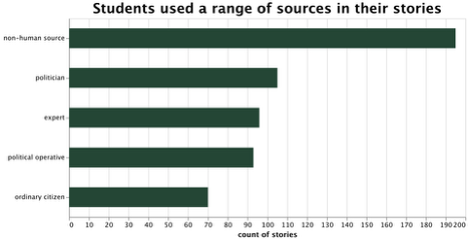
We also found a range of source types in student election stories. The data show that at least 79% of stories included non-human sources, making this the dominant source category (Figure 3). Politicians were the second most common source type, with 68.3% of all stories containing a strategic game frame quoting a politician. In contrast, only 35% of stories containing an issue frame used a politician as a source. Experts appeared more often in conflict-framed stories (46%) than in strategic game-framed stories (43.3%) or issue-framed stories (37.7%).

Figure 3: This graphic shows the types of sources used in student election stories.

The prominence of non-human sources may reflect the nature of election reporting, as many students cited official poll data, election results, legislation, government websites, databases, nonprofit reports, or official election materials. In online stories, these sources were often easy to include through hyperlinks. Their use also suggests an emphasis on transparency and verification, as publicly available documents and official materials can help reporters ground claims in verifiable evidence. This pattern is consistent with digital reporting practices and supports the idea that students are adopting sourcing routines grounded in publicly accessible information (Reich, 2009).
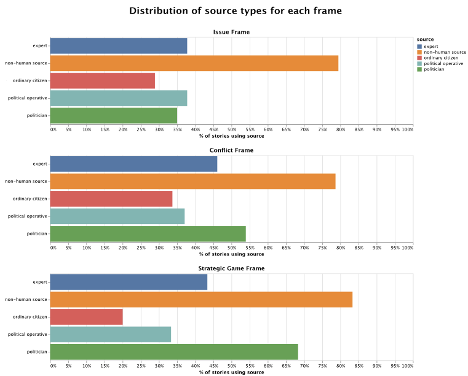
The use of politicians as sources was most common in stories employing the strategic game frame (68.3%) (Figure 4). This sourcing pattern mirrors standard journalistic routines in legacy media, where political figures often anchor strategy-centered stories (Bennett, 1990; Dimitrova and Strömbäck, 2012). In contrast, politicians appeared less frequently in issue-framed stories (35%), suggesting that source use varied by frame type. Student reporters drew more often on political figures when covering electoral tactics or candidate positioning, while issue-focused stories relied less heavily on politicians and more on other forms of evidence or perspectives. Because this study analyzes published content rather than students’ decision-making processes, this interpretation should be understood as a pattern in the stories rather than direct evidence of students’ intentions.

Figure 4: The above graphic visualizes the distribution of source types for each frame. For example, we can see that politicians (green) were used as a source in 35% of all stories that utilized issue framing. In contrast, politicians were cited in 68% of all stories using strategic game frame.

The use of experts, including academics, analysts, and specialists, was notable across all frames but most prevalent in stories with a conflict frame (46%). This aligns with prior research emphasizing the role of expert commentary in providing balance and contextual analysis in political reporting (Plasser and Plasser, 2002; Dimitrova et al., 2005). Their use here shows students’ awareness of the value of expert interpretation, especially in situations involving disagreement or complex political issues. Moreover, the frequency of ordinary citizens and political operatives was relatively balanced, offering a more democratic range of voices than typically found in national media, which often privileges elite political perspectives (Cook, 2005). The fact that 82.6% of stories included multiple source types indicates that students are actively working to incorporate diverse perspectives, an important journalistic norm often absent in quick-turn commercial election coverage.

Overall, students did not lean too heavily on one human source type. Instead, they interviewed politicians, citizens, election officials, professors, activists, and other relevant sources across their stories. This pattern suggests a balanced and diverse sourcing approach, while also showing that source selection varied depending on the type of frame used in the story.

Discussion

This study provides a nuanced understanding of how student journalists framed election coverage and selected sources during the 2024 elections. The findings challenge longstanding critiques of election journalism by demonstrating that student reporters adopted practices that leaned more toward public service journalism than the spectacle-oriented approaches often observed in legacy media. The most notable finding is the overwhelming use of the issue frame, which appeared in approximately 73% of the 247 stories analyzed. This frame emphasized substantive policy issues, legislative impacts, voter access information, and the local consequences of political decisions. These results depart from traditional media practices, where strategic game and conflict frames often dominate election coverage (Cappella & Jamieson, 1996; Strömbäck & Dimitrova, 2011; Aalberg, Strömbäck & De Vreese, 2012). Rather than portraying politics primarily as a competitive spectacle, student reporters prioritized civic education and community-focused information (Bright, 2022). This finding is important because issue-based reporting aligns closely with the democratic function of community journalism: helping residents understand how public decisions, candidates, and voting procedures affect their everyday lives.

Although the strategic game and conflict frames did appear, their use was measured and often paired with issue frames, implying that students used these more dramatized frames to complement, rather than drive, their stories. This pattern suggests that student journalists did not completely avoid conflict or strategy, which remain common and sometimes necessary elements of political reporting. However, they often embedded those elements within broader explanations of policy, voter access, and community impact. Importantly, the conflict-framed stories in this sample generally appeared to be carefully balanced rather than sensationalized, as disagreement was often presented alongside policy context, explanatory information, or multiple source perspectives. This suggests an editorial maturity: student reporters contextualized political strategy or disagreement within broader policy discussions rather than allowing such frames to dominate coverage. This stands in contrast to commercial media, which often emphasize conflict and competition to engage audiences (Patterson, 1994; Semetko & Valkenburg, 2000).

For journalism education, this finding is especially relevant because it suggests that university-led reporting programs may provide a setting where students learn to balance news values such as conflict, timeliness, and competition with public-service values such as explanation, verification, and civic usefulness. Rather than reproducing the dominant horse-race model of election reporting, students in this sample appeared to practice a form of political journalism that foregrounded voter needs and local relevance.

The prominence of issue framing also has implications for community journalism scholarship. Community journalism is often understood as journalism rooted in place, oriented toward local publics, and attentive to the information needs of specific communities. The student stories analyzed here reflect those commitments by focusing on local candidates, ballot access, voting procedures, school-related controversies, economic concerns, and policy consequences. In doing so, student journalists helped translate national or state-level electoral debates into information that local audiences could use. This matters because local election coverage is not only about reporting who is likely to win; it is also about helping citizens understand what is at stake in their communities.

In terms of source selection, the dominant category was non-human sources. The inclusion of data, reports, and documents reflects students’ efforts to ground their reporting in publicly verifiable information, reinforcing transparency and credibility (Reich, 2009). This finding connects with sourcing literature that emphasizes the role of documents, data, and institutional records in strengthening verification and reducing uncertainty in political reporting. However, reliance on non-human sources should be interpreted cautiously. These sources may strengthen accuracy and transparency, but they may also reflect the practical realities of student reporting, including limited time, uneven access to political actors, and the relative ease of using official documents or hyperlinks in digital stories. Because this study analyzes published content rather than student decision-making, it cannot determine whether students relied on these sources because of safety, confidence, access, deadline pressure, or faculty/editorial instruction.

Source use also varied by frame type. Political figures were most frequently quoted in strategic game-framed stories (68.3%), but their presence was more limited in issue-focused reporting (35%), suggesting that students drew more heavily on politicians when covering electoral tactics or candidate positioning (Bennett, 1990; Dimitrova & Strömbäck, 2012). Experts were especially common in stories featuring conflict frames, providing interpretation and clarity on complex or contentious issues (Plasser & Plasser, 2002). The inclusion of ordinary citizens’ perspectives across frames also suggests a more democratic approach to sourcing, contrasting with legacy media’s tendency to privilege elite voices (Cook, 2005). Overall, 82.6% of stories included more than one type of source, suggesting that student journalists are developing attention to source diversity and contextual appropriateness—hallmarks of professional reporting.

For journalism education, this sourcing pattern is encouraging because sourcing is one of the most difficult professional skills for emerging reporters to develop. Students must learn not only to gather information but also to decide which voices, documents, and forms of evidence are appropriate for different kinds of stories. The findings suggest that student election reporting programs can function as applied learning spaces where students practice verification, balance, and source diversity while producing work for real community audiences. At the same time, the findings point to the value of stronger curricular attention to election reporting, source development, and community-centered political journalism. If student journalists are increasingly helping local outlets cover elections, journalism programs should prepare them not only to report accurately but also to understand how framing and sourcing choices shape public knowledge. This includes helping students distinguish between issue, conflict, and strategic frames; encouraging them to move beyond easily available sources when appropriate; and teaching them how to use public documents without replacing human voices.

Taken together, the study contributes to community journalism and journalism education by showing that student-produced election coverage can serve both civic and pedagogical purposes. For communities, these stories can help address local election information gaps through explanatory, issue-focused, and locally grounded reporting. For journalism education, election coverage offers a powerful training ground where students learn to connect reporting routines with democratic responsibility. In an era of local newsroom decline, student journalism should therefore be understood not only as a supplement to professional news production but also as a meaningful site where future journalists practice forms of political reporting that may better serve local publics.

Conclusion

This study examined how student journalists framed and sourced local election coverage during the 2024 U.S. election cycle. The findings show that student-produced election stories were largely issue-focused, locally grounded, and oriented toward civic information. By emphasizing policy issues, voter access, election procedures, and local consequences, student reporters contributed to community information needs while also engaging in professional reporting practice.

At the same time, this study is limited in what it can say about why student journalists made particular framing or sourcing choices. Because the analysis is based on published content, it cannot determine whether students selected certain sources because of confidence, access, deadline pressure, faculty guidance, perceived safety, or professional judgment. Future research should therefore examine source-choice motivations through interviews with student reporters, particularly regarding their use of non-human sources such as public documents, government websites, election data, and official reports.

Future research should also examine whether student reporting experiences shape students’ long-term professional identities, editorial values, and reporting practices, including whether they carry issue-focused, service-oriented approaches into their careers. Additional studies could explore how newsroom mentorship, university-media partnerships, editorial oversight, digital tools, and AI technologies influence students’ framing and sourcing choices. Expanding this area of research can benefit journalism educators and scholars while contributing to stronger local democratic discourse in an era of media fragmentation.

References

  • Aalberg, T., Strömbäck, J., & De Vreese, C. H. (2012). The framing of politics as strategy and game: A review of concepts, operationalizations and key findings. Journalism13(2), 162-178.
  • Alieva, I. (2023). How American media framed 2016 presidential election using data visualization: The case study of the New York Times and The Washington Post. Journalism Practice, 17(4), 814-840.
  • Audette-Longo, P., & Alexiou, S. (2024). Becoming journalists: Navigating identity, pedagogy, and practice in journalism education. Journalism & Mass Communication Educator. https://doi.org/10.1177/10776958241226135
  • Bennett, W. L. (1990). Toward a theory of press-state. Journal of communication40(2), 103-127.
  • Bright, A. (2022). Listening for The Echo: How Our Students Are Stepping Into, Embracing Community Journalism. Teaching Journalism & Mass Communication, 12(2), 77-80.
  • Cappella, J. N., & Jamieson, K. H. (1996). News frames, political cynicism, and media cynicism. Annals of the American Academy of Political and Social Science, 546(1), 71–84. https://doi.org/10.1177/0002716296546001007
  • Carpini, M. X. D., & Keeter, S. (1996). What Americans know about politics and why it matters. Yale University Press.
  • CCN. (2023a). Student journalism’s growing impact: Annual report 2023. Center for Community News, University of Vermont. https://www.uvm.edu/ccn
  • CCN. (2023b). Covering statehouses: How student journalists are informing local communities. Center for Community News, University of Vermont. https://www.uvm.edu/ccn
  • CCN (2024). CCN’s Elections & Democracy Cohort is the first nationally coordinated effort to strengthen university-led election coverage. Center for Community News. Retrieved from: Student Journalists are Filling Critical Election Reporting Gaps at Colleges Across the U.S. | Center for Community News | The University of Vermont
  • Coleman, R., Anthony, S., & Stewart, B. (2018). Service journalism as civic communication: The case of public affairs news coverage of student debt. Journalism Practice, 12(10), 1229–1246. https://doi.org/10.1080/17512786.2017.1392254
  • Cook, T.E. (2005). Governing with the News. The News Media as a Political Institution, 2nd ed. Chicago, IL: University of Chicago Press.
  • De Vreese, C. H., & Semetko, H. A. (2002). Framing politics at the launch of the Euro: A cross-national comparative study of frames in the news. Political Communication, 19(2), 107–122. https://doi.org/10.1080/10584600252907461
  • Dimitrova, D. V., & Strömbäck, J. (2012). Election news in Sweden and the United States: A comparative study of sources and media frames. Journalism13(5), 604-619.
  • Dimitrova, D. V., Kaid, L. L., Williams, A. P., & Trammell, K. D. (2005). War on the Web: The immediate news framing of Gulf War II. The Harvard International Journal of Press/Politics, 10(1), 22–44. https://doi.org/10.1177/1081180X05275727
  • Entman, R. M. (1993). Framing: Toward clarification of a fractured paradigm. Journal of Communication, 43(4), 51–58. https://doi.org/10.1111/j.1460-2466.1993.tb01304.x
  • Esser, F., & D’Angelo, P. (2006). Framing the press and publicity process in US, British, and German general election campaigns: A comparative study of metacoverage. Harvard International Journal of Press/Politics11(3), 44-66.
  • Finneman, T., Heckman, M., & E. Walck, P. (2022). Reimagining journalistic roles: How student journalists are taking on the US news desert crisis. Journalism Studies23(3), 338-355.
  • Finneman, T., Heckman, M., & Wolgast, S. (2024). Examining Gaps in Journalism Curriculum to Solve the News Desert Crisis. Journalism & Mass Communication Educator79(1), 23-37.
  • Gan, S. L., Teo, L. S., & Detenber, B. H. (2005). Framing the fight against terrorism: A comparative analysis of frames in the British and US newspapers. International Communication Gazette, 67(5), 435–458. https://doi.org/10.1177/0016549205056050
  • Goffman, E. (1974). Frame analysis: An essay on the organization of experience. Harvard University Press.
  • Hayes, D., & Lawless, J. L. (2018). The decline of local news and its effects: New evidence from longitudinal data. The Journal of Politics, 80(1), 332–336. https://doi.org/10.1086/694105
  • Hertog, J. K., & McLeod, D. M. (2001). A multiperspectival approach to framing analysis: A field guide. In S. Reese, O. Gandy, & A. Grant (Eds.), Framing public life: Perspectives on media and our understanding of the social world (pp. 139–161). Lawrence Erlbaum.
  • Jamieson, K. H., & Cappella, J. N. (1993). The role of the press in the health care reform debate. The Journal of Law, Medicine & Ethics, 21(3), 206–210. https://doi.org/10.1111/j.1748-720X.1993.tb01203.x
  • LaMonte, A. (2019). Journalism students help fill the local news gap. Columbia Journalism Review. https://www.cjr.org/special_report/student-journalists-local-news.php
  • O’Neill, D., & Harcup, T. (2009). News values and selectivity. In K. Wahl-Jorgensen & T. Hanitzsch (Eds.), The handbook of journalism studies (pp. 161–174). Routledge.
  • Patterson, T. E. (1994). Out of Order: An incisive and boldly original critique of the news media’s domination of America’s political process. Vintage.
  • Plasser, F., & Plasser, G. (2002). Global political campaigning: A worldwide analysis of campaign professionals and their practices. Praeger.
  • Reich, Z. (2009). Sourcing the news: key issues in journalism–an innovative study of the Israeli press. Hampton Press.
  • Riffe, D., Lacy, S., Watson, B. R., & Lovejoy, J. (2023). Analyzing media messages: Using quantitative content analysis in research. Routledge.
  • Salahi, L., & Smith, C. C. (2021). Perceptions of news-academic partnerships as a sustainable business model. Teaching Journalism & Mass Communication, 11(1), 12–23.
  • Scammell, M., & Semetko, H. A. (2008). Election news coverage in the UK In: J. Strömbäck y LL Kaid (Eds.), The handbook of election news coverage round the world (pp. 73-89).
  • Scheufele, D. A., & Tewksbury, D. (2007). Framing, agenda setting, and priming: The evolution of three media effects models. Journal of communication57(1), 9-20.
  • Schudson, M. (2008). Why democracies need an unlovable press. Polity.
  • Semetko, H. A., & Valkenburg, P. M. (2000). Framing European politics: A content analysis of press and television news. Journal of communication50(2), 93-109.
  • Strömbäck, J., & Dimitrova, D. V. (2011). Mediatization and media interventionism: A comparative analysis of Sweden and the United States. The International Journal of Press/Politics16(1), 30-49.
  • Shoemaker, P. J., & Reese, S. D. (1996). Mediating the message: Theories of influences on mass media content (2nd ed.). Longman.
  • SPLC. (2026). Students: We must ‘draw the line’ on censorship. SPLC. Retrieved from:  https://splc.org/2026/03/students-we-must-draw-the-line-on-censorship/

About the Authors

Sima Bhowmik, PhD., is a Postdoctoral Research Associate at the Center for Community News, University of Vermont. Email her at Sima.bhowmik@uvm.edu

Benjamin Cooley, MA, is a Research Data Visual Engineer at the University of Vermont. Email him at Benjamin.Cooley@uvm.edu

Loading Viewer...