Abstract
This study examines how student journalists enhanced local communities’ understanding of the 2024 U.S. elections. A content analysis of 247 stories published in local news outlets reveals a strong emphasis on issue framing and diverse sourcing. Unlike commercial media, which focuses on strategy and conflict frames, student reporters prioritized civic information and policy relevance. Findings underscore the role of student reporting in strengthening community journalism by promoting democratic engagement and filling critical gaps in local election coverage.
Introduction
As local newsrooms continue to decline across the United States, media organizations face increasing challenges in delivering in-depth coverage of critical issues such as state politics, education and local governance (Hayes & Lawless, 2018). These gaps are consequential during election cycles, when voters need accurate, timely, and locally relevant information to understand candidates, policy issues, voting procedures, and the potential consequences of political decisions (Dimitrova & Strömbäck, 2012; Strömbäck & Dimitrova, 2011). In this changing local news environment, student reporting initiatives have become an increasingly visible part of the community journalism ecosystem (Finneman, Heckman, & Walck, 2022; LaMonte, 2019).
Scholarship suggests that student reporting is no longer limited to campus newspapers or classroom exercises. Across the United States, university-led reporting programs, newsroom partnerships, internships, and student-staffed initiatives connected to local and legacy media organizations are producing civic and public affairs reporting for broader community audiences (Bright, 2022; Finneman et al., 2022). These programs help address local reporting gaps while providing students with experiential learning opportunities that connect classroom instruction to professional news production (LaMonte, 2019). At the same time, student journalism is not immune to the broader pressures facing the news industry, as student media also operate within financial, editorial, and organizational constraints (Audette-Longo & Alexiou, 2024). Recent incidents involving student publications at Indiana University and the University of Alabama further illustrate the institutional pressures student media may face, including questions about editorial independence and administrative oversight (SPLC, 2026). Together, these opportunities and challenges make student-produced local election coverage important to examine as both a response to local information needs and a form of professional training for emerging journalists (Coleman et al., 2018).
In this study, “student journalists” refers to students affiliated with university-led or university-supported reporting programs whose election stories were edited, published, or distributed through local news outlets for public audiences. The focus is therefore not on student journalism as an internal campus activity, but on student-produced reporting that enters the local news ecosystem and serves community information needs. This distinction is important because these stories are not only learning exercises; they also function as publicly available election coverage for local readers.
Recent data from the Center for Community News (CCN) illustrates the expanding scale of student-produced, community-focused reporting. In 2023, approximately 2000 student journalists participated in university-led reporting programs, producing nearly 10,000 stories (CCN, 2023a). During the 2024 elections, student journalists from 125 higher education institutions across 46 states contributed election coverage for local communities (CCN, 2024). Their stories addressed issues such as immigration, abortion, the economy, local candidates’ agendas, voter registration, polling locations, and ballot access. Students also attended public meetings and campaign events, interviewed candidates and community members, and used public records and election data to produce locally relevant election reporting (CCN, 2024).
Democracy functions most effectively when citizens have access to accurate, comprehensive, and reliable information. A well-informed public is better equipped to make political decisions, participate in civic life, and hold elected officials accountable (Carpini & Keeter, 1996; Dimitrova and Strömbäck, 2012; Schudson, 2008). Prior research shows that election news often emphasizes strategic game and conflict frames (Strömbäck & Dimitrova, 2011), presenting politics as competition, strategy, or partisan disagreement rather than as a discussion of policy consequences and civic choices (Cappella & Jamieson, 1996; Aalberg, Strömbäck, & De Vreese, 2012). Source selection is also central to election reporting because sources influence which perspectives become visible, how credibility is established, and whether coverage privileges political elites, experts, ordinary citizens, or publicly verifiable documents (Bennett, 1990; Cook, 2005; Reich, 2009). For student journalists covering elections for local communities, framing and sourcing choices therefore offer an important way to assess both the journalistic character of their coverage and the professional values being developed through student reporting programs (Coleman et al., 2018; Bright, 2022).
Although extensive research has examined how professional and legacy news media frame political issues and national elections, as well as how they use sources in campaign coverage (Scammell and Semetko, 2008; Dimitrova and Strömbäck, 2012; Semetko and Valkenburg, 2000; Esser and D’Angelo, 2006), less attention has been paid to student journalists who produce election coverage for local and community news outlets. In particular, limited research has examined how student journalists frame election stories and what types of sources they rely on when reporting for community audiences. Existing scholarship on student journalism has largely focused on journalism education (Salahi & Smith, 2021), experiential learning (Bright, 2022), or the role of students in helping address local news gaps (Finneman et al., 2022).
To address this gap, this study analyzes 247 student-produced election stories published through local news outlets during the 2024 U.S. election cycle. Drawing on framing and sourcing research, the study examines whether student journalists relied on issue, conflict, or strategic game frames and identifies the source types most commonly used in their reporting. By analyzing student election coverage as both community journalism and journalism education practice, this study contributes to understanding how emerging journalists help fill local election information gaps and how their reporting practices may reflect or challenge dominant patterns in professional political journalism.
Theoretical Framework
Media Framing of Election Coverage
The foundation of news framing research was laid by Erving Goffman (1974), who argued that the structure and organization of messages influence audience perception. Goffman (1974) described audience frames as mental structures that people use to categorize and interpret new information based on their experiences. Later, Robert Entman (1993) conceptualized news frames, defining framing as “to select some aspects of a perceived reality and make them more salient in a communicating text, in such a way as to promote a particular problem definition, causal interpretation, moral evaluation, and/or treatment recommendation” (p. 52). From a journalistic standpoint, framing is a powerful tool that shapes public perception by emphasizing specific aspects of a story while downplaying others. This selection process is influenced by factors such as reporters’ social identities, education, routines, political beliefs, institutional policies, and broader societal ideologies (Shoemaker & Reese, 1996).
Analyzing media frames requires examining the content of news coverage (Entman, 1993). Although there is no universally standardized classification of news frames, certain frames frequently appear in election coverage, including the strategic game frame, conflict frame, and issue/policy frame (Gan, Teo & Detenber, 2005; Strömbäck & Dimitrova, 2011). These frames are especially important in election coverage because they influence whether citizens understand politics primarily as a competition among candidates, a clash between opposing groups, or a set of policy choices with consequences for public life (Dimitrova & Strömbäck, 2012).
The strategic game frame, also known as the horse-race frame, portrays election coverage as a competition between candidates, emphasizing poll standings, campaign strategies and political tactics rather than substantive policy discussions (Gan et al., 2005; Strömbäck & De Vreese, 2012). This type of framing influences how both individuals and institutions engage with elections (Hertog & McLeod, 2001). When elections are framed as a game, voters may focus more on candidates’ standings in the polls and campaign maneuvers rather than policy issues, potentially reducing their engagement with substantive political discourse (Aalberg et al., 2012). Prior scholarship also suggests that strategy-oriented election coverage can encourage citizens to view politics through calculations of winning and losing (Cappella & Jamieson, 1996), rather than through the substance of public problems and policy solutions (Aalberg et al., 2012).
The conflict frame, one of the most prominent news values (O’Neill & Harcup, 2009), highlights political rivalry, debates, scandals and clashes between candidates or parties. While this frame can increase audience engagement, it often does so at the expense of substantive reporting, turning political discourse into spectacle and controversy (Semetko & Valkenburg, 2000). Studies have shown that conflict framing tends to sensationalize elections, portraying them as dramatic battles rather than meaningful discussions on policy issues (Strömbäck & Dimitrova, 2011). Because conflict is a conventional news value, its presence in election reporting may reflect both journalistic routines and commercial pressures to produce stories that are dramatic, timely and easily understandable to audiences (O’Neill & Harcup, 2009; Semetko & Valkenburg, 2000).
The issue frame, on the other hand, fosters a more informed and engaged electorate by prioritizing discussions on policies, governance and societal impact (Cappella & Jamieson, 1996; Scheufele & Tewksbury, 2007). Unlike strategic game or conflict frames, issue-based coverage emphasizes the real-world consequences of political decisions. In election reporting, issue framing is particularly important because it provides citizens with information about candidates’ policy positions, public problems and the possible effects of electoral outcomes on communities (Dimitrova & Strömbäck, 2012; Scammell & Semetko, 2008).
Media critics argue that election coverage often leans toward strategy and conflict frames rather than issue-focused reporting (Patterson, 1993; Jamieson & Cappella, 1993). Researchers who have studied the effects of game and conflict frames in election coverage argue these frames foster political cynicism, ignorance and distrust (Cappella & Jamieson, 1996). In contrast, others suggest the frames can generate public interest in politics, enhance political knowledge and encourage participation (De Vreese & Semetko, 2002; Aalberg et al., 2012). The dominance of the game and conflict frames in election coverage is driven by several key factors, including the political system, the structure of the news industry, advancements in technology and commercial pressures. Strömbäck and Dimitrova (2011) conducted a comparative analysis of election news coverage between Sweden and the United States, finding that U.S. election news coverage was more focused on the strategic game and conflict frames. Their study highlighted how American election reporting tends to be highly commercialized, competitive and dramatized, emphasizing who is winning, campaign tactics and political conflicts rather than substantive policy issues. They argued that this tendency can contribute to voter cynicism and political disengagement, as the public may perceive politics as a spectacle rather than a meaningful policy debate (Strömbäck & Dimitrova, 2011).
Similarly, Alieva (2023) examined media framing in The New York Times and The Washington Post during the 2016 U.S. presidential election and found that both newspapers reinforced a horse-race narrative by prioritizing poll standings and candidate performance over in-depth policy discussion. Such framing matters because when politics is predominantly portrayed as a game or conflict, citizens may come to view the political process as entertainment rather than as a space for democratic engagement (Alieva, 2023). By shifting attention away from policy debates and toward strategy, competition, and electoral positioning, this type of coverage can influence how people understand and engage with the political system.
News Sources in Political News
Along with framing, news sources, whether through direct quotes or indirect references to experts’ opinions, play a crucial role in shaping election coverage. In political reporting, journalists often rely on official sources, such as candidates, officials and party operatives, to establish credibility (Strömbäck & Dimitrova, 2011; Bennett, 1990). As Dimitrova and Strömbäck (2012) highlight, “the impact of sources would be especially important during election campaigns when political actors compete even more intensely than usual for control over media messages” (p. 611). Consequently, political actors significantly influence public perception, as their statements often shape the news discourse more than independent journalistic analysis (Bennett, 1990). Political leaders strategically craft messages, provide information and hold press conferences or interviews to frame issues in ways that align with their objectives. This reliance on official sources is consistent with indexing theory, which suggests that news coverage often reflects the range of debate among official political actors, particularly in political and policy reporting (Bennett, 1990).
Additionally, Plasser and Plasser (2002) argue that, in addition to quotes from political leaders, reporters frequently include statements from party or campaign operatives to contextualize polling data and election strategies. Furthermore, media analysts are often cited in news reports to provide descriptive insights into specific election issues or processes (Dimitrova et al., 2005). Recognizing that the general public plays a crucial role in the democratic process, election coverage also incorporates voters’ perspectives, capturing their expectations and opinions about candidates and the electoral process (Strömbäck & Dimitrova, 2011). The inclusion of diverse sources in election news not only contributes to the frame-building process but also enhances credibility, reduces uncertainty and provides a more comprehensive perspective on electoral events (Cook, 2005; Reich, 2009). In this context, source diversity is particularly important in community-oriented election coverage because it can broaden the range of voices included in political news beyond candidates, campaign officials and institutional actors.
Understanding how student journalists covered the 2024 national elections is important because student reporting increasingly contributes to local information needs while also shaping the professional development of emerging journalists (Finneman et al., 2024). To date, however, no study has specifically examined the framing techniques and news sources used in student-led election coverage. Existing research on student journalism has largely focused on broader educators’ perspectives. For example, Bright (2022) shows that student involvement in community journalism can deepen students’ understanding of community needs while also benefiting the communities they serve. Similarly, research on news-academic partnerships suggests that these programs can serve both pedagogical and civic functions by preparing students for professional reporting while contributing to local information needs (Finneman et al., 2022; Salahi & Smith, 2021).
Despite this growing body of scholarship, research on student journalists’ actual reporting practices, particularly their framing choices and source selection, remains limited. This gap is important because journalism students are developing their professional identities within a rapidly changing media environment and may approach story selection and reporting differently from professional journalists (Audette-Longo & Alexiou, 2024; Coleman et al., 2018). As student reporters increasingly contribute to local election coverage, it is important to examine whether they reproduce dominant political media frames or adopt an alternative approach that prioritizes issue-based, community-oriented journalism. Additionally, source selection remains a critical aspect of student-led election coverage because it shapes whose voices and perspectives become visible in local political news. By analyzing students’ election coverage, this study explores the following research questions:
- How do student journalists frame their election stories to effectively convey information to local communities?
- What sources do student journalists most frequently use when covering election stories?
Method
To understand the research objectives, the researchers employed quantitative content analysis to explore student election coverage framing and news sources in the frame-building process. According to Riffe et al. (2023), quantitative methodology is a systematic approach that measures frequencies or patterns within data. By focusing on numerical data, quantitative content analysis allows researchers to objectively identify recurring themes, word frequencies and specific topics over time, providing insights into how media content evolves. Since quantitative content analysis often involves analyzing large datasets, the findings are more likely to be generalized.
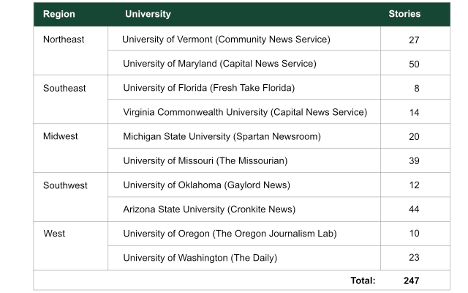
For this study, data was collected from 10 universities across five geographical regions using purposive sampling. Universities engaged in news-academic partnerships with local media outlets, where student coverage was directly published and distributed to local audiences, were selected. A total of 247 student election stories were collected from Sept. 1, 2024, to Nov. 5, 2024 (see Table 1).
Table 1: Election coverage contributions from selected university newsrooms.
For this study, we adapted a codebook originally developed by Dimitrova and Strömbäck (2012) in their research on election coverage. Our analysis focused on identifying the presence of three key journalistic frames: the strategic game frame, the issue frame, and the conflict frame, as well as examining the types of news sources used. Because election stories can contain more than one interpretive angle, frame categories were not treated as mutually exclusive. Following Dimitrova and Strömbäck’s recognition that news stories are often multifaceted, coders identified all applicable frames in each story rather than forcing the story into a single category. Therefore, a story could be coded as containing the conflict frame, strategic game frame, issue frame, or a combination of two or all three frames if the content met the coding criteria.
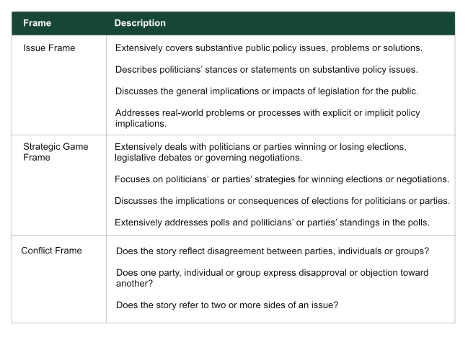
To guide frame identification, we followed the set of questions proposed by Dimitrova and Strömbäck (2012), which help determine whether a frame is present in a story (see Table 2 for details). According to their definitions, a conflict frame must clearly depict a clash between two or more parties, beyond merely presenting a controversial issue. A strategic game frame should focus heavily on the competitive aspects of the election, such as predicting outcomes, analyzing poll standings, or framing the election as a race to win. An issue frame, by contrast, should provide substantive information about a specific policy issue that impacts on a local community or a clearly defined group.
Table 2: To measure different frames, we used the following guiding principles and questions. If a description fit a story, or if a coder answered “yes” to one of the questions, the frame was marked as present.
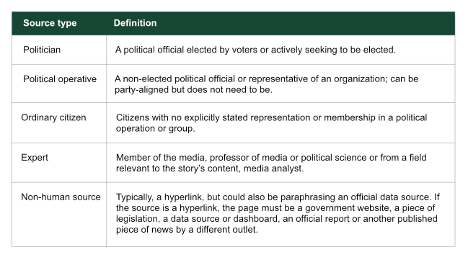
For source categorization, we also drew from the codebook developed by Dimitrova and Strömbäck (2012), which identifies five non-exclusive source categories: politicians, political operatives, ordinary citizens, experts, and non-human sources, such as election polls, survey data, or government databases. Because a single news story may include multiple types of sources, coders marked all applicable source categories present in each story based on the definitions and guidelines (see Table 3 for details). This approach acknowledges the multifaceted nature of political reporting and allows one article to include several source types.
Table 3: To identify source types, we used the working definitions above.
Data Analysis
For this study, each story was read carefully and coded separately for both framing and sourcing. Researchers emphasize that a story-by-story approach enhances the accuracy and comprehensiveness of data collection, providing a solid foundation for reliable analysis (Riffe et al., 2023). The unit of analysis was the individual news story; however, each story could receive multiple frame codes and multiple source-category codes when applicable. To test the reliability and consistency of the coding process, both researchers independently coded approximately 10% of the total news stories (30 in total), selecting three stories from each media outlet included in the sample. An intercoder reliability test was conducted to assess the level of agreement between coders. For frame coding, the agreement rate was 95.83%, with a mean Cohen’s Kappa score of 0.894, indicating strong reliability. For source coding, the agreement rate reached 98%, with a mean Cohen’s Kappa score of 0.911, reflecting excellent consistency. After confirming a high level of intercoder reliability, the first researcher proceeded to code the remaining stories independently, maintaining the same rigorous story-by-story approach throughout the dataset.
Findings
Framing Techniques: Predominance of the Frame
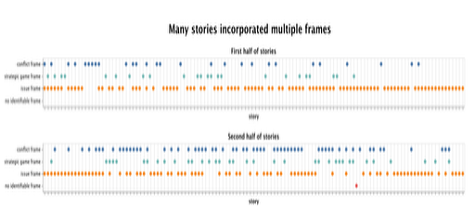
A content analysis of 247 student-produced election stories from 10 university-led newsrooms reveals notable trends in the use of framing strategies and source selection. Among the three dominant frame types, Issue, conflict, and strategic game, the issue frame was by far the most prevalent, appearing in approximately 180 stories (73%). These stories focused on substantive topics such as policy matters, legislative developments, voter access information, and concerns relevant to local communities. In contrast, conflict frames were identified in 89 stories (36%), while strategic game frames appeared in 60 stories (24%). An interesting outlier in the dataset was a single story categorized as having “no identifiable frame.” This story featured a student reporter profiling an ordinary citizen without any clear connection to a specific issue, policy, or electoral theme (see Figure 1).
Overall, the data show that student journalists most frequently reported on topics related to party politics, public policy, campaign-related challenges, and election processes. Election process coverage was especially common, with many stories providing voter education by explaining how to vote, where to locate ballot boxes, and what issues appeared on local ballots. Although voter eligibility, registration, absentee voting, and polling-location information may not resemble conventional policy issues such as taxation, immigration, education, or economic regulation, these topics were coded as issue framing because they addressed the practical conditions of democratic participation. In local election coverage, information about who can vote, how to vote, and where to vote directly affects citizens’ ability to participate in the political process. Therefore, these stories functioned as issue-oriented civic information rather than strategic or conflict-driven election coverage.
This emphasis on issue framing highlights student journalists’ orientation toward public service journalism, prioritizing the goal of informing and empowering voters over dramatizing the electoral process. For example, in one issue-framed story, “How do I know if I’m eligible?”, a student reporter provides a comprehensive guide to voter eligibility, registration procedures, polling locations, absentee voting, and accommodations. The piece includes direct links to official registration portals, sample ballots, and candidate lists, exemplifying service journalism that aims to support civic participation. Similarly, in “Ballots are here — how to vote by Nov. 5,” a student journalist offers straightforward explanations of absentee voting, in-person voting options, and ID requirements while deliberately avoiding partisan commentary or strategic analysis. These examples show how voting access and eligibility functioned as civic issues in local election coverage.
These stories were often grounded in verifiable public information, with city hall documents and state websites serving as frequently cited sources across the dataset. Student journalists also covered economic concerns such as inflation, tax changes, and employment, reflecting the breadth and depth of their engagement with election reporting. Taken together, these findings suggest that student reporters consistently used the issue frame to deliver practical civic information, not only about how and where to vote, but also about candidate platforms and the specific concerns of local communities. Their preference for issue-based reporting suggests a service-oriented approach that emphasized informing and engaging voters at the grassroots level.
Figure 1 shows the count of stories using each frame.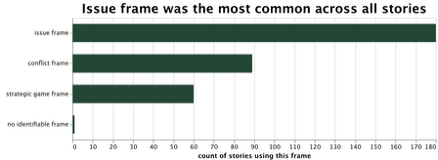
In this dataset, the conflict frame tends to emphasize ideological divides, institutional tensions or personal disputes among political actors and stakeholders. In the story “Orange 1 candidates offer different solutions,” for instance, the student journalist highlights contrasting policy positions between incumbent candidates, focusing on divergent views regarding education funding, drug policy and environmental legislation. The story moves beyond mere disagreement to portray a broader narrative of political polarization and debate.
Another example involves a report on the tensions between civic engagement advocates and school safety officials, where concerns about school shootings led to the removal of polling stations from schools. This piece illustrates the tradeoff between democratic accessibility and public safety, a hallmark of conflict framing. Some stories also featured national candidates yet grounded their coverage in localized impacts. In “Underground Workshop: Student perspectives on the upcoming election,” the reporter captured a spectrum of high school student opinions on presidential contenders. The emotionally charged and polarized responses, particularly around Donald Trump, reflected themes of generational divide, identity politics and civic tension, all of which align with the dynamics of the conflict frame.
While significantly less frequent than issue framing, the strategic game frame stories focused on electoral positioning, candidate image-building or campaign strategy—elements aligned with traditional horse-race journalism (Cappella & Jamieson, 1996). For instance, a story that focused on game frame, “Statehouse hopeful Chloe Tomlinson hears housing as key concern in Winooski,” includes policy discussions but also emphasizes Tomlinson’s campaign strategies—her voter outreach tactics, prior political affiliations and her perceived electability as a likely winner in an uncontested race. Likewise, another story, “Beck offers creative thinking, problem solving skills,” frames the subject’s candidacy in terms of his leadership strengths, decision-making style and political platform. These narratives place emphasis on how candidates are positioning themselves to win, a hallmark of the strategic game frame. In most strategic game-framed stories, student reporters either focused on a clear contest between two parties or provided narratives centered on electability.
However, we noticed fewer stories that focused solely on conflict frames or strategic game frames. In most of the stories, conflict or game frames were coupled with issue frames, suggesting students may have used conflict as a narrative device to highlight differing viewpoints or electoral competitiveness but still anchored those stories in policy relevance and civic information (Figure 2). For example, one story, “Benson, Karamo battle for secretary of state,” centers on ideological polarization and political strategy but remains anchored around voting access, election reform and state-level democracy. It reflects how students contextualize hot-button political clashes with underlying civic impact. This story portrays a heated race between two candidates from the Democratic and Republican parties and their arguments around election integrity and the 2020 election fallout. It includes pointed language, ideological contrasts and sharp disagreements on voting rights and administration. The article also includes campaign strategy discussions, endorsements, polling figures and narrative positioning—e.g., Karamo as a Trump-aligned candidate, Benson as a defender of electoral norms. Despite exploring the ideological clash, the story still provides substantive information on what the secretary of state position entails, how each candidate would approach voter access and changes to absentee ballot processes.
Figure 2: The above graphic shows each story as a vertical line. A colored dot is drawn (blue for conflict, teal for strategic game, and orange for issue) whenever a frame is used. It was common for multiple frames to be used in a single story: 44% (83) of all stories used more than one frame.
 Source Selection: A Balanced and Diverse Approach
We also found a range of source types in student election stories. The data show that at least 79% of stories included non-human sources, making this the dominant source category (Figure 3). Politicians were the second most common source type, with 68.3% of all stories containing a strategic game frame quoting a politician. In contrast, only 35% of stories containing an issue frame used a politician as a source. Experts appeared more often in conflict-framed stories (46%) than in strategic game-framed stories (43.3%) or issue-framed stories (37.7%).
Figure 3: This graphic shows the types of sources used in student election stories.
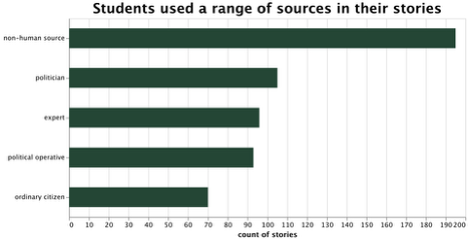 The prominence of non-human sources may reflect the nature of election reporting, as many students cited official poll data, election results, legislation, government websites, databases, nonprofit reports, or official election materials. In online stories, these sources were often easy to include through hyperlinks. Their use also suggests an emphasis on transparency and verification, as publicly available documents and official materials can help reporters ground claims in verifiable evidence. This pattern is consistent with digital reporting practices and supports the idea that students are adopting sourcing routines grounded in publicly accessible information (Reich, 2009).
The use of politicians as sources was most common in stories employing the strategic game frame (68.3%) (Figure 4). This sourcing pattern mirrors standard journalistic routines in legacy media, where political figures often anchor strategy-centered stories (Bennett, 1990; Dimitrova and Strömbäck, 2012). In contrast, politicians appeared less frequently in issue-framed stories (35%), suggesting that source use varied by frame type. Student reporters drew more often on political figures when covering electoral tactics or candidate positioning, while issue-focused stories relied less heavily on politicians and more on other forms of evidence or perspectives. Because this study analyzes published content rather than students’ decision-making processes, this interpretation should be understood as a pattern in the stories rather than direct evidence of students’ intentions.
Figure 4: The above graphic visualizes the distribution of source types for each frame. For example, we can see that politicians (green) were used as a source in 35% of all stories that utilized issue framing. In contrast, politicians were cited in 68% of all stories using strategic game frame.
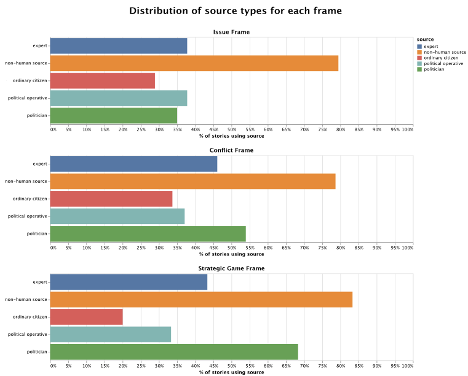 The use of experts, including academics, analysts, and specialists, was notable across all frames but most prevalent in stories with a conflict frame (46%). This aligns with prior research emphasizing the role of expert commentary in providing balance and contextual analysis in political reporting (Plasser and Plasser, 2002; Dimitrova et al., 2005). Their use here shows students’ awareness of the value of expert interpretation, especially in situations involving disagreement or complex political issues. Moreover, the frequency of ordinary citizens and political operatives was relatively balanced, offering a more democratic range of voices than typically found in national media, which often privileges elite political perspectives (Cook, 2005). The fact that 82.6% of stories included multiple source types indicates that students are actively working to incorporate diverse perspectives, an important journalistic norm often absent in quick-turn commercial election coverage.
Overall, students did not lean too heavily on one human source type. Instead, they interviewed politicians, citizens, election officials, professors, activists, and other relevant sources across their stories. This pattern suggests a balanced and diverse sourcing approach, while also showing that source selection varied depending on the type of frame used in the story.
Discussion
This study provides a nuanced understanding of how student journalists framed election coverage and selected sources during the 2024 elections. The findings challenge longstanding critiques of election journalism by demonstrating that student reporters adopted practices that leaned more toward public service journalism than the spectacle-oriented approaches often observed in legacy media. The most notable finding is the overwhelming use of the issue frame, which appeared in approximately 73% of the 247 stories analyzed. This frame emphasized substantive policy issues, legislative impacts, voter access information, and the local consequences of political decisions. These results depart from traditional media practices, where strategic game and conflict frames often dominate election coverage (Cappella & Jamieson, 1996; Strömbäck & Dimitrova, 2011; Aalberg, Strömbäck & De Vreese, 2012). Rather than portraying politics primarily as a competitive spectacle, student reporters prioritized civic education and community-focused information (Bright, 2022). This finding is important because issue-based reporting aligns closely with the democratic function of community journalism: helping residents understand how public decisions, candidates, and voting procedures affect their everyday lives.
Although the strategic game and conflict frames did appear, their use was measured and often paired with issue frames, implying that students used these more dramatized frames to complement, rather than drive, their stories. This pattern suggests that student journalists did not completely avoid conflict or strategy, which remain common and sometimes necessary elements of political reporting. However, they often embedded those elements within broader explanations of policy, voter access, and community impact. Importantly, the conflict-framed stories in this sample generally appeared to be carefully balanced rather than sensationalized, as disagreement was often presented alongside policy context, explanatory information, or multiple source perspectives. This suggests an editorial maturity: student reporters contextualized political strategy or disagreement within broader policy discussions rather than allowing such frames to dominate coverage. This stands in contrast to commercial media, which often emphasize conflict and competition to engage audiences (Patterson, 1994; Semetko & Valkenburg, 2000).
For journalism education, this finding is especially relevant because it suggests that university-led reporting programs may provide a setting where students learn to balance news values such as conflict, timeliness, and competition with public-service values such as explanation, verification, and civic usefulness. Rather than reproducing the dominant horse-race model of election reporting, students in this sample appeared to practice a form of political journalism that foregrounded voter needs and local relevance.
The prominence of issue framing also has implications for community journalism scholarship. Community journalism is often understood as journalism rooted in place, oriented toward local publics, and attentive to the information needs of specific communities. The student stories analyzed here reflect those commitments by focusing on local candidates, ballot access, voting procedures, school-related controversies, economic concerns, and policy consequences. In doing so, student journalists helped translate national or state-level electoral debates into information that local audiences could use. This matters because local election coverage is not only about reporting who is likely to win; it is also about helping citizens understand what is at stake in their communities.
In terms of source selection, the dominant category was non-human sources. The inclusion of data, reports, and documents reflects students’ efforts to ground their reporting in publicly verifiable information, reinforcing transparency and credibility (Reich, 2009). This finding connects with sourcing literature that emphasizes the role of documents, data, and institutional records in strengthening verification and reducing uncertainty in political reporting. However, reliance on non-human sources should be interpreted cautiously. These sources may strengthen accuracy and transparency, but they may also reflect the practical realities of student reporting, including limited time, uneven access to political actors, and the relative ease of using official documents or hyperlinks in digital stories. Because this study analyzes published content rather than student decision-making, it cannot determine whether students relied on these sources because of safety, confidence, access, deadline pressure, or faculty/editorial instruction.
Source use also varied by frame type. Political figures were most frequently quoted in strategic game-framed stories (68.3%), but their presence was more limited in issue-focused reporting (35%), suggesting that students drew more heavily on politicians when covering electoral tactics or candidate positioning (Bennett, 1990; Dimitrova & Strömbäck, 2012). Experts were especially common in stories featuring conflict frames, providing interpretation and clarity on complex or contentious issues (Plasser & Plasser, 2002). The inclusion of ordinary citizens’ perspectives across frames also suggests a more democratic approach to sourcing, contrasting with legacy media’s tendency to privilege elite voices (Cook, 2005). Overall, 82.6% of stories included more than one type of source, suggesting that student journalists are developing attention to source diversity and contextual appropriateness—hallmarks of professional reporting.
For journalism education, this sourcing pattern is encouraging because sourcing is one of the most difficult professional skills for emerging reporters to develop. Students must learn not only to gather information but also to decide which voices, documents, and forms of evidence are appropriate for different kinds of stories. The findings suggest that student election reporting programs can function as applied learning spaces where students practice verification, balance, and source diversity while producing work for real community audiences. At the same time, the findings point to the value of stronger curricular attention to election reporting, source development, and community-centered political journalism. If student journalists are increasingly helping local outlets cover elections, journalism programs should prepare them not only to report accurately but also to understand how framing and sourcing choices shape public knowledge. This includes helping students distinguish between issue, conflict, and strategic frames; encouraging them to move beyond easily available sources when appropriate; and teaching them how to use public documents without replacing human voices.
Taken together, the study contributes to community journalism and journalism education by showing that student-produced election coverage can serve both civic and pedagogical purposes. For communities, these stories can help address local election information gaps through explanatory, issue-focused, and locally grounded reporting. For journalism education, election coverage offers a powerful training ground where students learn to connect reporting routines with democratic responsibility. In an era of local newsroom decline, student journalism should therefore be understood not only as a supplement to professional news production but also as a meaningful site where future journalists practice forms of political reporting that may better serve local publics.
Conclusion
This study examined how student journalists framed and sourced local election coverage during the 2024 U.S. election cycle. The findings show that student-produced election stories were largely issue-focused, locally grounded, and oriented toward civic information. By emphasizing policy issues, voter access, election procedures, and local consequences, student reporters contributed to community information needs while also engaging in professional reporting practice.
At the same time, this study is limited in what it can say about why student journalists made particular framing or sourcing choices. Because the analysis is based on published content, it cannot determine whether students selected certain sources because of confidence, access, deadline pressure, faculty guidance, perceived safety, or professional judgment. Future research should therefore examine source-choice motivations through interviews with student reporters, particularly regarding their use of non-human sources such as public documents, government websites, election data, and official reports.
Future research should also examine whether student reporting experiences shape students’ long-term professional identities, editorial values, and reporting practices, including whether they carry issue-focused, service-oriented approaches into their careers. Additional studies could explore how newsroom mentorship, university-media partnerships, editorial oversight, digital tools, and AI technologies influence students’ framing and sourcing choices. Expanding this area of research can benefit journalism educators and scholars while contributing to stronger local democratic discourse in an era of media fragmentation.
References
- Aalberg, T., Strömbäck, J., & De Vreese, C. H. (2012). The framing of politics as strategy and game: A review of concepts, operationalizations and key findings. Journalism, 13(2), 162-178.
- Alieva, I. (2023). How American media framed 2016 presidential election using data visualization: The case study of the New York Times and The Washington Post. Journalism Practice, 17(4), 814-840.
- Audette-Longo, P., & Alexiou, S. (2024). Becoming journalists: Navigating identity, pedagogy, and practice in journalism education. Journalism & Mass Communication Educator. https://doi.org/10.1177/10776958241226135
- Bennett, W. L. (1990). Toward a theory of press-state. Journal of communication, 40(2), 103-127.
- Bright, A. (2022). Listening for The Echo: How Our Students Are Stepping Into, Embracing Community Journalism. Teaching Journalism & Mass Communication, 12(2), 77-80.
- Cappella, J. N., & Jamieson, K. H. (1996). News frames, political cynicism, and media cynicism. Annals of the American Academy of Political and Social Science, 546(1), 71–84. https://doi.org/10.1177/0002716296546001007
- Carpini, M. X. D., & Keeter, S. (1996). What Americans know about politics and why it matters. Yale University Press.
- CCN. (2023a). Student journalism’s growing impact: Annual report 2023. Center for Community News, University of Vermont. https://www.uvm.edu/ccn
- CCN. (2023b). Covering statehouses: How student journalists are informing local communities. Center for Community News, University of Vermont. https://www.uvm.edu/ccn
- CCN (2024). CCN’s Elections & Democracy Cohort is the first nationally coordinated effort to strengthen university-led election coverage. Center for Community News. Retrieved from: Student Journalists are Filling Critical Election Reporting Gaps at Colleges Across the U.S. | Center for Community News | The University of Vermont
- Coleman, R., Anthony, S., & Stewart, B. (2018). Service journalism as civic communication: The case of public affairs news coverage of student debt. Journalism Practice, 12(10), 1229–1246. https://doi.org/10.1080/17512786.2017.1392254
- Cook, T.E. (2005). Governing with the News. The News Media as a Political Institution, 2nd ed. Chicago, IL: University of Chicago Press.
- De Vreese, C. H., & Semetko, H. A. (2002). Framing politics at the launch of the Euro: A cross-national comparative study of frames in the news. Political Communication, 19(2), 107–122. https://doi.org/10.1080/10584600252907461
- Dimitrova, D. V., & Strömbäck, J. (2012). Election news in Sweden and the United States: A comparative study of sources and media frames. Journalism, 13(5), 604-619.
- Dimitrova, D. V., Kaid, L. L., Williams, A. P., & Trammell, K. D. (2005). War on the Web: The immediate news framing of Gulf War II. The Harvard International Journal of Press/Politics, 10(1), 22–44. https://doi.org/10.1177/1081180X05275727
- Entman, R. M. (1993). Framing: Toward clarification of a fractured paradigm. Journal of Communication, 43(4), 51–58. https://doi.org/10.1111/j.1460-2466.1993.tb01304.x
- Esser, F., & D’Angelo, P. (2006). Framing the press and publicity process in US, British, and German general election campaigns: A comparative study of metacoverage. Harvard International Journal of Press/Politics, 11(3), 44-66.
- Finneman, T., Heckman, M., & E. Walck, P. (2022). Reimagining journalistic roles: How student journalists are taking on the US news desert crisis. Journalism Studies, 23(3), 338-355.
- Finneman, T., Heckman, M., & Wolgast, S. (2024). Examining Gaps in Journalism Curriculum to Solve the News Desert Crisis. Journalism & Mass Communication Educator, 79(1), 23-37.
- Gan, S. L., Teo, L. S., & Detenber, B. H. (2005). Framing the fight against terrorism: A comparative analysis of frames in the British and US newspapers. International Communication Gazette, 67(5), 435–458. https://doi.org/10.1177/0016549205056050
- Goffman, E. (1974). Frame analysis: An essay on the organization of experience. Harvard University Press.
- Hayes, D., & Lawless, J. L. (2018). The decline of local news and its effects: New evidence from longitudinal data. The Journal of Politics, 80(1), 332–336. https://doi.org/10.1086/694105
- Hertog, J. K., & McLeod, D. M. (2001). A multiperspectival approach to framing analysis: A field guide. In S. Reese, O. Gandy, & A. Grant (Eds.), Framing public life: Perspectives on media and our understanding of the social world (pp. 139–161). Lawrence Erlbaum.
- Jamieson, K. H., & Cappella, J. N. (1993). The role of the press in the health care reform debate. The Journal of Law, Medicine & Ethics, 21(3), 206–210. https://doi.org/10.1111/j.1748-720X.1993.tb01203.x
- LaMonte, A. (2019). Journalism students help fill the local news gap. Columbia Journalism Review. https://www.cjr.org/special_report/student-journalists-local-news.php
- O’Neill, D., & Harcup, T. (2009). News values and selectivity. In K. Wahl-Jorgensen & T. Hanitzsch (Eds.), The handbook of journalism studies (pp. 161–174). Routledge.
- Patterson, T. E. (1994). Out of Order: An incisive and boldly original critique of the news media’s domination of America’s political process. Vintage.
- Plasser, F., & Plasser, G. (2002). Global political campaigning: A worldwide analysis of campaign professionals and their practices. Praeger.
- Reich, Z. (2009). Sourcing the news: key issues in journalism–an innovative study of the Israeli press. Hampton Press.
- Riffe, D., Lacy, S., Watson, B. R., & Lovejoy, J. (2023). Analyzing media messages: Using quantitative content analysis in research. Routledge.
- Salahi, L., & Smith, C. C. (2021). Perceptions of news-academic partnerships as a sustainable business model. Teaching Journalism & Mass Communication, 11(1), 12–23.
- Scammell, M., & Semetko, H. A. (2008). Election news coverage in the UK In: J. Strömbäck y LL Kaid (Eds.), The handbook of election news coverage round the world (pp. 73-89).
- Scheufele, D. A., & Tewksbury, D. (2007). Framing, agenda setting, and priming: The evolution of three media effects models. Journal of communication, 57(1), 9-20.
- Schudson, M. (2008). Why democracies need an unlovable press. Polity.
- Semetko, H. A., & Valkenburg, P. M. (2000). Framing European politics: A content analysis of press and television news. Journal of communication, 50(2), 93-109.
- Strömbäck, J., & Dimitrova, D. V. (2011). Mediatization and media interventionism: A comparative analysis of Sweden and the United States. The International Journal of Press/Politics, 16(1), 30-49.
- Shoemaker, P. J., & Reese, S. D. (1996). Mediating the message: Theories of influences on mass media content (2nd ed.). Longman.
- SPLC. (2026). Students: We must ‘draw the line’ on censorship. SPLC. Retrieved from: https://splc.org/2026/03/students-we-must-draw-the-line-on-censorship/
About the Authors
Sima Bhowmik, PhD., is a Postdoctoral Research Associate at the Center for Community News, University of Vermont. Email her at Sima.bhowmik@uvm.edu
Benjamin Cooley, MA, is a Research Data Visual Engineer at the University of Vermont. Email him at Benjamin.Cooley@uvm.edu
Loading Viewer...