Categories
Uncategorized

Bar jokes only a copyeditor could love

So take a break from reporting and editing and enjoy some jokes only a copyeditor or an English professor could appreciate – bar jokes that hinge on the finer points of grammar, punctuation or linguistics.

Don’t let anyone see you reading these or your newsroom nerd status will be set in stone.

These were circulated on a national grammar listserv.

Here goes:

  • A comma splice walks into a bar, it has a drink and then leaves.
  • A dangling modifier walks into a bar. After finishing a drink, the bartender asks it to leave.
  • A question mark walks into a bar?
  • Two quotation marks “walk into” a bar.
  • The bar was walked into by the passive voice.
  • Three intransitive verbs walk into a bar. They sit. They drink. They leave.
  • What would have happened had a subjunctive walked into a bar?
  • An antecedent walked into a bar, and they ordered a drink.  
  • An ellipsis walked into a bar…
  • Bartender asks a woman what she wants. “An entendre,” she says. “Make it a double.”  So he gives it to her.
  • An alliteration traipsed into a tavern, where it tangled tempestuously with an insistent, illiterate intern.
  • A typo wakled into a bar. 
  • A rabbi, a priest, and a clichĂ© walk into a bar.
  • Two possessive apostrophe's walk into the bar as if they owned the place.
  • A subject and a verb have a disagreement in a bar, and one of them pull out a pistol.
  • A heedless homonym walks into a bar.  You think he wood of scene it write in front of him.
  • The Oxford Comma joined in a high-spirited debate at the bar that included his parents, Ayn Rand and the Bishop of Canterbury.
Categories
Uncategorized

Ideas for getting great high school basketball shots

Even though it can sometimes be difficult to get a decent exposure in a high school gym, no matter what high school you’re at, I’ve found one thing remains constant:

Unbelievable access. 

If you’ve ever shot college or professional basketball, you know you’re told where you can shoot, or more specifically the long list of where you can’t.

With high school basketball, the only direction I’ve ever received from any official body is to be aware of where the referees are and give them space to move around the baseline.

As a photographer, that opens up a wide variety of angles and opportunities to make images.

I’m going to share my process to approaching basketball games.

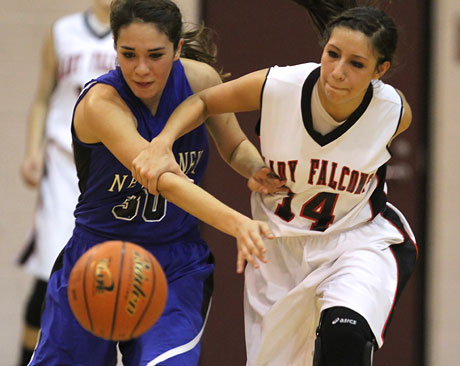
ACROSS THE COURT: Shooting action across the court with a telephoto lens will give you a couple of different shots, such as rebounds, steals and general defensive plays. In these photos, I’m using my Canon 300mm lens. From this angle, you can capture a lot of the emotion that comes with steal and rebounds. Plus, fast breaks coming the other way should yield clean, unobstructed shots.

As a point of reference, I’ll shoot with two camera bodies (Canon 7D as my primary body and a 30D as a backup) with two-of-three lens (Canon 18-35mm, 70-200mm or 300mm) attached at any given point.

I’ll get my safe shots out of the way.

If I’m covering both teams, I’ll start with my 70-200mm f2.8 lens and split the first eight-minute half, so I’m on both sides of the floor in the first quarter, allowing me to get shots of the both teams’ offenses and defenses.

Typically, I’m stationed behind the basket, at either corner where the paint and court meet.

Once I’ve gotten some offensive shots, I’ll mix things up by using my 300mm to grab shots that are too far away for a 70-200.

Without switching to the other side of the court, I’ll use the 300mm to get defensive shots, both out on the perimeter and up in the air rebounding, of the team that was just on offense.

You can also get a nice shots of offensive turnovers.

FROM THE BASELINE: With a wide-angle lens, you can do a number of different things. If you put your camera on the floor and tilt it slightly upward, you can give a viewer a different angle on rebound shots. This angle is also nice because it gives the viewer a sense of place. For this kind of shot, I tend to focus about a foot in front of the basket and turn the camera lens focus to manual so all you have to do is position the camera and wait for the action. Another thing you can do is position yourself on the baseline just to the edge of the paint. What I’m looking for is a player to drive from the wing to the basket -parallel to you.

If you don’t have a long lens, you can get a similar shot — you just have to move your feet to get close.

There should be a sizable gap between the scorer’s table and the row of chairs for either team.

If you shoot on either side of the scorers table, you should be able to get close enough to get defensive shots, just be aware of where coaches and players are, as some coaches will like to pace around and players will check-in at the table to sub-in.

Now that you have your safe shots, it’s time to play.

Unlike my safe shots, I’m going for low-probability, high-yielding positions.

By this I mean I’m looking for shots that I may have to be patient to get.

Remember, I already have my safe shots, so I know if I go a quarter and a half with nothing decent to show, I’m all right.

I’ll go for a couple of different shots: low-angle shot below the basket, high shot from the stands, long lens at mid court, etc.

Below basket:

This type of shot can give you a sense of place, as well as an appreciation for the athleticism players have.

I’ll point the focus of my camera with my wide-angle lens at a usually a foot or so in front of the basket. I’ll turn the lens focus from automatic to manual so the focus won’t change and lay my camera on the ground at a slight upward angle. I’ll shoot a photo to check the composition and wait for a rebound, fast-break layup, etc., to happen in front of me.

In the stands:

The great thing about shooting from the stands is how it cleans up your backgrounds and helps with your exposure, and you don’t have to necessarily have a 300mm to get shots from higher up. Even a 70-200mm lens from even a few rows up can help give you a difference vantage point.

As a bonus for shooting higher up, you can get the light from the gym shinning more directly on players’ faces as they look toward the basket filling in shadows you might have seen if you shot from the floor level.

FROM THE STANDS: Shooting from the stands will not only clean up the background, but also show you the faces of players as they battle for rebounds or go up for shots you wouldn’t see from the floor. From the stands I switch off between using my 300mm lens and my 70-200mm lens. As an added bonus, you can also get a better handle on what teams are doing both offensively and defensively, which can help you anticipate action.

You also see expressions as players go up for shots and rebounds that you may not see from the floor level.

From this point of view, I’m looking for expression and to some degree a variation of shots I get from the floor.

The other thing that can help you from this angle is you can see beyond just the pile of bodies in front of you.

In addition, it’s easier to understand plays and defensive schemes from that angle, allowing you to anticipate what will happen when and get a feel for players’ tendencies.

Images, such as player’s diving out of bounds, can be enhanced depending on your vantage point.

From higher up, you can see that play develop easier than you can from the floor.

If you get bored, you can always try other things, such as shooting completely wide angle for a while, or going super-tight from the baseline.

Mix it up, have fun and enjoy the freedom. 

Categories
Uncategorized

Ideas for getting great high school basketball shots

Even though it can sometimes be difficult to get a decent exposure in a high school gym, no matter what high school you’re at, I’ve found one thing remains constant: Unbelievable access.
If you’ve ever shot college or professional basketball, you know you’re told where you can shoot, or more specifically the long list of where you can’t.
With high school basketball, the only direction I’ve ever received from any official body is to be aware of where the referees are and give them space to move around the baseline.
As a photographer, that opens up a wide variety of angles and opportunities to make images.
I’m going to share my process to approaching basketball games.
As a point of reference, I’ll shoot with two camera bodies (Canon 7D as my primary body and a 30D as a backup) with two-of-three lens (Canon 18-35mm, 70-200mm or 300mm) attached at any given point.
I’ll get my safe shots out of the way.
If I’m covering both teams, I’ll start with my 70-200mm f2.8 lens and split the first eight-minute half, so I’m on both sides of the floor in the first quarter, allowing me to get shots of the both teams’ offenses and defenses.
Typically, I’m stationed behind the basket, at either corner where the paint and court meet.
Once I’ve gotten some offensive shots, I’ll mix things up by using my 300mm to grab shots that are too far away for a 70-200.
Without switching to the other side of the court, I’ll use the 300mm to get defensive shots, both out on the perimeter and up in the air rebounding, of the team that was just on offense.
You can also get a nice shots of offensive turnovers.
If you don’t have a long lens, you can get a similar shot — you just have to move your feet to get close.
There should be a sizable gap between the scorer’s table and the row of chairs for either team.
If you shoot on either side of the scorers table, you should be able to get close enough to get defensive shots, just be aware of where coaches and players are, as some coaches will like to pace around and players will check-in at the table to sub-in.
Now that you have your safe shots, it’s time to play.
Unlike my safe shots, I’m going for low-probability, high-yielding positions.
By this I mean I’m looking for shots that I may have to be patient to get.
Remember, I already have my safe shots, so I know if I go a quarter and a half with nothing decent to show, I’m all right.
I’ll go for a couple of different shots: low-angle shot below the basket, high shot from the stands, long lens at mid court, etc.

Below basket

This type of shot can give you a sense of place, as well as an appreciation for the athleticism players have.
I’ll point the focus of my camera with my wide-angle lens at a usually a foot or so in front of the basket. I’ll turn the lens focus from automatic to manual so the focus won’t change and lay my camera on the ground at a slight upward angle. I’ll shoot a photo to check the composition and wait for a rebound, fast-break layup, etc., to happen in front of me.

In the stands

The great thing about shooting from the stands is how it cleans up your backgrounds and helps with your exposure, and you don’t have to necessarily have a 300mm to get shots from higher up. Even a 70-200mm lens from even a few rows up can help give you a difference vantage point.
As a bonus for shooting higher up, you can get the light from the gym shinning more directly on players’ faces as they look toward the basket filling in shadows you might have seen if you shot from the floor level.
You also see expressions as players go up for shots and rebounds that you may not see from the floor level.
From this point of view, I’m looking for expression and to some degree a variation of shots I get from the floor.
The other thing that can help you from this angle is you can see beyond just the pile of bodies in front of you.
In addition, it’s easier to understand plays and defensive schemes from that angle, allowing you to anticipate what will happen when and get a feel for players’ tendencies.
Images, such as player’s diving out of bounds, can be enhanced depending on your vantage point.
From higher up, you can see that play develop easier than you can from the floor.
If you get bored, you can always try other things, such as shooting completely wide angle for a while, or going super-tight from the baseline.
Mix it up, have fun and enjoy the freedom.
Categories
Uncategorized

Losing of “Dublin Dr Pepper” was big news for the Dublin Citizen

As many small town newspapers know, when a major news events happens, you become the center of information. The demise of Dublin Dr Pepper was not as big an event as many towns have had to deal with (such as ElDorado) but it was major news and attracted a lot of attention from large dailies as well as metro TV stations.

Many use the newspaper as a source of background information as well as a prop for their newscast. Having been with major dailies as well as one TV station, I like to help out as I want them to have the right information.

Unfortunately, some strike out on their own and somehow don’t get all the information. Many of the out-of-towners sought information before it was available and kept calling, but that also helped me trace down rumors so I could keep on top of the situation.

I don’t know how big this news cycle will continue – of course, for us it will be a story for some time to come as we deal with the fallout of losing our “brand” name and identity.

It’s a story most of us have not had to deal with as it is unusual due to the “branding” of Dublin.

Categories
Ask an Expert Questions and Answers

Can I use a book cover in the newspaper to illustrate a news story?

Q:  We are doing a feature this week on the history of Rudolph the Red Nosed Reindeer. (actually pretty interesting… another marketing ploy by corporate giant) Anyway, I am thought I might scan in the cover of a little Golden Book about the flying mammal and use it as my artwork for the story. The book is copyright 1958 and has been out of print for years. Am I trudging on infringement issues?

A:  First, it’s good that you stop to ask.  Often, news staffs scan and use without even giving a second thought to copyright issues, simply presuming that if it can be found, then it is fair use.  This is not always the case, of course, and that’s when the Copyright Scrooges can come calling.

Chances are that the image is not in the public domain.  Even though it was published in 1958, if long as Little Golden Books renewed the copyright after its first term would’ve expired in 1986, the copyright would extend to 95 years after the original publication date.  That’s the rule for works published between 1920 and 1963; today, copyright extends to 70 years after the death of the author. (see a full list of copyright duration here:  http://copyright.cornell.edu/resources/publicdomain.cfm)

In this instance, however, I think printing the Rudolph cover would qualify as fair use.  Fair use is the chief exception under U.S. copyright law, which calls for penalties including $750 minimum and up to $150,000 in damages per infringing use.  Worse than a lump of coal, indeed.

To qualify for fair use consideration, the use must fall into one of the following categories:  criticism, comment, news reporting, teaching, scholarship and research.  Because you would be using the Rudolph image for news reporting purposes, you are at least eligible for the fair use exception.  However, this alone does not mean the use is fair.

Courts apply a four-part test to gauge whether the use is fair.  No one part of the test is supposed to be given any greater weight than the other; rather, courts apply the test on a case-by-case basis and provide an overall ruling based on the facts and circumstances.  The test includes the following: (1) purpose of the secondary use, (2) nature of the copyrighted work, (3) amount and substantiality of the portion taken and the secondary use, and (4) effect on market value of the original.

In the case of the Rudolph cover, the test would apply as follows:

  1. Purpose of the secondary use:  News uses are for profit, which favors the copyright holder.  However, the fact that the original is out of print helps the secondary user because you are making it available to a wider audience.
  2. Nature of the copyright work:  Rudolph is without a doubt fictional and fanciful, which is more creative than historical or factual works.  This favors the original copyright holder.
  3. Amount and substantiality:  This kind of depends on how the copyright was registered.  Was it done as a whole, or was the cover image registered separately?  Most likely, it was registered as a whole, meaning you’re using just one image (albeit the most important one) from dozens in the book.  It’s hard to use images fairly without “transforming” them somehow – using them in a photo illustration, for example – because it usually requires taking the whole image.  Using the photo in a de minimis way – as a small image accompanying a longer story, with other images from other sources as well – would help the news reporting use even more.  This factor also slightly favors the copyright holder.
  4. Effect on market value:  Essentially zero, which favors the secondary use.  It’s not plausible to believe that people would substitute the newsprint image for the original, thus undercutting sales of the book.

Though courts are not supposed to favor any one factor, they often do focus on amount and substantiality and effect on the market.  Here, with no negative market effects, and with only one image from the book taken, these factors seem to favor the secondary use.  The fact that the book is out of print helps as well.

Thus, I think this use would qualify as fair.  To be safe, however, I encourage attributing to the original work – under the image, I suggest listing the name of the artist, the title of the book, the publisher and the date.  Such acts of good faith – you’re giving credit to the original artist and publisher to the audience, rather than hiding them – tend to be appreciated by the courts. Think of it as a way of staying on the “nice” list.

For more information on copyright, go to www.copyright.gov, which is full of resources and FAQs for the public.

Categories
Ask an Expert Questions and Answers

What can I do if a government body regularly goes into unnecessary executive sessions?

Question: Under the Open Meetings Act, what can I do if a government body goes into executive session under a vague “personnel matters” exception every meeting, even if the body is doing other things such as receiving reports or discussing other matters about high-level government employees during this closed session?

Answer: First, to be clear, a government body can go into executive session to discuss personnel matters (551.074). To comply with the notice requirements under 551.001, the government body must (a) meet in open session and announce that a closed session will be held and (b) state the exception under which the body is going into executive session. So, technically, a city council that meets in open session and states that it will be going into closed session to discuss personnel matters – without any further detail – is complying with the notice part of the Open Meetings Act.

While some government bodies voluntarily disclose which personnel are being discussed or otherwise provide more detail, there is nothing in the statute or court/attorney general rulings demanding that government bodies provide more clarity, except in cases involving a “special public interest.” Texas courts have only required more than “employment of personnel” for hiring decisions when such a “special public interest” is involved (for example, courts required more for school boards hiring principles or superintendents; see Cox Enterprises, Inc. v. Board of Trustees of the Austin Independent School District, Texas Supreme Court, 1986).

Thus, hiring and firing of high-level personnel – perhaps including city managers and tax assessors/collectors – would seem to require an additional level of notice beyond merely stating “personnel matters.”

However, the “personnel matters” exception does not cover anything dealing with government personnel. Under 551.074(a)(1), the only personnel discussions that can be closed are sessions “to deliberate the appointment, employment, evaluation, reassignment, duties, discipline, or dismissal” of a public employee. So, if the body is receiving a report about the aforementioned matters – particularly, say, an audit or investigation about a public employee – that portion of the meeting can be closed.

That said, the personnel matters exception can be (and surely often is) abused. If a government body is trying to dodge public scrutiny by wrongfully hiding behind an exception, it is in violation of the Open Meetings Act. If you hear that matters have been discussed besides those claimed as the reason for meeting in closed session, then you can challenge the validity of closing the meeting in court.

Proceedings of closed sessions must be recorded, either through video/audio recording or through a certified agenda that includes details about any business conducted during the closed session (551.103(a)] This includes at least a brief summary of the subject matter discussed and any actions taken.

Unfortunately, there is no way for you to gain access to the recording or the certified agenda without court intervention – a court can conduct in camera review of the recording/agenda and can admit it into evidence if the case proceeds. I would normally suggest that you seek a friendly member of the board to leak you a copy, but doing so is a misdemeanor.

To be clear, the closed session on personnel matters is only for deliberation, not for final votes and decisions, which must be made on the record. Any final decisions made regarding the public employee (or final decision on any other issue, for that matter) must be made in open session.

Categories
Uncategorized

Got the journalism blues? We’ve got your song

First, an economic downtown.  Then competition from digital media.  Then classified all but disappeared and all ad revenues plummeted.  Then layoffs.  Then more of the same.

Journalists have certainly had enough to sing the blues about.

But maybe they haven’t a great blues song to sing, one that reflected what was happening in journalism, and especially community journalism.

But now they do, courtesy of the Texas Center for Community journalism.

It started with a blues song written by veteran journalist Donna Darovich, a lyricist well-known for her work in the Fort Worth SPJ Gridiron shows, which were discontinued in 1996.

I saw Darovich’s lyrics and urged her to add more references to the unique world of community journalism, and The Journalism Blues was born.

To make the video, we enlisted a faculty blues band from the TCU Schieffer School of Journalism – The South Moudy Blues (so named from the Moudy Building South  at TCU where most of them have offices) – and audio and video help from the Department of Film, Television and Digital Media at the university.

We wanted a blues song that really reflected some of the dilemmas of today’s community journalist.  The song talks about everything from competition with Craigslist and Patch to the problems many long-time journalists have in adapting to a digital world.  It’s the real-world journalism blues, pure and simple.

The video  and its lyrics can be accessed at /journalism-blues.

Categories
Uncategorized

The Journalism Blues: What happened to the news?

Lyrics

I once was a reporter, I used a pad and pen
I only had to find out who, what, where and when
Now they want a podcast, take a photo with my phone,
Write a blog and post on Facebook; never felt so all alone

Oh Lord, what’s happened to the news?
Help me keep my head up;
Save me from the jour na lism blues!

I once was a gatekeeper. I always checked my facts and beat
Now nobody cares; they just wanna see me Tweet.
They all want a quick read, news from the Internet
I know times they are a changing, but they ain’t gonna see me sweat

Oh Lord, what’s happened to the news?
You know I’m lost about what’s happenin’
Save me from the jour na lism blues!

Got to keep a charger powered ‘cause I write from a laptop.
Work my beat by email; news room’s a Starbucks coffee shop
No one assigns investigation, no one lets me rake some muck
They’re putting ads on the front page. How much more can this suck?

Oh Lord, what’s happened to the news?
Help me keep my head up;
Save me from the jour na lism blues!

Got me some financing for a paper of my own
Sold everything and then some; my retirement fund is blown
Then along comes Patch; my advertisers jump with glee.
Some zit-faced kid from Dallas says he’ll give ‘em space for free.

Oh Lord, what’s happened to the news?
Help me keep my head up;
Save me from the jour na lism blues!

I’m in community journalism, they love my paper here,
The kind of place where all the local meetings start with prayer
But I tried to sell some classifieds, and my sales pitch they dismissed!
Anybody know a hit man who will find Craig and his list?!

Lord I need a vacation, need to get away from here,
But I’m my only employee, what a hell of a career
If it’s done I do it, do you think that sounds like fun
Cause I sweep and clean the toilets when my editor’s work is done

Oh Lord, what’s happened to the news?
Help me keep my head up;
Save me from the jour na lism blues!

Oh Lord, what’s happened to the news?
I’ll be in church next Sunday
Just save me from the jour na lism blues!

Share this

Credits

The Band The South Moudy Blues (@SouthMoudyBlues) – Bill Johnson, Steve Levering (@levering) and David Whillock
Lyrics Donna Darovich (@Flackgirl)
Producer Tommy Thomason (@thomason)
Audio/Video Andy Haskett
Photography Rebecca Philp
Editing Greg Mansur
Online presentation Andrew Chavez (@adchavez)
Sponsored by Texas Center for Community Journalism (@tccj)
 

Categories
Uncategorized

Convincing advertisers newspapers work is difficult, but not impossible

“We tried newspapers. They don’t work!”

“We tried your newspaper. It didn’t work!”

“I tried advertising on your newspaper’s web site a few years ago and really didn't get any new business from it.”

You have probably heard the above refrains — not once, not twice, but a few times too many. How do you answer these objections?  They are tough to overcome … but not impossible! 

Consider this strategy:

First and foremost, acknowledge that you have heard your potential advertiser’s objection … show some empathy!  Remember, too, that objections are not problems. They are opportunities to excel!

After acknowledging that you have heard them, resist going on the defensive. Rather, ask this simple question: How do you know? In most cases, retailers, service providers or small businesses simply don’t know whether their advertising has worked, in terms of generating sales results, regardless of the investment cost or its nature.

As you know, many reasons could contribute to a less-than-successful ad or promotional effort: An initial error in identifying the target audience which, in turn, may have lead to incorrect media selection; poor merchandise or sale offered; weather; poorly designed ad copy.  Also, the retailer may believe but cannot confirm poor performance or the ad tracking results may not be available. Or there may have been poor positioning on the newspaper’s web site.  Or a better competitive offer from some other retailer offered at the same time. It is not always possible to review a past unsuccessful advertising investment and determine the reasons it was not a success.

Inasmuch as many small businesses may not know how to effectively determine whether their advertising investment generated results or not, you have an opportunity for a teachable moment and an opportunity to build your integrity and relationship with your potential client.

Help your current and potential advertisers understand the value of tracking their advertising investment and its effectiveness – the results of the ad. Tracking results helps to identify which media best reach their target audience, which product or service promotion yields the best results, and when is the best timing (daily, weekly or monthly) for ad placement.

A relatively easy method is to track revenue changes. Two weeks prior to scheduling the first ad in an advertising campaign, the retailer should review total revenue for the entire store in a given time period (e.g. each day). The retailer should then monitor total revenue during the advertising campaign (e.g. while the ads are running).  And finally, the retailer should analyze total revenue for the entire store in the same given time period (e.g. each day) two weeks after the ad campaign is completed. In addition to tracking revenue, number of transactions, overall inventory changes and changes in advertised inventory are additional means of tracking ad effectiveness in a similar manner.

Ask your potential advertisers for a couple of minutes to allow you help them to map out the future rather than redesigning the past! Explore with your potential client some strategic initiatives (where are you now? what do you want to move away from? what do you want to move to?) by asking questions … and more questions (how do they plan to grow their business, describe your best customer, etc.).

Once you have clarified your potential advertiser’s goals and introduced a tracking method, begin rebuilding the value of newspaper products and your newspaper’s various products. Who reads newspapers? Who reads your newspaper or visits your newspaper’s web site? Back up your value statements with proof positive — testimonials, both from your readers and your advertisers.

Walk your prospect through your newspaper, pointing out some successful and campaign-orientated advertisers. Let them hold your newspaper and watch how they interact with it. What do they like or dislike about it?

Visit your newspaper’s web site. Point out its everyday strengths and ongoing resources (breaking news, local and current reference tools, obits, community information and events). Then just listen. “Nothing I say today will teach me anything. If I am going to learn anything I need to listen!” What valuable feedback is being shared with you? What short term and long term potential exists based on this new client information?

Last but not least, always encourage your current and potential advertisers to invest in an advertising campaign. A single, one-time promotion or ad puts your newspaper franchise and you at risk and, more importantly, wastes your advertisers’ ad dollars and time.

One-time coupons to track response should be refused! Again, don’t put your newspaper franchise and you at risk. Coupons are a promotional vehicle.  They also bring in a less profitable customer for your advertiser.  

Once you have acknowledged your prospect’s objection, outlined the benefits of tracking their advertising investment response and rebuilt your newspaper product’s value, then demonstrate proof-positive — offer a different point of view or a solution or a proposal and close the sale.  Ask for the business!

Advertising campaigns + Methods to track their effectiveness (Results) = Advertiser success (Growth) and ongoing investment in you and your newspaper products.

Categories
Uncategorized

How to respond to ad customers who want to buy only one ad

Like any sales person, I hate to hear a prospect tell me “no.”  But, I’d much rather hear an outright “no” than have someone tell me, “I’ll try an ad and if I get some business, we’ll take it from there.”

I prefer the “no” because I will have a chance to sell that customer another day. The “buy an ad” response is a trap that sets me up for long-term failure. In most cases, a “one shot” program will not produce noticeable results. One of the most challenging objections to overcome is, “I tried advertising in the past and it didn’t work.”

When I probe these prospects further, almost always I find that when they “tried advertising,” they had run just one or two ads. This would be equivalent to taking a dip in the pool once or twice a year and then being surprised when you don’t make the Olympic Swim Team. To be successful a sales person needs to sell their prospects on the benefits of advertising frequently.

Elements of effective advertising programs

There are three components of an effective advertising program: Reach, Frequency and Message. Reach is easy to understand; advertisers know they must get their name in front of a potential customer if they want a chance to sell them. Likewise, they must reach these people with a compelling message that will entice them to patronize the advertiser’s business. The importance of reach and message are relatively easy to explain. Maps and spec ads provide tangible examples of these aspects of a well-crafted advertising program. The importance of consistent advertising is much harder to demonstrate because frequency does its work inside the human brain.

Why TOMA matters

Advertising sales people have talked about TOMA (Top of Mind Awareness) for many years. Recent psychological and economic research has explained the mechanism behind this concept. Sociologist Niklas Luhmann stated that, “Familiarity is a pre-condition of trust.” Researchers found that the more familiar a person is with a firm, the more likely they are to make a purchase from that firm. One of the senior reps that I work with tells his customers, “My job is to make you famous.” Frequent advertising does just this. By staying in front of the customer, a business makes their name familiar to potential customers. When making a buying decision, consumers prefer to spend their money with a company whose name they know and therefore, trust.

The thin market—I’ll be right here when you need me

America is the land of the microwave pancake. We are an impatient people. Consumer research has found that most sales are made within 24 hours of the decision to buy. Another 25 percent of sales are made within a week of the decision to buy. This means 75 percent of sales are made within seven days of the moment when a consumer decides to make that purchase. If a consumer decides he or she a pair of shoes in a week when Jones’ shoe doesn’t advertise and Smith’s shoes runs a sale, guess who gets the business? 

The “Thin Market Concept” describes the distribution of sales throughout a certain period of time, a year for most products, shorter for seasonal items. For example, if consumers in a certain market purchase 200 washing machines in a year, appliance dealers in that area will sell about four machines per week. If an advertiser decides to skip just one week per month, and taking consumer behavior into account, they will miss the opportunity to make 48 sales (12 weeks X 4 machines per week).

These opportunities can never be recovered. In addition to the lost revenue, these businesses have lost the chance to build a relationship with a new customer. The “Thin Market” highlights the risks businesses take when they do not advertise consistently.

The sale is in the eye of the beholder

I work with an advertiser whose ad is virtually invisible to most of my readers. He runs a large display program 52 week a year, but most people simply don’t notice his ad. This customer owns a business that specializes in emergency water heater replacement.  He doesn’t care that most people pay no attention to his ad, because he knows that it screams at the people who need his service. Neuroscientists have named this phenomenon “Reticular Activation,” after the reticular cortex in the brain. The job of the reticular cortex is to protect the brain from information overload. To make sense of a complex world, our brains are conditioned to filter out all but the most interesting and important data. This is why if you decide to buy a Honda Civic, suddenly you start seeing Civics everywhere. By advertising consistently, my plumber customer made sure people would have access to his ad when they needed him.

Selling frequency

As a sales manager, I also told my reps that I never wanted them to sell an ad.  I wanted my people to always sell programs. Even a fire station advertising their annual carnival benefits from frequency. They can generate interest in their event by running a series of ads in the weeks leading up to the event. I encouraged my reps to refuse single ads. This is not easy for a commissioned rep to do, but it is in their best interest. Consistent advertising produces results and leads to solid customer relationships. Here are some ideas to help you sell advertisers programs that will make them (and their rep) successful.

  • Think contract from the first contact. When approaching new prospects, plan to sell them a program. Build your presentation around the benefits of consistent advertising.
  • Get the client thinking long term. When probing for information, ask prospects about their goals and long-term plans. Ask them where they want the business to be in five or 10 years and what must happen for them to achieve their goals. This will put them in the right frame of mind to discuss long term advertising.
  • Don’t take the quick sale. As discussed above, customers who run an ad now and then are unlikely to get measurable results. If a customer suggests doing this, defend your program recommendation. Concentrate your efforts on building your territory, not on making a quick sale. This will pay dividends in the long run.
  • To sell a program, plan a program. Develop a marketing plan for your prospects. Talk to them about different approaches for different aspects of their business. Talk to them about how to promote their business in different seasons. This approach will help them see the benefits of long-term programs.
  • Advertising agreements are more than a discount. If your publication offers a discount to advertisers for making a commitment, do not try to sell the program on price. Position the program based on the benefits of consistent advertising. If the customer is not totally sold on the value of the program, it is not likely that the discount will motivate them.  If the focus is on simply saving money, they can accomplish this by simply cutting back on their advertising.
  • Manage the customer’s expectations. Don’t promise the customer immediate results, remind them that they are building a program that will produce long term results. Stay close to the customer and help them develop their ads and reassure them that they made the right decision. One of my reps tells a customer not to expect any increase in business for three months. When advertisers begin getting results in a month or so they are pleasantly surprised.

Be committed to selling advertising commitments

Selling long-term programs is always difficult. The recession has made this even more challenging. In an uncertain economy, customers are nervous about making a commitment. The key to overcoming this objection is reminding customers that they committing to the success of their business. Business owners have already made many commitments — they have financial commitments, commitments to their suppliers and to their employees. Committing to an advertising program is a minor commitment which protects all of their other commitments.

As a professional advertising salesperson, my job is to help my customers to be successful. My training and my experience tells me that the best way to help my customers is to keep them in front of their customers. Selling ads is easy; selling advertising programs requires a professional.

Professionals must sometimes tell people things they don’t want to hear, but need to hear. Professionals help people understand what is best for them. We show our commitment to our customers by convincing them to commit to their own futures. I’ll finish with the words of Edwin L. Artzt, CEO of Proctor & Gamble:  “No company that sells products or services to the consumer can remain a leader in its field without a deep-seated commitment to advertising.”