Imagine three baskets in your newsroom – and you have to put every story in one of the three baskets.
One is labeled what, another one so what, and the last is now what? The idea of the baskets, the brainchild of Washington Post reporter Chris Cillizza, comes from the reality that journalism has shifted away from being a “what happened” field.
Modern journalism was built on reporting what happened. We brought the news to America. People turned to newspapers to find out what was happening in their world. But that franchise has been eroding at the hands of first radio, then TV, then the Internet. For several decades now, our major metro newspapers have not been the primary medium people turned to for up-to-date information.
But community newspapers were different. Our job is not to cover the world or the nation or even the state. It’s to cover our city and county. And often, we were literally the only game in town – the only medium that had the reporters to go out and cover the news in print and photographs. People could read their news in the paper or in our online editions.
So whether it was a school board meeting or a football game or the county fair or a fatality accident just outside of town, we had complete and accurate information – and pictures. Sure, maybe people heard about the accident or talked about it at the coffee shop, but when the paper came out we satisfied their news hunger for complete information. They may have known who won the football game, but we gave them the quarterback’s completion stats, the number of tackles the star linebacker made, the post-game comments of the coach, and a rundown on next week’s opponent.
Radio and TV and the Web ate into the hard news franchise of the metros, but for community papers – not so much.
Until social media.
Facebook now has 1.6 billion users, more than 60 percent of whom are logged in for at least 20 minutes a day, according to the Economist. Contrast that with the Washington Post, which has the biggest Web traffic of any U.S. publisher. The Post received 73 million visits during the entire month of March, with readers spending an average of one to three minutes per visit.
No matter how small or isolated your community, people are spending lots of time on Facebook every day. When they hear about news, they share it – with pictures. It’s an axiom that a lie can spread halfway around the world while truth is putting on its boots. The modern media equivalent of that is that news can spread through your community while you are figuring out who should write the story.
So if your newspaper’s claim to fame is being first with the news, that ship has probably long since sailed. If you tell people only what they already know, they’ll think you are irrelevant. And nothing is so damning to a newspaper as the reputation that it contains “old news.”
Facebook is not a “detail” medium. Facebook readers get only the big picture, the major points of the news. But when we write that same story, what do we lead with? The big picture, the major points — so it’s the readers’ perspective that we’re telling them what they already know.
Of course, we still need to print the what-happened news, but there has to be more. As we move more of the breaking news to social media and our online edition (because you may be a weekly in print, but you have to be a daily online and in social media), that means we need to focus more on the other two boxes – so what and now what.
We don’t just tell readers what happened at City Council. We look for how those actions will impact citizens. What will that mean for their safety or their pocketbook or the economic future of the community? We do a rundown of the what-happened, but we focus on its impact on the community and on our readers.
So perhaps the school board has voted to reduce the teaching faculty in elementary schools as a cost-cutting measure. What will that mean to class sizes? How will it impact student learning and test scores? What do teachers think? A budget saving proposal might look good until your realize that your kid’s third-grade class will go from 25 to 34 kids – and the students with learning problems will be the most adversely affected.
Unfortunately, this kind of reporting takes more time. It’s a lot easier to take notes at a meeting and produce a story that reports votes and quotes from the participants.
The real issue here is staying relevant for our readers. And if it takes re-thinking our stories – classifying each as a what or so what or now what story, that will be time well-spent.
Note: This blogpost has focused on news coverage. To see how this same idea impacts sports coverage, see our earlier blogpost.
So what if someone asks: “Do you think animals are endangered?”
There’s literally no answer to that. We know that mountain gorillas, elephants, rhinos and tigers are critically endangered and we may well see their extinction in our lifetime.
But other animals exist in abundance – rats, rabbits, dogs, deer and hundreds of others.
And that’s the problem with the question newspaper people are asked so often: “Do you think newspapers are endangered?”
Here’s your answer for the next time someone asks: “Depends.”
And mostly, it depends on the size of the market. Metropolitan dailies are in a world of hurt because their business model doesn’t work anymore. Large cities are media-saturated and there are countless places to get the news – and countless places for businesses to advertise.
Just over a decade ago metros made money from display advertising, classified advertising and circulation. The big display accounts realized that there were many other ways to get their message out. Classified died, killed by Craigslist and similar sites. And circulation declined in the face of many other places to get the news. Of course, as circulation declined, advertisers noted the dwindling audience for their commercial messages.
Depressing, huh? But the metro newspaper is like the endangered animal – don’t assume that because lowland gorillas may die out that we’ll soon have no dogs or deer or rabbits. They exist in superabundance.
And people who would never lump all animals together find it easy to lump all newspapers together. Lots of folk don’t realize that there are some 7,000 paid circulation weekly papers and around 1,300 daily papers with circulations less than 25,000 in the U.S.
So that’s around 8,300 community newspapers with a circulation of more than 45 million readers. Counting the pass-along rate (the number of people who actually read the paper, as opposed to the number who purchase it), readership of community newspapers in the U.S. exceeds 150 million a week.
Or take Texas. Our largest newspaper is the Dallas Morning News, with more than 400,000 circulation. But the No. 10 paper in circulation, the Lubbock Avalanche Journal, has just over 27,000 circulation. So obviously, most newspapers in Texas and in the U.S. are community papers.
Community newspapers still dominate in smaller communities. Rather than just being one voice among many as with their metro brethren, they are often the only game in town. You want to know what happened at City Council? Why school taxes are going up? How the local teams are doing? Who was involved in that big wreck on Center Street? Why the old warehouse burned down? What’s for lunch tomorrow at your kid’s elementary school? Check out the community paper – because you won’t find it anywhere else.
One rural publisher, in a speech to a journalism conference, put it this way: “To our readers, we are not the newspaper, we are their newspaper. Down the block at Rogers Mini Stop, we sell more than a hundred papers every week. If our press run is late we get frantic calls from the Rogers family. They have a store full of irate customers who want their papers now…. We all know the traditional reasons — the little stories that never would be considered ‘news’ anyplace else. Our readers really care about those things.”
So when someone asks why newspapers are dying, explain that they are talking about a small – if highly visible – part of newspaper journalism. Most papers are community papers, not metros.
Question: City officials routinely wait 10 days on all my open records requests, even when those records are easily accessible. Is that a violation of the Texas open records laws?
Answer: The Texas Public Information Act (552.221) does indeed give officials 10 days to produce a document “if it is in active use or in storage.” But otherwise, the law stipulates that the record shall be produced “promptly.” The law leaves no doubt about what that means: “An officer for public information of a governmental body shall promptly produce public information for inspection, duplication, or both on application by any person to the officer. In this subsection, “promptly” means as soon as possible under the circumstances, that is, within a reasonable time, without delay.”
For city officials who want to quibble about the definition of “promptly,” note that the law itself defines the word: “without delay.”
Also, the Attorney General’s Guide to the Public Information Act specifies this on page 22: “’Promptly’ means that a governmental body may take a reasonable amount of time to produce the information, but may not delay. It is a common misconception that a governmental body may wait ten business days before releasing the information. In fact, as discussed above, the requirement is to produce information ‘promptly.’ What constitutes a reasonable amount of time depends on the facts in each case.”
When is the last time you waited for the morning newspaper to learn the final scores of last night’s sports action?
Do you anxiously wait for the thump of the newspaper on the front porch to learn if Eric Hosmer went 2-for-4 with three RBIs, or how many strikeouts Adam Wainwright threw in the Cardinals’ most recent victory?
Didn’t think so.
With the advent Twitter, live blogging, dedicated apps for every major and minor sports league, score alerts on smart phones and Apple watches, the traditional sports game coverage story – “the gamer” – is dead.
The final score, the leaders on the stat sheet and sometimes even player and coach reaction is reported in the seconds and minutes after the game. The Twitter feed has become the sports fan’s best friend instead of the random stranger sitting on the next barstool.
This does not mean sports reporting is no longer an integral part of the newspaper or newsroom. It does mean sports editors and reporters need to think differently about the content they create, and the stories they tell.
If your newspaper is still publishing the majority of its sports page with 25-inch play-by-play game stories then it might be time for a content remodel. And this sports page remodel will work at a metro daily with a circulation of 200,000 along with at a small-town weekly with 2,000 copies hitting the street.
I know what you’re thinking: “But how I am going to get all of the names of athletes in the paper? Those names sell papers to the parents and relatives in the market. That’s revenue, especially in small markets.”
You are right. And I am not suggesting to not report the game’s highlights.
I am proposing a way to do it differently.
You have access to the coaches, players and stadiums that Joe Fan does not, so use it: What can a sports reporter provide that fans can’t get on their own? Access. Your coverage should provide Joe Fan access to the players, coaches and team. Go heavy with “notebook” type coverage about players who are trending up and down, and why. Talk to players more, and report what they think about their game or the team’s performance. You have the chance every day to interview the coach — use that access to provide insight to the team and its performance. Fans can’t go up to the coach and players and ask them questions about a certain play, but you can. So do it.
Focus on the big play, moment: Instead of providing a play-by-play recap of the Friday night game, focus on the one big play that changed the game, or possibly the player that hit the winning shot, returned from injury to make a difference in the game, or a player who had a special moment that can’t be found in the box score.
Deliver stats, recaps in an alternative format: In baseball, do a breakout “how they scored” box that provides the play-by-play recap, and allows you to get those all-important names in the paper. For football, break down the scoring by quarters; hockey by periods; soccer by halves. You get the picture. This content should be featured in a graphic format with the analysis or feature post-game coverage.
Three stars of the game: Another great way to get names in the paper outside of 25-inch copy is a breakout “Three Stars” box to highlight three players who made a difference on the stat sheet or with a big play. Use mug shots of the athletes to add a little visual pop.
Look ahead, not back: This coverage model is especially true for weekly newspapers. While providing coverage of the past week’s action in alternative format such as graphic boxes and features, consider focusing the majority of your efforts previewing the coming week’s big games. And, as always, use your website throughout the week after publication days to report final scores, and game highlights right after the game to provide that “daily coverage” from a weekly print publication.
Those are just five examples of thinking differently when reporting and editing your sports coverage.
By moving away from the traditional 25-inch game story and incorporating some of these new elements, you might just hit a home run with your readers.
Somewhere, every publisher has a list with a heading something like this: “Stuff We Really Need to Do If We Had the Money and/or the Time.”
It’s frustrating to look at because, as the list-heading says, these items are necessary – but not affordable in terms of money or time. Probably, both.
And at the head of the list: Professional development of your staff.
It hasn’t been that long ago that professional development was a luxury item for financially successful newspapers. But that was before newspapers became more than just print-on-paper. Now we’re trying to reach audiences across various media platforms and new hardware and software and journalistic techniques mean that we always seem to be playing catch-up.
So is training available for community newspapers? You betcha. But it often involves travel and hotel stays and expensive tuition and time away from the job.
Fortunately, there are lots of training/professional development opportunities for community newspapers – and lots of it is free. So let’s look at what’s available.
Online training
The downside to online training – as opposed to classes you may attend – is that you have to make time to do it. It takes self-motivated staffers. If you suspect that motivation, you may get several people take the training online and to share what they are learning with others.
Let’s look at some free or low-cost training that’ll jump-start your professional development program:
NewsU. Probably the best-known online training is the Poynter Institute’s News University. NewsU offers a broad range of online training on everything from reporting to writing to FOI to social media to grammar to sports to video, and lots more. A few are free. Lots are one hour and cost $29.95. They are also archived, so you can access them anytime you want to.
Lynda.com. Lynda offers the motherlode of online training. You can get a free 10-day trial to check it out, and subscriptions begin at $25 a month. Lots of great software and tech training – including photo courses.
The National Press Foundation. The NPF offers free resources and webinars for any journalist. Put them on your “check occasionally” list to see what they having coming up. Some are more appropriate for metro journalists, but others are valuable for reporters at community newspapers.
The Reynolds Center for Business Journalism. The Reynolds Center focuses on the business beat, but some of their workshops relate to broader topic areas. You’ll find archived workshops online.
The Society of American Business Editors and Writers. This group offers podcasts on important skills for journalists – you can spend an hour developing skills like using Linked-In as a reporting tool or developing an email newsletter for your newspaper or digital business writing.
Google. Don’t forget one of the best tools you have – asking Google to find you the training you are looking for. Have a new staff member who needs Photoshop training? Ask Google, and tell the search engine you want free training: “free online photoshop tutorials.” That search term, by the way, netted 2.6 million responses.
Online Media Campus. These online modules offer training in advertising, editorial, technology, management, even revenue generation. The cost for most is only $35.
Investigative Reporters and Editors. IRE and its sister organization NICAR (National Institute for Computer-Assisted Reporting) offer all kinds of seminars and webinars for your reporters who want to deep-dive into investigative reporting. You have to join IRE first, but after you do, the organization offers lots of training and other resources free.
The Knight Center for Journalism in the Americas. The Knight Center has free digital books on journalism you can download (the classic “Web 2.0,” “10 Best Practices in Social Media”). You can also sign up for free online courses.
DigitalEd. You can register for live webinars for $39 or view archived webinars for $19. At this writing, available archives include Advanced Social Media Analytics, How to Personalize Your Content for Better Engagement, Learn to Use the Amazing Camera on Your Mobile Phone and more.
The MulinBlog Online Journalism School. You probably haven’t heard of this, but it offers online courses in topics like Writing for the Web, Intro to Data Visualization, Audio Slideshow Storytelling, and Social Media Marketing.
The Freedom of Information Foundation of Texas. If your staff members need a refresher in Texas open meetings and open records laws, check out one of the FOIFT’s Open Government Seminars. They are held in various locations around the state and they are reasonably priced at $50.
In-house training
Don’t overlook what you can do in your own newsroom. You can start with a training lunch once every two weeks. The paper should provide pizza or burgers or salad, and for openers your staff can talk about their training needs. What do they want to know? What kinds of software training, for instance, would be valuable. Do they want to know more about copyright law? InDesign? Smartphone photography? Once you know this, you can go to work. For some things, you may find that your expertise is right there in-house.
And for other areas, you may need to bring in someone. But don’t assume that “bringing in” means paying a trainer or consultant. You’d be surprised whom you can Skype in for a half-hour talk. Some of the country’s top professors and trainers would be willing to talk by Skype to your staff. All you need is a free Skype account on both ends. Then open a laptop and you have a trainer.
Another great resource that’s free is the Journalist’s Toolbox. This site, sponsored by the Society of Professional Journalists, is the best collection of resources you’ll find. Anywhere. So let’s say, for instance, that you want to beef up your reporting on weather-related stories. Go to the weather tab on the Toolbox, and you will find literally more than 100 weather-related sites. And that doesn’t even include covering drought, where you’ll find more than 10 resources just for covering that topic.
Also consider getting workshop leaders from local universities and community colleges. You may even get a high school English teacher to talk about grammar problems your writers are having.
The resource close to home: TCCJ
If you’re a Texas newspaper, TCCJ exists to help with training issues. You know already about our workshops – both two-day and one-day workshops. All are free, underwritten by the Texas Newspaper Foundation. TCCJ has held free workshops on iPhone and Android photography, advertising sales, advertising copywriting, advertising design, newspaper management, reporting and writing, sports journalism, media law, FOI, newspaper design, photojournalism, and more. We announce our workshops on our Facebook site and in emails to our extensive list of Texas journalists. If you’re not on our email list, just send your name and email address to us at tccj@tcu.edu and ask to be included.
We also put the PowerPoint presentations from our workshops online at Speaker Deck. You can use anything you find there to do your own in-house workshop.
At TCCJ, we think one of our best training resources is the Center’s Facebook page. We spend a lot of time monitoring the online world for information of interest just to community newspapers. Then we link to it on that page. You could literally have an in-house training session where all you did was to look back at our postings over the last couple of weeks and talk about the articles you find there. In addition to news of the industry, we also post lots of training-related articles – anything from news of an upcoming webinar to an article on how to improve your leads. And if we find something that’ll make you laugh, we post that, too.
And one of our best resources is the phone on the desk at the Center. If you want to train your staff in something and don’t know where to start? Call us at 817.257.6551. If we don’t know, we’ll research it for you.
Question: I interviewed a jail inmate yesterday who claims that deputies broke his ribs in two places when they arrested him on Dec. 16. He said he complained of the pain daily, but they didn’t x-ray him until Jan. 29. Can I get a copy of the x-rays and any related medical documentation provided the inmate signs off on it?
Answer: I’m sure a request would (appropriately or not) denied with HIPAA as an excuse. The inmate can request those records, of course, and pass them on to the reporter.
I’d argue that AG Open Records Decision 577 (1990), as noted in the AG handbook, would allow a person to request personally identifiable health information maintained by a state agency with the permission of the person named in the record. That would be under 552.023.
Underlying most of the issues we cover as journalists is the principle of open government, which is under attack on many fronts. Local governments want state legislatures to weaken public-notice laws; public officials evade open-meetings laws with private conversations; and legislators all over the country are trying to weaken open-records laws. For example, two bills in Florida would eliminate mandatory awards of attorney fees in cases where plaintiffs prove that government officials have violated the state Public Records Law, as we noted on The Rural Blog at http://bit.ly/1Q17PjT.
Bipartisan efforts continue to improve the Freedom of Information Act. In January, the House sent the Senate a bill that would scale back exemptions to the law and make it easier to use. We reported on it at http://bit.ly/1PFcF52.
Meanwhile, keeping track of what’s going on in Washington has become more difficult as news organizations reduce staff in the capital. More than 20 states have no reporters dedicated full-time to covering their congressional delegations. We updated the Pew Research Center’s annual report on that problem at http://bit.ly/1KpuAxz.
Closer to home, members of the International Society of Weekly Newspaper Editors recently debated, on the list-serve we host for them, whether they should carry guns to public meetings. Barbara Selvin, a journalism professor at Stony Brook University, did a story about it for The Poynter Institute and we excerpted it at http://bit.ly/1TnGiKt.
More than once, editors on the list-serve have discussed how to handle reporting of suicides, and a recent discussion revealed that the dominance of social media has prompted some editors to be less timid in their coverage. The discussion prompted Brad Martin, editor of the Hickman County Times in Centerville, Tenn., to write an article for the online Daily Yonder about his coverage of suicide as a public issue, and his involvement in community efforts to prevent it, after his county had six suicides in four months. Suicide rates are 70 percent higher in rural areas than urban ones, according to 2013 data from the Centers for Disease Control and Prevention. The Rural Blog noted that and covered both discussions at http://bit.ly/1PFeM8T.
A growing problem in rural areas is the financial condition of their hospitals. Stories about the problems of rural hospitals led the list of most-read topics on The Rural Blog in 2015. Of the 60 blog posts that were viewed at least 250 times by TRB readers, eight excerpted stories about rural hospitals, and some related items also had high readership. We gave some examples in a Jan. 1 blog item, at http://bit.ly/1R7Q0i6.
Another growing health issue in rural areas is intravenous drug use, evident in increasing numbers of drug overdoses and local epidemics of HIV and hepatitis C. Our latest blog item on the issue is at http://bit.ly/1opAzJ6.
Even in rural areas, some health problems are causes or exacerbated by air pollution. How polluted is your county’s air? If you’re in one of the 25 most polluted states, you can find out from maps compiled by HealthGrove, a site that emphasizes data. The Rural Blog reported on it at http://bit.ly/1SSayie.
The biggest factor in U.S. air pollution, and the nation’s contribution to climate change, is coal-fired power plants. Most rural electric cooperatives are very dependent on coal, so they cheered the Supreme Court’s order blocking the Obama administration’s new power-plant rules while the D.C. Circuit Court of Appeals considers legal action. Our latest item on the issue is at http://bit.ly/1PQodjG.
County-level maps are a favorite Rural Blog topic. The Center for Food Safety created a map of concentrated animal feeding operations in Michigan, and says it will map CAFOs in any state upon request; see http://bit.ly/1XxtAcF.
Another map, by researchers at the University of Vermont, identified areas where bees are in trouble; see http://bit.ly/1mHaDGY. The recent increase in number of inmates at rural jails is illustrated by a map compiled by the Vera Institute of Justice. We published the map at http://bit.ly/1ooCCwl.
A vast array of data about rural areas is available in Rural America at a Glance, from the Agriculture Department. We noted it at http://bit.ly/1TnGs4J.
If you do or see good work that deserves national notice or could help other rural journalists, by appearing on The Rural Blog, email me at al.cross@uky.edu so we can publish it at irjci.blogspot.com.
While we uphold a tradition of excellence in news coverage as Grayson County’s oldest newspaper, we are also vested in offering effective marketing and advertising expertise.
As the Internet and social media grow, a new advertising opportunity seems to pop up every day.
Small businesses, on limited budgets, can easily be overwhelmed with a rush of information and (in some cases) get taken by out-of-town companies who don’t have their best interest at heart.
Through it all, community newspapers remain the local marketing experts. We are here to help and are passionate about the services we provide.
One example of an out-of-town outfit over-promising and under-delivering is an outfit called Team Sportz Advertising that made calls on local businesses about this time last year.
They promised a full color Whitesboro Bearcat football schedule poster to be littered on walls all over town.
They convinced five local advertisers to subsidize their efforts at the tune of several hundred dollars per ad.
In return, each advertiser was delivered a crude wall hanger that included their five ads and the 2014 football schedule… no local pictures, nothing personalized about it.
Beyond that, the graphic design work could have been done by any fifth grader and the worst part was the advertisers didn’t get their shipment of posters until four weeks into the football season.
So, more than $1,000 left the community in exchange for 25 posters that no one ever saw because they were too ugly and out-of-date to hang in a store front.
Whitesboro athletic director and then-high school principal Rendell Cole both assured me the school was not contacted beforehand and did not have a hand in the process.
I have seen this before, and it is sad. There are countless companies who all operate on the same model. Some are better than others, but I have seen none as bad as the group mentioned above.
Posters are fun and different. I have done plenty of them in my career and would love to do some here.
In 2013, I entered into a partnership with the New Boston (Texas) Athletic Booster Club that yielded three different posters over the course of a school year and resulted in a $2,500 donation to the Booster Club.
We then implemented the same model at Atlanta, Queen City, Linden and Pittsburg (all Texas).
We were able to give local businesses an attractive new marketing option, keep the revenue local and offer the community a collectible piece of art they could be proud of.
I have made similar offers to each of our local booster clubs with limited interest that has yet to materialize.
The point is, once again, the local newspaper is able to be inventive when it comes to local marketing needs.
An even sadder story occurred this winter when a few downtown businesses were taken by a con artist supposedly selling ads on restaurant menus.
At least in the poster case the company delivered a product. The menu crook did not.
Local business owners said a salesman blew in from the metroplex selling ads for a menu at a local eatery.
He needed to be paid up front. A few folks bought it and never heard from him again.
The restaurant in question had never heard of him either.
Things like this are sad but are more common than you may think.
I am not saying all menu ads are scams. In fact, I will be around talking to some of you soon about a legitimate offer we are partnering with a local restaurant on.
All I am saying is, do your homework. If nothing else, pull out your phone and Google the salesman you are dealing with.
Even easier than that, call me. I don’t care if I’ve ever sold you an ad or ever will. Advice is free and I will give it honestly.
I will never tell you 100 percent of your advertising budget should go in my (or anyone else’s newspaper).
I believe in a balanced approach and will help anyone find that approach.
But the one thing I will not stand for is folks getting scammed; either by a poor product or no product at all.
We are your local marketing experts and we will be honest with you. We are here to serve you and, in turn, help you better serve the community we all call home.
It also seems every Chamber of Commerce has and ad to sell as well. Most of which bypass their local newspapers (which are usually their longest-standing members) and consult out-of-town firms. So once again, money leaves town –doesn’t that contradict the very mission of a Chamber of Commerce?
There are advertising opportunities everywhere and (nowadays) it seems everyone is a marketing expert.
We here at the News-Record really are. It is what we do and we want to help you. We can offer advice with print, radio, TV, mobile, online, whatever advertising you are interested in. Just because we don’t produce it, doesn’t mean we can’t help with your campaign.
The Whitesboro News-Record has been answering local marketing questions since 1877. It is what we do. We keep it local.
As women across West Virginia continue to ascend the editorial ranks of the state’s newspapers at an increasing rate, it’s valuable to study how they obtained their positions and what role culture – Appalachian, newsroom, and others – has played in the process. Ten women in high editorial positions at West Virginia newspapers were interviewed, and their experiences were analyzed using grounded theory. A sense of community was the unifying concept, and they identified insider/outsider barriers, community boosts and complications, and reciprocity as the main factors comprising it, with their sex playing a lesser but still notable role.
Newspapers in Appalachia, specifically West Virginia, tend to lag behind the national average in terms of advancement due to shortcomings in technology, manpower and resources (Partridge, Betz, & Lobao, 2012). In terms of employing women in editorial positions at those newspapers, however, West Virginia is on par with the rest of the country with about 30 percent of the total editors being women (American Society of Newspaper Editors, 2012). This often overlooked, understudied group of people can provide a glimpse into the world of Appalachia and a better understanding of its culture, specifically the women of West Virginia. Moreover, this research contributes to the understanding of community journalism as a whole. With the odds being against women rising in the newsroom ranks and a culture known for being humble and refraining from bragging about success, how do women who did, in fact, obtain a powerful position view their own career paths?
Roles are constantly changing within journalism, and women are making more progress, albeit slowly (Enda, 2002). Women are beginning to make more important decisions within the industry, and it has been shown that women present the same news judgment as men (Craft & Wanta, 2004). The media industry has been slow to accept women as leaders, yet women continue to make strides within journalism (Enda, 2002). This increase of women rising to the top of the news industry warrants attention from media professionals, as well as others, to examine how women view themselves, especially within rural areas.
This research will examine how Appalachian women view their careers in journalism in the context of culture. How do women, who reach a position that few women across the United States hold (American Society of Newspaper Editors, 2012), believe they reached that role? What, if anything, do they believe helped lead to that position in terms of outside factors? And what elements of Appalachian culture do they perceive as contributing to that line of thinking concerning career paths? All of these elements will help contribute to the overall understanding of women in media, specifically within West Virginia, and contribute to literature looking at the culture of West Virginia and community journalism overall. Because gender issues and regional culture play a vital role in community journalism, this research contributes to the understanding of rural journalists in community publications.
Women in Editorial Roles
Journalism in the United States has been dominated by men (Lewis, 2008), though the numbers are slowly changing. Most top editors at major newspapers are men (Reed, 2002); in 2012, slow progress has been made; 37 percent of all reporters and 34 percent of newsroom supervisors were women (American Society of Newspaper Editors, 2012). Major online news sources remain male-dominated, and women are missing from the most senior rank of editor-in-chief or executive editors (Creedon, 2007). Many newsrooms still exhibit patriarchal cultures, which alienate women (Elmore, 2007). Characteristics include low priority for “women’s” issues coverage, leaving women out of decision-making positions, and few accommodations for women with family responsibilities (Ross, 2001). In the past, nearly 40 percent of female journalists perceived sex-based discrimination in their own careers (Walsh-Childers & Chance, 1996). Women lead newsrooms in much the same ways as men and treat both male and female reporters similarly (Craft & Wanta, 2004), yet the proportion of female editors in newsrooms lags severely. The lack of significant change for women in media has become a roadblock (Armstrong, 2014).
The roots of this culture trace to the earliest days of women in journalism. Many male editors of the 1900s believed the woman’s place was in the home, often assigning them to domestic topics such as fashion and food (Lewis, 2008). They were often not allowed to cover crime beats because these were assumed to be too shocking or frightening (Goward, 2006), and women made up a minority of sports reporters. This trend persists to this day (Kian & Hardin, 2009).
When women are consistently put on low-priority beats, their chances for advancing to positions that require oversight of hard news is limited (Beasley & Gibbons, 1993). Studies of news content have showed that women are trivialized when compared to their male counterparts (Armstrong, 2014). Women tend to support family-friendly policies, openness, teamwork and communication (Everbach, 2006) in newsrooms. Women say they encourage participation and share power (Rosener, 1990). But the women in high-level positions tend to show the same type of leadership behavior as men, which some scholars argue shows journalistic values coincide with typically masculine ones (De Bruin, 2000). Thus women who take on traits such as being aggressive, coercive and tough tend to get ahead (Mills, 1988; Toegel & Barsoux, 2012). “It could be the case that only women who exhibit the same sorts of leadership styles and behaviors as male leaders make it through” (Riggio, 2010). The result is a culture that systematically prevents many women from advancing to top editorial positions.
While it has become more common to see women entering journalism, it remains infrequent to see them rise to the top. Published announcements of female reporter hires, for example, are rarely treated as notable, yet when a woman has become the editor-in-chief of a large market newspaper, her sex is often still treated as newsworthy (Enda, 2002). While women are increasingly common in city editor, news editor or section editor positions, men remain more common at the upper managerial level (Lee & Man, 2009).
News media, however, have been slow to report on their own profession’s gender gap, and as female journalists attempt to fit in, they have helped to perpetuate the trend (Goward, 2006). For example, some have felt the need to keep silent about any sexual harassment in the workplace rather than risk harm to how they are perceived in the male-dominated newsroom. Although the numbers of women reaching editorial positions has not made recent significant gains, however, some women do rise to those top roles (Enda, 2002). This study’s focus on such women in small rural publications is intended to investigate one smaller, less noticed, part of the current landscape.
Small-town Newspapers
Small, local newspapers tend to focus on local news, in contrast to their large counterparts, which tend to cover metro areas and national and international news. Many of the journalistic values famously identified by Herbert Gans (1980) are on clear display in the small-town press, especially ethnocentrism (emphasizing the values of the region) and small-town pastoralism – many newspapers in these areas place an emphasis on the average American (Garfrerick, 2010). When the United States newspaper industry began to suffer significant blows in the 21st century, due in significant part to online competition and to the recession, community newspapers fared better than the larger, city-based dailies (Cross, Bissett & Arrowsmith, 2011).
Research on newspapers in rural areas is sparse (Smith & Wiltse, 2005). Small media organizations without competition have, in the past, been successful in terms of circulation and profit (Downie & Schudson, 2009). In fact, about 70 percent of smaller daily newspapers continue to be more profitable than their larger cousins (Morton, 2009). Community-based, hyperlocal non-daily papers seem to be doing well in general because they are concerned with their civic responsibilities (Bradshaw, Foust, & Bernt, 2005). In West Virginia, there are currently 81 paid-circulation newspapers with a total market circulation of 656,815; 59 are non-daily newspapers, 12 of which have Sunday papers, and 22 are daily newspapers (West Virginia Press Association, 2012). Of these 81 newspapers, 28 (34%) have a woman in an upper editorial role.
With small staffs and few resources, editors at small papers typically do not have the opportunity to specialize in one particular area (Kirkpatrick, 2001). The community newspaper editor is hands-on in both journalistic practice and in administrative duties such as scheduling and payroll. Editors at community papers also must be involved with that community – attending bake sales, volunteering at baseball games and organizing food drives – engaging the local readers in person in order to best tell the stories no one else can cover (Bunch, 2008). Community newspapers are charged with providing information about local or regional events as well as social issues (Campbell, Smith & Siesmaa, 2011). Editors in these positions must be equipped to tell their audiences a range of stories under pressure because they are the only ones in the position to do so (Kirkpatrick, 2001).
Rural newspapers are characteristic of Appalachian culture. While research on Appalachian culture is limited (Tang, 2007), the region is generally understood be along the Appalachian Mountains, including the entire state of West Virginia and parts of Alabama, Georgia, Kentucky, Maryland, Mississippi, New York, North Carolina, Ohio, Pennsylvania, South Carolina, Tennessee and Virginia. Appalachian culture varies by definition from person to person (Clark, 2013), but conditions such as a high poverty rate, the collapse of both steel and mining industries, and a cherished cultural heritage are typically cited as its hallmarks (Lohmann, 1990).
RESEARCH QUESTIONS
The research will examine how top-level female newspaper editors in West Virginia perceive the influence of Appalachian culture on their career. Do they consider Appalachian culture a contributing factor? Because it is less common for women to hold top editorial positions (Lee & Man, 2009), such women are of particular interest. How the participants describe their careers places their attitudes in perspective. It is also relevant to examine whether they view education, experience, regionalism, or other attributes as significant factors.
RQ1: How do top female editors at West Virginia newspapers describe their paths to their current positions?
In addition to being a female editor in a field where they are not prevalent, the participants are also performing the job in a particular location: West Virginia. Some may see editing a newspaper in West Virginia as the pinnacle of success, others as a stepping stone; the position may be seen as earned, as fallen-into, or as something else. It is of note to study what influence West Virginia and Appalachian culture have in how the women view their career paths.
RQ2: How do top female editors at West Virginia newspapers address the role of their region’s culture in shaping their career paths?
METHOD
This research employed grounded theory, which aims to develop a theory from interview-generated data (Glaser & Strauss, 1967). Interviews with top-level female editors in West Virginia were conducted in order to develop a theory about how they describe their paths to their current positions and how Appalachian culture played a role. Grounded theory was selected to allow the female editors freedom to answer and to let those answers inform their own theory. The result of this method was the development of a theory that explains a social process, in this case, how the participants viewed their career paths and how Appalachian culture has played a role in them.
Sampling
Grounded theory uses two types of sampling: selective and theoretical (Draucker, Martsolf, Ross & Rusk, 2007). Both were used in this research. Selective sampling occurred first, as is consistent with grounded theory (Thompson, 1990). Participants who are able to share experiences relating to the topic (i.e., female editors who work in West Virginia) were identified and contacted. Next came theoretical sampling, which is the process of selecting individuals who vary within the intended topic so as to further refine the emerging theory (Glaser & Strauss, 1967). This study sought interviews both from individuals who were originally natives of West Virginia as well as those who were not. Although we could have sampled women who occupied various levels of editorial responsibility, previous researchers have found that it is fairly common for women to reach lower-level editorial positions (e.g., Lee & Man, 2009), so this project focused on understanding the experiences of top female editors (a much smaller group).
Participants
Participants were drawn from current or former female editors at West Virginia newspapers in top decision-making roles, all of them either editor-in-chief or managing editor. Participants remained anonymous to help ensure honest, accurate data, as well as to focus on the patterns of behavior, rather than individual people. Ten participants were interviewed in all. Although this number may seem low, at the time of the study there were 23 women in West Virginia in such positions; as such the sample is 43% of the population, a healthy response rate. All participants were white and between the ages of 30 and 60. Although the lack of diversity may seem like a major limitation, white individuals make up more than 90% of the population in West Virginia (US Census, 2010).
Procedure
A series of open-ended interviews were conducted with each participant. Each lasted about an hour, and all were recorded, transcribed, and coded. Consistent with grounded theory methods, the constant comparative method of data collection and analysis was used (Glaser & Strauss, 1967). Constant comparative analysis is the process of collecting data and analyzing it simultaneously, as opposed to collecting all of the data and then analyzing it. As such, coding began after the first interview and guided interview questions in later interviews so that coding categories could be tested and the developing theory could be more fully identified.
Data analysis was performed on three different levels: open, axial, and selective. Open coding began after the first interview in order to help guide further data collection. At this stage, each sentence was coded. We looked for patterns to emerge and began to understand how participants’ experiences compared. Codes, such as hardworking and women’s issues (problems related to being a woman), emerged at this stage. Axial coding began after open coding. After the data was taken apart in open coding, axial coding involved reassembling the data according to the connections discovered between categories. For example, the insider/outsider category was created, which combined a number of smaller codes (i.e., barriers and integration). Selective coding was the final step in the data analysis. The purpose is to identify a main category that can explain the connections to each of the previously identified categories and codes. This main or primary category is the concept that unifies the study and is critical in theory creation.
RESULTS
This research revealed an interaction between two primary concepts: community and Appalachia. The first, community, is the keystone concept of how editors talk about themselves; Appalachia is related but more rooted in a specific sense of place. In the overlap of community and Appalachia, three supporting place characteristics emerged: boosts, challenges, and reciprocity. In addition, these female West Virginia editors saw their efforts to function as part of a community as strongly influenced by an insider/outsider effect that determined admission to place. This effect was described in terms of three areas: barriers, integration, and womanness.
Community and Appalachia
These two concepts worked in tandem: community as the broader idea, Appalachia as the sense of place specific to the region. The concept of community was not an exclusive one. Multiple communities existed for a given person, an observation that was particularly notable in discussion of the insider/outsider effect. The communities the editors described were defined by two main ideas: place functions and admission to place. Each is described below, but first, some discussion of Appalachia is necessary to understand the place in which these women function.
The women perceived Appalachia as inherently community-driven. When asked how they defined the region, they often did so in terms of the types of people (“friendly,” “willing to help”), the terrain (hills, natural) and debunking the stereotypes (uneducated, poor). Many believed that community was innately part of Appalachia, rather than acting as a separate concept. A recurring theme was that community exists in individuals, and discussions of Appalachia frequently shared this description. Community is what Appalachia does: “When I think of the [Appalachian] people, I think of people that are friendly, that will go out of their way to help certainly a neighbor in need or maybe even a stranger they’ve never met before” (Editor 2). According to this woman, the fact that West Virginians have had to rely on each other, in a state that has notoriously lacked technological advances to make communication with outsiders easier, has made community essential to the lives of West Virginians.
The other side of this, however, is that members of the Appalachian community may not be expected to ask for that relied-upon help. Editor 3, a West Virginia native, described her upbringing as an example of the traditions and behaviors that define Appalachia: “I grew up in a family that was very hardworking; a family of coal-miners. My mother was traditional … five kids, so she worked from sun up to sun down. That’s how you grew up. You didn’t call in sick for no reason; you didn’t take a day off.” In this community, work and endurance are expected; support is characteristic yet never requested. At the heart of the Appalachian community are three place functions: community boost, community complications, and reciprocity.
Community boost
This function describes the support one receives as part of the Appalachian community. Several of the editors described how their existing community roles helped them obtain their positions. Editor 5 is not from West Virginia, but “the fact that I had worked for a community newspaper in a metropolitan area [helped me get the job]. The [current newspaper and former newspaper] are very, very similar in their readership.” Demonstrating a solid place in her previous community allowed her editors to see that she was community-driven. When it came to advancing to an editorial position, she credited her community with helping: “People in the community I became associated with liked me and told my boss they liked me.”
This community boost can even overpower institutional decisions. In Editor 7’s case, when new management decided that she might not be the best person for the job, her community stood up for her. The people with whom she interacted on a daily basis weren’t the ones making the hiring decision, but because she had made such an impact on the community, they rallied to support her:
“This may sound like bragging but I know there were several people in the Community who told them – because I heard them with my own ears – ‘I don’t understand why you don’t make her editor … she knows how to do the job; she’s done it before.’ There were a few people who went to bat for me. That’s a nice thing about small towns.”
When these editors had a close connection with their communities, the communities vouched for them and encouraged their hiring or promotion.
Community complications
Community connections do not only serve as assets; these relationships and their expectations can create professional problems as well. One editor described the difficulty in balancing friendliness with objective journalism:
“They might think they deserve special treatment. Let something slide – ‘Don’t put me in the court news, I’m so and so.’ Well sorry. If I was in the court news, it would be in there. You can’t do that. I wrote my own traffic report one time about how I got into an accident [laughs].”
Another such complication is the perceived need to demonstrate authenticity. Despite her credentials as a lifelong resident, Editor 1 felt a need to make explicit her role as a local:
“When I was first editor of [the newspaper], the first week I wrote a column introducing myself. I talked about three steps to Kevin Bacon – three degrees of separation. … I wrote a column about that. Here’s who I am. Here is who my parents are, my siblings, any organizations. Now I challenge you to see how you can get connected to me in three steps. It was an instant way that [readers] could say ‘that’s so-and so’s sister in law, she can’t be that bad.’ ”
Even though she felt the need to demonstrate her role in the community explicitly, Editor 1 believed her relationships with the people in her community helped place her in a better position, more able to secure interviews and connect with people. It is true that any editor will benefit from such connections, but the implication of this and other examples is that in West Virginia, those who are not born into their connections may never truly earn them.
Regional longevity is also seen as valued in West Virginia. Editor 3 identified time as a factor in strengthening connections: “Three of our reporters have been here 20 years or more. People trust us; people talk to us.” That established role, she said, helped her achieve a potentially sensitive goal:
“We did a piece on coal towns. Did not have the best press from the outside previously. … We decided to focus one of our pride sections on that. A lot of older miners have passed on. We have found that people loved those days. So many told them had I not had family who grew up as coal miners … had I not understood it, they would not have been interviewed. They did not trust the media to portray it accurately. It does give the foot in the door sometimes. You have to maintain that trust.”
This example is instructive because, according to the editor, it is not her time spent as a local journalist that matters so much as her time as a resident. Once again, the revelation is not merely the common knowledge that a journalist’s time in a community will lead to stronger connections; it is her time spent there as a person, and even her family’s time, that determines her level of access. The implication is that in West Virginia, the community is treated as an entity that can reward or punish, and the credentials needed to appease it may transcend even one’s own lifetime.
Reciprocity
Many of the women editors noted that while community is vital to the newspaper, the newspaper is also an important part of the community. The two work in conjunction. In terms of reciprocity, the newspaper gave the community as much as, if not more than, the community gave the newspaper.
Reciprocity may exist at the group and individual level. Editor 10 described a series of fundraisers in which her newspaper helped raise tens of thousands of dollars in a weekend. The newspaper helps sponsor a number of events that give back to the community, enriching its position and standing. As for smaller interactions, Editor 7 said it is typical for community members to stop into the newsroom, sometimes with news tips but other times just to chat (or complain). It’s not always conducive to work, but she described it as a necessary part of the newspaper’s role in the community:
“We have a couple people who come in here to just chit chat. Sometimes, I’m sitting here looking at my watch thinking ‘man I have a lot to do.’ That’s all part of it. The open door policy is very important.”
Editor 7 stated that the smaller newspapers work hard to get the community the news it needs and wants:
“Community newspapers must do everything – can only get community news here. With the small town papers, the readers get something they can’t get anywhere else. And that’s reliable community news. Whether it’s the trial of the person or this business that you, or the gentleman up the road who grew a tomato that looks like a duck, it’s stuff that you can’t get on CNN.”
Whether it is informational or financial, the editors see the newspaper-community relationship as important. The newspaper aims to be part of the community and deliver necessary information, and the people in the community rely on the newspaper not only for information but for helping with local events. The relationship becomes a two-way street in which both are important to their respective communities. The sense of place within those communities, however, comes with certain guidelines for admission, and this is the realm of the insider/outsider effect.
Insider/Outsider Effect
Most of the editors presented an insider/outsider theme. In the geographic sense, insiders tended to be from West Virginia or the area they specifically cover. Outsiders were not and thus were typically not fully accepted into a community. If one is from West Virginia, the view was that one is accepted more readily by natives. Editors who are not from West Virginia felt the effects of being an outsider. This makes a community operational – being inclusive and exclusive – and helps define who is and who is not Appalachian. In addition to West Virginian status, the concept also includes those with differing values or (less-common) sex.
Barriers
Those who believed they were perceived as not West Virginian (even if they were) were often skeptical of that perception ever changing. Editor 5 said so frankly: “I will never be part of this community. I will always be an outsider. I haven’t been from around here.” She’s also seen her experiences mirrored in others.
“I have a friend who has since moved away. She’s lived here for a while. We kept trying to convince her to run for public office. She would say, ‘You know just as well as I do, just because I wasn’t born here, I don’t have a snowball’s chance.’ And she’s right.”
Editor 5 said she would never consider running for office for this same reason: “People respect me and like me, and respect what I do, but I’m not from around here. I’m not even from West Virginia.”
Geographic outsiders talked about what they perceived as the rules for being seen as part of the community. One of these is time-based: how long one has been part of the community. Editor 5, a non-native, said she’d once heard it said that a family needed to live in West Virginia for three generations to be accepted. “If I was from [a city in West Virginia] or some place like that, that would be OK. I would only have to be here for two generations [laughs].” Even living in some part of the state may have been beneficial to her to break down that insider/outsider theme that so many non-West Virginians find themselves experiencing. Editor 9, another non-native, also referred to a time-based standard, but she believed her time spent in the state may qualify her to be more West Virginian.
“I’ve been here for 20 years. I’m accepted, I think. And I think because we came in the way we did where we were connected to a family that had been here too, it helped us. But there definitely is a stigma against transplants.”
In essence, being from West Virginia – even if it is not the part in which the editor is working – is better than not being from West Virginia at all.
Integration
As the editors attempted to assimilate into their chosen communities, they tended to internalize what the community values in order to be in touch with its needs. Editor 6 described the successful transition of another (male) outsider editor at her former newspaper: “He came from a rural area, similar to West Virginia … but [had a] willingness to learn about West Virginia.” Being accepted by the community helps one to become an “insider,” and a visible desire to become an “insider” is necessary. Some editors noted that the community changed their own values as they adapted to what it wanted and needed from its local newspaper. Part of adapting to a new place is learning to value what the community values:
“[Working at this newspaper] made me think of news in a different way – what’s important to these people? They like their community parades, events, they love their town … [I] began to value what they value. The community changed my own values. I just realized I had to start looking at news differently; it was no longer about what seems the most – not newsworthy – everything in that town is newsworthy to those people – it was about what people cared about.” (Editor 6)
When editors become part of the community, they often remain because they enjoy that acceptance and those community values. Editor 10 was interested in staying in her community because after she came to the area and got involved, and she said she couldn’t see herself anywhere else. Editor 7 kept her office door open so that members of the community could stop in. Her genuine listening and care about her community’s thoughts encouraged more visits from the community, which led to trust and acceptance. “Once they saw that I cared about what they were saying, it changed some attitudes,” she said. “I want to know what they care about because that’s what I care about.”
By these accounts, visible presence and desire are necessary ingredients of community integration. It was important for them to become part of their communities and begin to value what those communities valued. In order to truly become part of the community, they needed to embody those traits that were valued; to become part of the community, they had to become the community.
Womanness
A final component of the insider/outsider concept is one distinct to these female editors: Being a woman in a traditionally male role. While the women did not actively frame their gender group as a community, they provided examples that showed its influence on their path. They tended to describe themselves as outsiders attempting to seek entry into a male community, which in and of itself shows the women as part of their own outsider community.
The women provided multiple examples where they believed they were treated differently (and less respectfully) by readers, colleagues, and superiors for being women. Editor 3 recounted an incident where a reader did not believe a woman had the final say at the newspaper:
“In my first year, I had a gentleman up here who was old-school, you know, who wanted to publish a religious announcement and wanted to publish it as a letter to the editor. I’m trying to tell him he has to write something if he wants it to be a letter to the editor. Finally, he says, ‘Why can’t I talk to the man?’ I just looked at him and said, ‘You are talking to the man.’”
Editor 7 had a more severe incident where she believes she essentially lost her job because she was a woman when a new boss came to town and didn’t see women as managerial leaders. Because Editor 7’s new boss did not even have a conversation with her before announcing to a male coworker that she would no longer have her job, Editor 7 reasoned that he was uncomfortable with having a woman in that role. He complimented the accolades and coverage the newspaper had been involved with, but in Editor 7’s eyes, noticing that a woman was in charge tainted his vision for the newspaper. Many of the women described similar accounts in which they felt they were being treated differently; in nearly all cases, they noted it was never explicitly stated that the treatment was due to the fact that they were women.
Outsiders need proof – be it time worked at the publication, being born in the right state, or respect from readers and coworkers – to cross barriers and become insiders. Female editors tended to think they needed an extra level of proof beyond those every West Virginia journalist has to endure. Many of the editors read between the lines to describe the sex-related issues they faced from coworkers. “I do think we do have some difficulties, especially in the workforce,” Editor 8 said. “In my experience, I have dealt with some [coworkers] that are hard to get along with and that don’t want to help. I don’t know if it is because I am a woman, but it seems that way sometimes.”
While some of the women were reluctant to address their sex in terms of their career, their responses show it has played a role in their experiences as editors. It seems as though the women have an unstated insecurity about their sex in a male-dominated work environment, one based on a presence they may not have concrete evidence of, yet perceive nonetheless. This sense is supported by its recurrence across interviews, but the non-explicit nature of the reported examples also suggests that many editors have developed a sense for such interactions. As much as their sex may affect some coworkers, it seems as though it also inhibits the editors themselves.
DISCUSSION
This study focused on the role of Appalachian culture in the career paths of top female editors in West Virginia. A main expectation, based on the traditionally male culture of American newsrooms and the low proportion of women in top positions, was that women would describe an outsider perspective based significantly on their sex. The insider/outsider effect was indeed described as significant, yet the role of sex played a distant second to that of membership in the Appalachian community. The sense of community they described was found in functions of community boosts, complications, and reciprocity. It was tempered by their various insider and outsider statuses, drawing from barriers, integration, and womanness. The result is a balance of places and roles the editors constantly returned to in their descriptions. Awareness of place and one’s admission to place defines the editors’ roles in their communities.
Working in an Appalachian Community
The women generally believed that living in a community that relies heavily on interpersonal relationships has benefited their careers. Although West Virginia, and much of Appalachia, tends to lag behind the national average in technological advancement (Partridge, Betz, & Lobao, 2012), the editors frequently characterized that lag as contributing to the sense of community found in Appalachia, bringing about a sense of closeness, dependence, and a need to work together. Essentially, the lack of assets was presented as an asset. Further, editors at smaller newspapers must be equipped to tell a range of stories on the local level because they are the only ones capable of doing so (Kirkpatrick, 2001). Editor 2 said that her small staff has to be well-versed in writing, social media, and advertising, and Editor 3 explained that with a handful of staff, it is necessary for each writer to produce as many as seven stories per day to fill the newspaper. Metropolitan newspapers do not take on community news, so the community relies on the newspaper as much as the newspaper relies on the community.
The emphasis on the average American is typical of community newspapers (Garfrerick, 2010), and one of Gans’ (1979) news values. This may not seem distinctive to Appalachia, but several editors described an emphasis on the average and regional that superseded other criteria of newsworthiness: Editor 6, for example, noted that zoning stories were so important in her community that they came before events that some would consider more important, such as a former president coming to town. Many of the editors placed themselves in that “average American” role as well, noting how their place in the community – whether regional, within the newspaper, or with other organizations – helped lead to their current positions. Previous research has suggested female editors need to be involved with the community, and although these women were not hosting bake sales, they attended community events and helped raise money to give back to their community. Regular demonstrations of averageness and belonging seem a necessary part of the women’s careers.
Weekly papers in much of Appalachia tend to serve less affluent and less educated communities (Cross, Bissett & Arrowsmith, 2011), characteristics that may be involved in the hesitancy to accept outsiders, both geographically and those who may be more affluent or educated than the typical community member. Their protection of what and whom they know helps determine admission into individual communities. The female editors have internalized many of the qualities necessary to bridge that insider-outsider gap and become part of their community. Community newspapers have to provide information on local and regional events as well as social issues and more (Campbell, Smith & Siesmaa, 2011). In order to be one with the community, the editors have internalized those values, often to the extent that whatever is important to the community becomes personally interesting to many of the editors.
Although many of the editors were hesitant to describe gender-related issues they experienced ascending the editorial ranks, the examples they did give illustrated issues Elmore (2007) discussed: when women serve in editorial roles, it is sometimes at the cost of respect in the newsroom. Editor 5, for example noted how new management had planned to dismiss her before even having a conversation with her, a decision she suspected was due to her sex (the new manager didn’t know much about her, the newspaper had been doing well, and her second-in-command, a man, assumed the position immediately). Ross (2001) found most newsrooms still tend to be patriarchal, with some women still perceiving sex-based bias against them, and Walsh-Childers and Chance (1996) found women were often passed over for promotions in favor of men who were equally or less qualified, relegating qualified female editors to lower-level positions. The women in this study were rarely definite in claiming substandard treatment due to their sex, but considering culture described in the literature, it is not difficult to understand why they might perceive discrimination.
Model
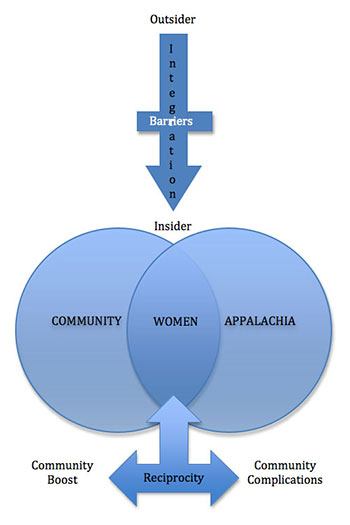
The following model describes the functions of and effects on community in Appalachian culture. Models are a necessary product of Grounded Theory and provide the method with explanatory power (Glaser & Strauss, 1967). Community’s overarching concept of a relationship among a group of people is embodied in two main concepts: place (Appalachia) functions and admission to place (the insider/outsider effect).
As part of Appalachia, the women made choices that influenced their role within the community. Based on their experiences, a strongly integrated community role might be expected to produce both greater assets (“community boost”) and greater drawbacks (“community complications”). The give-and-take relationship of newspaper and community (“reciprocity”) attempts to balance these two functions. Where the above concepts describe what a community is and does, the insider/outsider effect deals with individuals: Who is and is not part of that community, how one can become a part, and what stands in one’s way.
Through a “route to citizenship” of Appalachia, the model (Figure 1) illustrates the interaction of specific community variables. The women are a particular group that stands at the intersection of community and Appalachia. From this intersection flow the functions of community boost and community complications; the two are linked through the reciprocity function. The insider/outsider effect acts upon the women, who in addition to regional outsider factors, must deal with the additional outsider status of being a woman in top editorial roles traditionally filled by men. These and other barriers stand on the integration arrow, the “road to citizenship” for a given community, and are enforced by the insiders of that community. They may be surmounted via bonds, relationships, and longevity. Integration, in turn, determines the boosts and complications they may experience. The relationship is therefore a circular one: Once one becomes an insider, one becomes a part of Appalachia with a role and an expected reciprocity.
FIGURE 1: A PROPOSED MODEL OF COMMUNITY FUNCTIONS AND ADMISSION.
This particular model is distinct to Appalachia because it specifically characterizes concepts related to this particular region by way of admission standards related to the culture. For example, specific barriers to an Appalachian community include not originating in the specific area in which one works; the same may not be true (or as significant) elsewhere. With adjustments based on similar interviews, however, the model could be expanded to other groups.
The model can explain community’s vital part in rural journalism. With community being the central focal point, areas of place and admission help explain its standards. The model can break down these factors’ roles in the community newsroom, and whether they are overall beneficial or detrimental. The reciprocal relationship requires one to understand a place to cross the insider/outsider barrier at which point one becomes a part of that place with new roles and responsibilities.
CONCLUSION
Although the women in this study vary by their involvement in various communities, they all share that certain relationships have played a role in both the Appalachian culture as well as their career paths as editors in West Virginia. The relationships the women have encountered within the culture have helped them achieve their current positions. The strong ties of community within Appalachia helped shape their values and inclusion within the culture.
Some limitations were involved in this research. Sex did not seem to enter into the equation often, whether because it was not relevant or because of a reluctance to speak on the subject. Other limitations are the focus on small, community newspapers: Women working near larger West Virginia cities may have significantly different experiences. The results are not intended to be generalized to West Virginia or Appalachia, but they do describe the experiences of the women who work there and attempt to understand them as a group. With the infrequent references to the role of sex, future work might compare interviews with men in the state to give a more comprehensive view of the Appalachian journalist’s experience. Further study of why women may choose not to speak about their sex when viewing their career paths may be of interest to future research, which might also consider whether men choose to speak about their sex when describing their career paths. Further research might also be replicated with other underrepresented women in journalism.
The model is a blueprint for how relationships function in community journalism. It is beneficial to see how any community – physical, interest or relationship – functions and accepts members. It can be applied to various situations: workplace environments, interest groups, family dynamics and more. Any community that has relationship inner-workings can look to the model to apply individual characteristics and see how the community functions and accepts new members.
Discovering how female editors in Appalachia see themselves has been unexplored territory. In general, this segment of the population is not studied as often as others, perhaps in part due to that insider/outsider effect. Becoming aware of what role the women see their culture playing in their career paths can help explain both Appalachia and the distinctive strengths and challenges of community journalism.
WORKS CITED
American Society of Newspaper Editors (2012). Newsroom employment census. Retrieved January 24, 2012, from http://www.asne.org
Armstrong, C.A. (2014). Media Disparity: A Gender Battleground. Lexington Books.
Beasley, M.H., & Gibbons, S.J. (1993). Taking their place: A documentary history of women and journalism. Washington, D.C.: American University Press.
Bradshaw, K. Foust, J. & Bernt, J. (2005). Local television news anchors public appearances. Journal of Broadcasting & Electronic Media, 49(2), 166-181.
Bunch, W. (2008). Disconnected. American Journalism Review, 30(4), 38-45.
Campbell, C., Smith, E., & Siesmaa, E. (2011). The educative role of a regional newspaper: Learning to be drier. Australian Journal Of Adult Learning, 51(2), 269-301.
Clark, A., & Hayward, N. M. (2013). Talking Appalachian: Voice, identity, and community. Lexington; Lexington, KY: University Press of Kentucky.
Craft, S., & Wanta, W. (2004). Women in the Newsroom: Influences of female editors and reports on the news agenda. Journalism & Mass Communication Quarterly, 81(1), 124-138.
Creedon, P.J. and Cramer, J. (2007). Women in Mass Communication, Third Edition. Sage.
Cross, A., Bissett, B., & Arrowsmith, H. (2011). Circulation patterns of weekly newspapers in Central Appalachia and Kentucky. Grassroots Editor, 52(3), 4-8.
De Bruin, M. (2000). Gender, Organizational and Professional Identities in Journalism. Journalism 1, 217-238
Downie, L. and Schudson, M. (2009). “The reconstruction of American Journalism.” Columbia Journalism Review, 28-51.
Draucker, C., Martsolf, D., Ross, R. & Rusk, T. (2007). “Theoretical sampling and category development in grounded theory” Qualitative Health Research 17(8), 1137-1148.
Enda, J. (2002). Women journalists see progress, but not nearly enough. Nieman Reports, 56(1), 67.
Elmore, C. (2007). Recollections in hindsight from women who left: The gendered newsroom culture. Women & Language, 30(2), 18-27.
Everbach, T. (2006). The culture of a women-led newspaper: An ethnographic study of the Sarasota Herald-Tribune. Journalism & Mass Communication Quarterly, 83(3), 477-493.
Gans, H. J. (1980). Deciding What’s News. London: Constable.
Garfrerick, B. H. (2010). The Community weekly newspaper: Telling America’s stories. American Journalism, 27(3), 151-157.
Glaser, B. G., & Strauss, A. L. (1967). The discovery of grounded theory. Chicago: Aldine Publishing Co.
Goward, P. (2006). 2. Gender and journalism. Pacific Journalism Review, 12(1), 15-19.
Kian, E. M., & Hardin, M. (2009). Framing of sport coverage based on the sex of sports writers: Female journalists counter the traditional gendering of media coverage. International Journal Of Sport Communication, 2(2), 185-204.
Kirkpatrick, R., (2001). Are Community newspapers really different?, Asia Pacific Media Educator, 10, 16-21.
Lee, P., & Man, Y. (2009). Breaking the “glass ceiling” in the newsroom: The empowerment experience of female journalists. Conference Papers — International Communication Association, 1-47.
Lewis, N. P. (2008). From cheesecake to chief: Newspaper editors’ slow acceptance of women. American Journalism, 25(2), 33-55.
Lohmann, R. A. (1990). Four perspectives on Appalachian culture and poverty. Journal of the Appalachian Studies Association, 2, 76-91.
Mills, K. (1998). A Place in the News. New York: Dodd, Mead & Co.
Morton, J. (2009). “Not Dead Yet.” American Journalism Review, 48.
Partridge, M. D., Betz, M. R., and Lobao, L. (2013). Natural Resource Curse and Poverty in Appalachian America. American Journal of Agricultural Economics 95 (2), 449-456.
Reed, S. E. (2002). The Value of Women Journalists. Nieman Reports, 56(1), 63.
Riggio, R. (2010). Do men and women lead differently? Who’s better? Psychology Today.
Rosener, J. (1990). How women lead. Harvard Business Review, 68(6), 119-125.
Ross, K. (2001). “Women at work: Journalism as an engendered practice,”JournalismStudies, 2(1), 531–544.
Smith, K. and Wiltse, E. (2005). “Rate-setting procedures for preprint advertising at nondaily newspapers.” Journal of Media Economics, 18(1), 55-66.
Tang, M., & Russ, K. (2007). Understanding and facilitating career development of people of Appalachian culture: An integrated approach. The Career Development Quarterly, 56(1), 34-46.
Thompson, J. (1990), Hermeneutic enquiry. In E. Moody (Ed.), Advancing nursing science through research (pp. 223-280). London: Sage.
Toegel, G. and Barsoux, J. (2012). Women leaders: The gender trap. The European Business Review. Retrieved from http://www.europeanbusinessreview.com
Walsh-Childers, K., & Chance, J. (1996). Women journalists report discrimination in newsrooms. Newspaper Research Journal, 17(3/4), 68-87.
Candace R. Nelson is a graduate student at the Reed College of Media, West Virginia University.
Dr. Bob Britten is an assistant professor at the Reed College of Media, West Virginia University.
Dr. Jessica Troilo is an assistant professor of child development and family studies in the Department of Technology, Learning, and Culture at West Virginia University.
This ethnographic study examines the effect leadership can have on newsroom culture and, ultimately, how news is produced. Lowery and Gade (2011) argued that the future of community journalism will happen online, and Kaye and Quinn (2010) noted that the Internet allows for different funding models of journalism. Together, this means online community journalism will take many different forms over the next decade. This study examines one popular form of community journalism: the digitally native news nonprofit. The study illustrates that when a journalist, and not a business executive or executives, controls the entire news operation, the community journalism organization focuses on quality journalism more than profits.
The journalism industry and community journalism specifically currently face a time of change, with comprehensive transformations affecting how news is produced and what it looks like when consumed (Lowrey & Gade, 2011). These changes have made scholarly arguments concerning the future of journalism more contested and relevant than ever before (Christians, Glasser, McQuail, Nordenstreng, & White, 2009). Economics and technology have allowed for more journalistic competition and contributed to numerous new market models for news production (Bruns, 2005; Kaye & Quinn, 2010).
As the news industry continues to change, more work that examines how news is produced at these new models of journalism is vitally needed (Singer, 2008). Kaye and Quinn (2010) argued that the Internet allows for more community journalism, as the rise in the availability of the Web makes it easier for journalists to reach people and far cheaper for journalists to start their own online-only publications.
While corporations traditionally own most legacy media outlets including newspapers and television stations, the Internet makes it far easier for anybody to own a journalistic publication, providing more opportunities for journalists to simply start their own news organization (Lowrey & Gade, 2011). This can become a reality for community journalists, both reporters and editors, once they find an appropriate funding model (Kaye & Quinn, 2010). One such community journalism funding model gaining in popularity is the digitally native news nonprofit (Nee, 2013), a Web-only model funded through a combination of grants and donations.
This study examines one such digitally native news nonprofit. It uses ethnography to ask the question of how leadership affects organizational culture and, ultimately, how a community journalism organization produces news. As more and more community journalism sites join the news ecology, it is becoming more obvious that the future of community journalism lies online (Paterson & Domingo, 2008). In the decade ahead, various models with different cultures and values will appear online (Kaye & Quinn, 2010). Understanding how leadership affects the culture of an organization is vital to understanding how an organization will produce news.
Ethnography is the study of culture. The method originated in the field of anthropology, and researchers have employed it to study different cultures of people, usually from foreign lands (Bird, 2009). Singer (2008) argued that we could not truly understand a news organization without ethnography. This study examines the culture one such news organization, to understand how leadership affects its organizational culture.
LITERATURE REVIEW
News Organizations
Weeks and Galunic (2003) wrote that the goal of all organizations revolves around memes, which are units that carry cultural symbols, ideas and practices. They argued that organizations preserve, replicate and distribute cultural meanings. Morgan (2006) asserted that organizations rely on a series or set of rules and norms that provide members with a formal structure. Leaders transfer these implicit and explicit rules from other organizations, but, over time, each organization will acquire its own set of practices (Schein, 2006). The main reason organizations develop this structure is to maximize their ability for economic gain (Argyris, 2004).
The commercialization of the press in the United States began during the middle part of the 19thcentury (Baldasty, 1992). Private citizens and families began purchasing newspapers as for-profit enterprises throughout this moment in time. This began a shift away from political party-owned news organizations and toward the type of market models still prevalent today (Baldasty, 1992). Before this period, the main goal of a news organization revolved around spreading a particular ideology; this shift resulted in a strong focus toward profit (Bagdikian, 2004). Many owners of news organizations began treating newspapers as primarily a business (Baldasty, 1992).
News organizations focused equally on producing news and generating profits through advertising and circulation (Baker, 1994). In these early days of the commercial press, a distinct line evolved between the newsgathering and financial sides of the organization. For example, the work of the people in advertising became completely separate from the work of reporters and editors (Schudson, 2003). As time went on, a struggle between the business and editorial sides of newspapers arose, as ownership and management attempted to influence editorial independence. Baldasty (1992) wrote that “circulation managers defined a successful newspapers as one with high circulation and prompt delivery, and they saw the editor as a major obstacle to those goals” (p. 82). In the early-to-mid portion of the 20th century, news organizations began explicitly discussing the “wall of separation” between the newsgathering and financial sides of the organization; it became routine to disconnect these parts of the organization to minimize influence (McManus, 1994).
This does not mean the wall eviscerates influence; in fact, studies have found that the wall is becoming more and more porous (Pompilio, 2009). An economic downturn over the last two decades forced news organizations to adopt new strategies to sell more products and attract more readers and viewers (Kaye & Quinn, 2010). Weaver, Beam, Brownlee, Voakes, and Wilhoit (2007) found that journalists believe economics continue softening the wall of separation. Another survey found journalists now view business pressures as the principal threat to journalism (Journalism, 2008). And these business pressures are typically transferred to journalists through leadership, specifically leaders not normally involved in news decisions but rather business ones (Kaye & Quinn, 2010). For the vast majority of the 20th century and beyond, media organizations featured similar hierarchal models, with news department that answered to a business side. This subsequently set up a struggle between news and business interests (McManus, 1994). Currently, though, journalism faces its biggest paradigm shift since the introduction of the printing press (McChesney & Nichols, 2010), and each different publishing model that appears brings with it some new or altered norms and goals. These norms and goals make up the culture of the organization (Pavlik, 2013).
Organizational Culture
Schein defined organizational culture as a configuration of shared basic assumptions
learned by a group as it solved problems of external adaptation and internal integration, that worked well enough to be considered valid, and therefore, to be taught to new members as the correct way to perceive, think, and feel in relation to those problems (2006, p. 17).
Leadership plays a large role in shaping organizational culture. Leaders provide the vision and communicate these ideas through conversations, resource allocation, apportionment of power, and instatement of organizational structures and processes (Schein, 2006). A detached or disengaged leader can severely and negatively affect an organization’s culture (Kets De Vries, 2001). No matter the type of organization, a leader significantly impacts the day-to-day operations (Keyton, 2005). The leader, even if he or she is not hands on, originally sets the organizational culture, and this can influence the organization long after the leader departs (Kunda, 2006). In a news organization, there are multiple departments and leaders (McManus, 1994). The editor may control the news department, but in the vast majority of news organizations, the editor must report to a leader who prioritizes the business interests of the organization (Gans, 2004). This means that usually the ultimate leadership of a news organization does not come from a journalist (Barnouw, 1997). In many of the new community news websites that have begun in recent years, though, the opposite is true: Journalists started and control these sites, which could have a significant effect on organizational culture.
Studies of newsrooms have examined the impact of leadership. One classic media sociology study combined both observation and interviews (Paterson & Domingo, 2008). Tuchman (1978), Breed (1955) and Gans (1979) conducted three of the most cited and influential examinations of newsrooms. The studies found that organization culture directly influences how a newsroom operates, and leadership significantly affects the culture. Gans (1979) found that newsroom leaders primarily put into place the wishes of corporate leaders. This means that while regular journalists may not see or communicate with the corporation that owns their organization, their routines and roles are still greatly impacted by corporate leaders. Ryfe (2009) studied a newsroom undergoing a change in leadership. He found that when a newspaper brought in a new newsroom leader, that editor imparted new rules and routines that greatly impacted news production. Corporate executives hired this leader specifically to impart these changes. This finding is consistent with other studies that illuminated how news values shifted in the digital age due to a change in what leadership desired (Schultz, 2007), and how business interests can affect who leads a newsroom and how that leader acts (Velthuis, 2006). Thus, how leadership is structured not only affects how journalists perform their jobs, but also the type of content they produce. To understand organizational culture and leadership, we must study culture.
Theory of culture
Schein (2006), when defining and outlining his theory of culture, argued that elements shape an organization’s culture on three distinct levels: artifactual, the espoused values, and the basic underlying assumptions. He wrote that to understand the culture of an organization and the way that one operates, a researcher must understand cultural influences from all three levels. He defines culture as a combination of the values, visions, norms, behaviors, symbols and systems that the organizational members share and proselytize. These cultural elements provide the least pliable characteristics of an organization, and members share and spread them implicitly and explicitly.
When joining an organization, members undertake a conscious and subconscious group learning process that slowly but effectively indoctrinates them to the organization’s culture; when a new member fails to embrace culture, they typically leave the organization willingly or unwillingly (Gabriel, 1999). When an organization begins, leadership extensively shapes culture; leaders remain the largest influence on organizational culture (Schein, 2006). To understand organizational culture, a researcher must understand leadership (Kets De Vries, 2001). When a researcher embeds inside an organization and studies the culture and the leadership within at all three levels, the researcher can understand the organization’s culture. Therefore, the following research question will be examined:
RQ: How does leadership contribute to the organizational culture of the organization studied?
METHOD
Anthropologists created ethnography as a manner to study different cultures (Bird, 2009). Over time, more academic fields including communication have utilized ethnography. Singer (2008) wrote that to understand the organization’s culture is to understand the organization. Spradley (1979) posited that ethnography is the art of describing a culture, and we must first understand how the culture operates before we can begin to ask questions. Researchers must immerse themselves in that culture and get as close as possible to understanding the language used. The language is not necessarily foreign to the researcher, but each culture has its own language. To perform ethnography, the researcher can utilize multiple methods (Van Maanen, 1988). This study utilizes both observation and long-form, in-depth interviews.
Observation
Before a researcher can ask informed questions of the people studied, the researcher must fully understand what he or she observed (Spradley, 1979). The three keys to any in-depth qualitative study are describing, understanding and explaining (Hamel, Dufour, & Fortin, 1993). Spradley (1979) argued that the goal of observation is to grasp the observeds’ point of view and to realize their vision of the world.
In-depth Interviews
An interview is valuable because of the “wealth of detail that it provides” (Wimmer & Dominick, 2006, p. 139). Spradley (1979) wrote that when conducting ethnographic interviews, researchers must find informants, not subjects or participants. The people are informants because they teach the researcher. Without the informant, it would be impossible to learn. Spradley (1979) wrote that to simply treat the people being studied as subjects means the researcher will attach his or her own meanings to what is happening.
Studying An Organization
This study utilizes the theoretical model set forth by Schein (2006) concerning how to study organizational culture. For Schein, culture is many things, but generally culture is the values, visions, norms, symbols, systems and behaviors the people of an organization share. Culture takes the form of the “elements of a group or organization that are most stable and least malleable” and the “result of a complex group learning process that is only partially influenced by leader behavior” (p. 5). When examining culture as he defines it, Schein distinguishes between three distinct levels of culture, or levels of analysis a researcher must observe when analyzing an organization: artifacts, espoused values and basic underlying assumptions.
Artifacts are the surface level characteristics that one can observe easily. These can include observable things such as what we see, hear and feel. They can also include products that an organization makes or owns, technology it uses, the logo of a place, clothing worn by employees, the layout of the office, etc. A researcher must enter an organization with an open mind and not interpret data at the artifactual level until more information is gathered. Implicit in this argument is that a researcher must gather data at other levels of analysis before giving meaning to data at the artifact level.
Espoused values are the center of the second level of culture and analysis. The organization verbalizes or publishes espoused values; they could, for example, be part of a mission statement. While the organization makes espoused values public internally and/or externally, the organization does not necessarily follow these values in practice. Espoused values are ideas, goals and values that an organization acknowledges. These can be gleaned from documents such as original mission statements.
The final level of culture and analysis are basic underlying assumptions. These are unconscious beliefs shared by members of the organization. These evolve, for example, when a problem repeats itself numerous times and organizational members then solve it with the same solution. In theory, basic underlying assumptions are what prompt members of the organization to behave in the ways they do. Organizational members do not espouse these assumptions. Organizational members do not necessarily verbalize or publish basic underlying assumptions, but rather members share and act on these types of beliefs.
Schein argued that while observing all levels of culture, a researcher must note how the organization distributes power in the workplace. This is accomplished by not only identifying the titles of employees, but also through identifying decision makers who participate in those conversations. Leaders typically grant types of power to others, and finding those others and observing how that power is applied is vital to understanding how culture manifests itself. To see culture, researchers must identify how leaders allocate authority. The distribution of power heavily influences how members of an organization behave (Gabriel, 1999). People in power also develop rules and regulations. These rules are both espoused and implicit. Understanding how members of an organization deal with these rules, communicate with authority and with peers can tell a researcher quite a bit (Kunda, 2006).
The Case
A study of one particular case is “an empirical inquiry that investigates a contemporary phenomenon within its real-life context; when the boundaries between phenomenon and context are not clearly evident” (Yin, 2008, p. 26). This study examines an anonymous news organization, which this study will call The Gazette, a digitally native news nonprofit in the United States. A group of experienced journalists launched the Gazette in the mid 2000s. The digital news organization includes 15 paid, full-time employees.
The Gazette boasts a donor model. In 2010, the organization reported $2.22 million in revenue, while its expenses totaled only $1.29 million. The organization’s revenue comes from a mix of foundation grants, individual donations and fundraising events. In 2010, 59% of revenue came from donations, 35% from grants and 6% from fundraising events. More than 53% of the Gazette’s expenses come from editorial costs. The rest of the news outlet’s expenses come from marketing and development (24%), general administration costs (19%) and information technology costs (4%).
I spent a total of 43 days and 367.5 hours in the field. My time at the Gazette began on Jan. 18, 2013, and ended April 9, 2013. Weiss (1994) wrote that when information acquired becomes redundant and begins to not add to conclusions, fieldwork should conclude. By the beginning of April, the information I gathered started becoming redundant. I stayed in the field an extra week to corroborate the correctness of this determination.
Emerson, Fretz, and Shaw (1995) identified three stages of field note analysis. The first stage finds the researcher closely reading through the field notes and then writing initial comments in the margins. This stage is called writing memos. The second stage involves what Emerson et al. (1995) call open coding. To complete this stage, the researcher must do a line-by-line reading of the field notes and attempt to identify themes and patterns. Focused coding is the third and final stage of analysis, and this occurs when the researcher returns to the field notes with the themes and patterns in mind. This time, the researcher will begin to write a draft of the findings section. Once this is completed, the writing will begin.
This study follows these systematic procedures for analyzing field notes, interview transcripts and artifacts. I typed both the field notes and the interview transcripts; this provided an entry point for the data and became an initial reading. As I typed field notes and interviews, I would add notes in a different colored font. During the third and final stage of my analysis, I returned to the data with patterns in mind and examined it for the research question. For this study, I read the data completely 18 times.
To maintain confidentiality, throughout the findings, the news organization will be referred to as the Gazette, and the employees by their title.
FINDINGS
In this study, the research question asks how leadership contributes to the organizational culture of the Gazette. Kets De Vries (2001) and Schein (2006) both identified leadership as a prime component of how culture develops in an organization. Leaders have a strong influence on how culture is shaped. At the Gazette, Editor-in-Chief is the clear leader. She spent more than 30 years in legacy media. When she took a buyout and left her prior organization, she immediately began wondering about her next step.
Role of Leadership
Over the years since the Gazette began, Editor-in-Chief’s role at the organization shifted. At the start, employees said she played a much larger role in the organization’s day-to-day operations. However, she now contributes to the overall focus of the Gazette, but spends most of her time dealing with business issues. During the time period observed, Editor-in-Chief focused a lot of time on a specific future funding opportunity. She frequently attended meetings concerning this opportunity. She also frequently worked offsite, editing stories while traveling to visit her children and grandchildren. Even when she was not physically in the newsroom, however, Editor-in-Chief ‘s influence remained. She is the leader, and the culture of the organization is set and influenced by her. This culture is set even when she is not there and when visitors occasionally come to the newsroom. In various spots around the newsroom sit Gazette brochures that define the organization’s mission statement. This mission statement, written by Editor-in-Chief, specifically notes what she wants for news. This artifact sets the tone for the organization.
When in the office, Editor-in-Chief clearly led the staff. At all meetings she attended, she controlled the conversation and facilitated discussion. Everything went through her. Other editors did not ask Editor-in-Chief specific questions about specific stories, but rather questions about the overall issues. For example, when talking about coverage of the State of the Union Address, Editor-in-Chief asked Features Editor how the Gazette planned to cover the event. When Features Editor responded that they would focus on “the facts,” Editor-in-Chief agreed and made her vision known: “We don’t need a narrative. If there is one, great, but if not, just the facts.” This quote paraphrases exactly what Gazette brochures lay out as a mission statement. She said her primary focus with the Gazette is quality. “I’m worried about good journalism” (personal communication, March 13, 2013). These decisions and explicit instructions were not only followed in those instances, but also recalled by other employees in subsequent situations. For example, when a reporter planned to cover a speech a month after the State of the Union, the News Editor told the reporter to “focus on the facts and don’t worry about narrative.” This advice clearly parroted Editor-in-Chief. When Political Reporter discussed how he dealt with editors, he inadvertently illustrated Editor-in-Chief’s role at the Gazette.
“I talk with my editor, (News Editor), all the time. We have many conversations about stories and she knows what she’s looking for. I talk with (Features Editor) occasionally, when (News Editor) is on vacation or if I’m doing an arty story or a more featury story. Occasionally I talk to (Health Editor) if it’s health related, but not very often. (Editor-in-Chief) sometimes gets in the mix as a person who pushes you in the right direction or something” (personal communication, March 21, 2013).
Political Reporter’s quote explains how Editor-in-Chief sets the direction of the news organization without becoming involved in the day-to-day decisions about coverage. News Editor and Features Editor also said that Editor-in-Chief occasionally becomes very interested in a particular topic, and that means coverage needs to focus on that issue; this idea is communication both explicitly and implicitly. For example, at a news meeting, Editor-in-Chief simply told the staff that she wanted a series concerning gun control. That series was set in motion immediately. In a different meeting, one held about a month later and without Editor-in-Chief, Features Editor noted that something in the news that day usually interested Editor-in-Chief so the staff should act accordingly and follow up with coverage. Editor-in-Chief will not say how she wants the coverage, just that she finds something interesting. News Editor said that Editor-in-Chief is very clear on direction.
“One thing is that Editor-in-Chief does set direction. She makes it clear. You know, she gives us a lot of leeway and I think Features Editor and I, well, we pretty much manage the daily. I was going to say paper, but you know what shows up every day. But I think Editor-in-Chief is very clear about giving direction about the kinds of things she thinks are important” (personal communication, March 15, 2013).
Editor-in-Chief sets the directional tone at the Gazette also. Employees look to her for the “right” decision. In multiple interviews, Gazette employees noted that whenever they find themselves unsure about how to deal with an issue, they contact Editor-in-Chief. This illustrates her role because not one reporter discussed Editor-in-Chief playing a large part in how they produce stories. When a Gazette reporter said “my editor,” they meant either Features Editor or News Editor, not Editor-in-Chief. But major decisions come from Editor-in-Chief. When a reporter struggled with how to cover something, not what to cover, they looked to Editor-in-Chief for guidance.
For example, an organization in a partnership with the Gazette became outspoken concerning a certain ballot item. Nobody in the newsroom knew exactly how to deal with the issue and immediately turned to Editor-in-Chief for answers. “I don’t want to overreact to this,” she said, “but we cannot be involved in a partnership where they’re strategizing with one side.”
In another example, the Gazette accepted a grant from an arts organization. The grant called for the Gazette to hold community meetings to discuss issues in the arts. Editor-in-Chief found herself a little indecisive about the experience at first, but after the meetings, she said she thought the partnership worked well. She noted, and again crystalized her vision for the news organization, during a morning budget meeting. This experience served as a blueprint for how the Gazette should approach grants in the future.
“If you were going to articulate a guideline for us, this seems like a start. This felt a little uncomfortable for me at first because we were partnering with an organization that was giving us money, and we report on them. But they were also genuinely wanting to know what was going on. So that’s a sort of guideline for the future. There are probably organizations we don’t want to partner with, like a liquor store that wants to know where liquor is sold” (personal communication, March 16, 2013).
Strategic Development Manager noted the tension between the business side of the Gazette and the editorial.
“There’s never really a bad monetary opportunity for grants or whatever, I think. The editorial side might disagree. The bottom line is it comes down to (Editor-in-Chief). I mean, she has such a great background with journalistic ethics that, like, the line does end with her. So basically we have to feel out what feels right and then think about it. In the end, we ask (Editor-in-Chief) because she’ll have the right answer” (personal communication, March 18, 2013).
This statement implicitly notes the difference between the Gazette and typical news organizations. In most cases, the decision above would be made by a leader from the business side, but at the Gazette, Editor-in-Chief makes the decision. She can alleviate the tension between business and editorial as she leads both, explained the Features Editor in one conversation.
“She sets the tone. We know that all decisions will be based on what’s best for the community, not what’s best for us monetarily or something. (She) knows that our ultimate bosses are the readers and they don’t care about anything but receiving the highest quality news possible” (personal communication, March 15, 2013).
During the time period observed, the Gazette worked on a series of stories concerning obesity in the community. An organization funded the series, and Health Editor noted how the editorial side of the Gazette worked with the business side of the organization on this type of story.
“It’s very touchy and it was hard for (Editor-in-Chief) to say, ‘OK, we’ve got to go out to these foundations and get money.’ This is new territory for journalists, of course, but it’s also our future. So we went. We’ve been very, very careful. News Editor looks carefully at our stories. She takes a political test on all of them so she feels they are unbiased. (Editor-in-Chief) looks again, as she reads every story. But it’s something we’re all really careful about” (personal communication, April 5, 2013).
Some of the journalists at the Gazette consider Editor-in-Chief a mentor or an idol. In interviews, numerous Gazette employees lauded Editor-in-Chief’s experience and remarked how much they have or hoped to have learned from her.
How Leadership Shapes Culture
Editor-in-Chief informs and influences the culture of the Gazette on both a daily micro and macro way. During the time period observed, Editor-in-Chief worked out of the newsroom 35% of the time. When in the newsroom, the Gazette had a more formal environment. The staff held budget meetings, they engaged in fewer personal conversations, and the workday appeared more structured. On days when Editor-in-Chief worked from the Gazette newsroom, all major decisions concerning editorial went through her. This did not appear to be the case on days when she worked offsite. On a more macro level, Editor-in-Chief built the foundation of the Gazette, and the staff enacts her mission for the organization daily. She still retains a firm hold on communicating that mission.
Editor-in-Chief enacted a “news that matters” approach taken daily by the Gazette. When in the office, Editor-in-Chief sometimes verbalizes this approach concerning a story. When discussing a particular story with a reporter, Editor-in-Chief said, “Start with people directly affected and then you build around them, not the other way around. You need a place to start. We need a vehicle.” This advice clearly articulates her vision of an online newspaper using context to tell stories. On a day when Editor-in-Chief worked out of the office during a trip to Vermont, News Editor told a reporter over the phone that a story needed more people affected by the incident, thus continuing the mission.
When Editor-in-Chief is out of the office, News Editor and Features Editor run the day-to-day operations, but Editor-in-Chief’s mission remains present. For a series on gun violence, Editor-in-Chief called a meeting to brainstorm ideas. Before the meeting, she told News Editor and Features Editor that she could not oversee the series as closely as she would want. She implied that this meeting would allow her the ability to communicate what she wanted out of the series, even though she would only be tangentially involved. Editor-in-Chief originated the idea for the series and called the meeting to make sure Gazette employees understood her vision. In the newsroom, to other editors, she said,
“I think the key would be doing it in a way that would let people see the patterns of gun violence. Maybe we pick a block that’s in the middle of this and see who’s here, what’s happening and how this intersects with these bigger trends. I will send this note around and say, ‘Let’s make a big deal out of this.’ But I’m doing that without knowing if it is a big deal” (personal communication, March 16, 2013).
When the Gazette faced the quandary of whether to publish a racist political photo, the staff looked to Editor-in-Chief for the decision. Editor-in-Chief verbalized what she saw as the predicament. The Gazette could run the photo, letting the community see the depiction, but it would also spread a racist image. Or the organization could describe it, and not give it any more prominence. Eventually, Editor-in-Chief decided on the latter. “I’m inclined to describe it and not print it. People can find it if they want,” she said.
When Education Reporter wondered how to proceed with a story about a local university, Editor-in-Chief assisted in the decision. Education Reporter had off-the-record sources concerning an administrator at the school, but struggled with publishing the piece without attribution. Editor-in-Chief stepped in and verbalized that she did not feel comfortable running the story without this particular attribution. Editor-in-Chief consistently made this type of decision, ones that could potentially affect the Gazette’s credibility.
In one specific instance, Editor-in-Chief’s influence manifested itself without her ever actually having a say in the manner. During a three-day period when Editor-in-Chief traveled on a working vacation, one political reporter encountered a predicament: Should the Gazette cover a specific angle concerning a political race that might not add anything to the story, but could generate interest. “I couldn’t decide what to do,” the reporter said. “It was an interesting little bit of a story that would ultimately not matter in terms of the campaign, but it could upset certain people and generate interest. I knew other organizations would fully cover it.”
With Editor-in-Chief away and not easily accessible, the reporter literally thought, “What would (Editor-in-Chief) do?” The reporter briefly discussed the issue with a direct editor, but neither of them could come to an understanding of exactly how to cover the situation. “We both had a similar idea of what was necessary,” said the reporter, “but we didn’t know exactly what to do. On one hand we could completely discuss the issue and maybe generate some interest with readers who care about prurient issues; on one hand we could just not cover the issue at all because it really did not matter and was just a propped up charge with no meaning behind it; and then on the mythical other hand, we could discuss the story briefly and just make it clear that it has no legs” (personal communication, April 5, 2013).
After spending the early afternoon debating the next step, the reporter made a decision, not based on a direct editor’s opinion or their own, but on what Editor-in-Chief would do. “I just kept going back and forth,” said the reporter, “but then I thought this isn’t too complicated. Our mission is to provide news that impacts people and helps them understand the world around them. That’s what (Editor-in-Chief) always says to do. That’s what our mission statement basically says” (personal communication, April, 5, 2013). In this particular situation, the reporter initially thought that the covering the issue at all would be a negative decision since it would bring attention to something that didn’t deserve it. But the reporter also knew other organizations would cover it and not give the community the information it needed to process the information. “I knew that our job is to provide news that matters and this was going to matter to people regardless of whether we covered it. I knew, as (Editor-in-Chief) always says, we need to impact our readers. Explaining that this isn’t news and where the information came from is what our job would be” (personal communication, April 5, 2013).
Even when she is not physically present, during the time period observed, Gazette employees called Editor-in-Chief to solicit advice. Therefore, even as time passes, and Editor-in-Chief delegates more and more decision-making power to staffers, she is still shaping culture. Schein (2006) wrote that a particularly strong leader’s vision would powerfully influence culture even after they step down from a leadership position. Over time, that influence dissipates but not without the emergence of a new significant leader. This has not yet happened at the Gazette, where Editor-in-Chief still shapes culture on a daily basis.
DISCUSSION
The Gazette remains an award-winning digitally native news nonprofit producing community journalism. The three main co-founders of the organization all spent more than three decades in prominent positions at a legacy media organization in the same community. All three founders remain heavily involved in the community through charities and civic organizations.
As a newsroom, the Gazette spends more than 53% of its operating budget on the editorial department, and its large staff, relative to its operating budget, displays a clear and sizeable commitment to editorial quality. The organization prides itself on this commitment, with numerous mentions in promotional materials speaking to its nonprofit status and goal of providing contextual reporting that connects issues to the community. The organizational culture of the Gazette revolves around this commitment to quality. Editor-in-Chief, the undisputed leader of the organization, significantly impacts and sets the vision for this culture. She started the Gazette because of her dealings with her prior employer, which she thought placed too much of an emphasis on finances. The Gazette, alternately, places an emphasis on journalistic quality because of its leader.
This study illustrates that the perceived lack of quality of Editor-in-Chief’s former employer directly led to the Gazette’s establishment. Founders, especially Editor-in-Chief, believed the community needed another media source, one that would “fill in the gaps in coverage” created by other local media, as noted by Assistant Editor (personal communication, March 15, 2013). Founders acknowledged that they believed a nonprofit media source would alleviate the need for high profits and allow the Gazette to focus on providing readers with quality and important news. After surveying the country and hearing about Voice of San Diego, Gazette founders decided they could start and support a similarly structured enterprise.
During the time period observed, this focus on quality and contextualized reporting became overtly apparent. Gazette staffers consistently espoused and displayed an allegiance to what the organization deemed quality journalism. This language concerning quality journalism and “news that matters” appeared on flyers printed by the Gazette in its early days, and years later all reporters still mentioned it as a priority. These fliers still sat prominently in the newsroom and were handed out to community members at events.
This shows how Editor-in-Chief’s leadership and mission still shaped organizational culture at the Gazette. Gazette employees rarely discussed finances. While some staffers displayed an underlying fear concerning the long-term viability of the organization’s market model, none relayed fears of layoffs or losing their job. McManus (1994) found that in market-driven organizations, a need for continuously growing revenues permeates into the newsroom and affects news production. The Gazette displays none of this. Conversations expressly concerning the wants of the audience did not occur. In fact, I observed quite the opposite numerous times. Gazette editors and reporters occasionally discussed how the audience did not want, for example, coverage of small county elections, but journalists believed this coverage affected readers and therefore boasted strong importance.
News judgment remains the underlying main element of the Gazette’s culture. Editors preach and practice an unadorned focus on news judgment. Reporters should find and report stories that represent the Gazette’s definition of news. Editors will consistently imply that content is completely dependent of news judgment. In some cases, the aforementioned anecdote concerning whether to cover a specific story about a political campaign, the Gazette only covered the issue so it could debunk expected coverage from other news sources. The reporter’s initial instinct was to cover the issue, but the implicit influence of leadership made the reporter rethink the decision and realize the job, in that instance, was to contextualize the situation and help community members understand why this issue did not matter.
Schein (2006) presented a theory of organizational culture that researchers can only see and understand culture through three levels of analysis: artifacts, espoused beliefs and basic underlying assumptions. The Gazette presents an aligned culture based upon these three levels. From promotional material to personal interviews to underlying assumptions, the Gazette demonstrates a newsroom focused on providing its own definition of quality journalism, which revolves around contextualized reporting on issues that affect the community, or as employees call it, news that matters.
This unified vision remains due to strong leadership from Editor-in-Chief. Both Schein (2006) and Kets De Vries (2001) stress that leadership shapes organizational culture. They wrote that, especially at the beginning when original leaders remain in positions of power, leadership provided the most important influence on culture. At the Gazette, Editor-in-Chief takes this role seriously. During the time period observed, staffers did not make important decisions without her. At various instances, when a staffer encountered an issue, they turned to Editor-in-Chief for a solution. All staffers noted her ability to steer the Gazette, even when not intimately involved in a situation. Employees discussed Editor-in-Chief as someone constantly lurking behind the scenes, making the final decisions about major issues and, as Political Reporter noted, “someone who pushes you in the right direction.” Staffers all valued her leadership.
As Schein (2006) and Kets De Vries (2001) noted, leadership can shape the culture of an entire organization. This study illustrates that in a newsroom, leadership plays a much larger and more important role. McManus (1994), Gans (1979) and countless other researchers found that news organization leaders tend to focus on profits and, in recent years, this attention to stock prices affected newsrooms (Bagdikian, 2004). More often than not, journalists do not lead news organizations (e.g., Barnouw, 1997; McChesney, 2004). Going all the way back to Joseph Pulitzer, journalists acknowledged the potential tension between news and profits (Schudson, 1978). McChesney (2004) argued that very rarely does this tension dissipate, only when the goal of quality news coverage aligns with the goal of financial profits. Therefore, in a news organization, leadership’s influence on culture remains critical. McManus (1994) found that journalists still vocalized an ultimate goal of quality, but remained highly skeptical of leadership. At the Gazette, because staffers believe in Editor-in-Chief’s journalistic credibility, and because it is Editor-in-Chief’s primary mission, the entire newsroom acts accordingly. In most businesses, there is one primary, ultimate goal, but journalism serves a dual market, one for audience and one for advertising (Baker, 1994).
This study finds that in a newsroom, leadership becomes even more important to the ultimate vision due to consistent goals. In traditional newsrooms, leaders on the editorial side predominantly answer to leaders on the business side. These sides, according to McChesney (2004), rarely have the same goals. Schein’s theory of organizational culture primarily focuses on how leadership determines ultimate success. Disagreements arise between leaders and workers primarily because of differing goals. Editor-in-Chief’s leadership keeps the ultimate goals of employees uniform.
If the future of community journalism really does lie online, then many different market models, such as the digitally native news nonprofit, will begin to permeate the industry. It is important to understand each of these models’ leadership structure because that will significantly impact the type of news it covers. The industry is seeing an influx of smaller, flatter organizational models (Kaye & Quinn, 2010), models that allow for leaders to make a more direct impact. When AOL purchased Patch in 2009, many believed this changed the future of community journalism. Yet numerous studies show that corporate leadership affected content choices and journalists did not successfully engage with readers (e.g., St. John, Johnson, & Nah, 2014). Ultimately, corporate ownership decreased funding significantly for Patch sites. Journalists who start their own publications, however, do not primarily seek financial gain and are more interested in quality journalism (Nee, 2013). This could result in leadership having a large effect on the future of community journalism.
WORKS CITED
Argyris, C. (2004). Reasons and rationalizations: the limits to organizational knowledge. Oxford; New York: Oxford University Press.
Bagdikian, B. H. (2004). The new media monopoly. Boston: Beacon Press.
Baker, C. E. (1994). Advertising and a democratic press. Princeton, N.J.: Princeton University Press.
Baldasty, G. J. (1992). The commercialization of news in the nineteenth century. Madison, Wis.: University of Wisconsin Press.
Barnouw, E. (Ed.). (1997). Conglomerates and the media. New York: New Press.
Bird, S. E. (2009). The anthropology of news & journalism: global perspectives. Bloomington, IN: Indiana University Press.
Breed, W. (1955). Social control in the newsroom: A functional analysis. Social Forces, 33(4), 326-335.
Bruns, A. (2005). Gatewatching : collaborative online news production. New York: Peter Lang.
Christians, C. G., Glasser, T. L., McQuail, D., Nordenstreng, K., & White, R. A. (2009). Normative theories of the media: Journalism in democratic societies. Urbana: University of Illinois Press.
Emerson, R., Fretz, R., & Shaw, L. (1995). Writing ethnographic fieldnotes.
Gabriel, Y. (1999). Organizations in depth: The psychoanalysis of organizations. London ; Thousand Oaks, Calif.: Sage Publications.
Gans, H. J. (1979). Deciding what’s news : a study of CBS evening news, NBC nightly news, Newsweek, and Time (1st ed.). New York: Pantheon Books.
Gans, H. J. (2004). Democracy and the News. New York: Oxford University Press, USA.
Hamel, J., Dufour, S., & Fortin, D. (1993). Case Study Methods (Vol. 32). Thousand Oaks: Sage Publications.
Kaye, J., & Quinn, S. (2010). Funding Journalism in the Digital Age: Business Models, Strategies, Issues and Trends. New York: Peter Lang.
Kets De Vries, M. (2001). The Leadership Mystique. A user s manual for the human enterprise. Saddle River, NJ: FT Press.
Keyton, J. (2005). Communication & Organizational Culture: A to Understanding Work Experiences. Thousand Oaks, C.A.: Sage.
Kunda, G. (2006). Engineering culture : control and commitment in a high-tech corporation (Rev. ed.). Philadelphia, PA: Temple University Press.
Lowrey, W., & Gade, P. J. (2011). Changing the news : the forces shaping journalism in uncertain times. New York: Routledge.
McChesney, R. W. (2004). The problem of the media : U.S. communication politics in the twenty-first century. New York: Monthly Review Press.
McChesney, R. W., & Nichols, J. (2010). The death and life of American journalism : the media revolution that will begin the world again (1st Nation Books ed.). Philadelphia, PA: Nation Books.
McManus, J. H. (1994). Market-driven journalism : let the citizen beware? Thousand Oaks, Calif.: Sage Publications.
Morgan, G. (2006). Images of organization (Updated ed.). Thousand Oaks, Calif.: Sage Publications.
Nee, R. C. (2013). Creative Destruction: An Exploratory Study of How Digitally Native News Nonprofits Are Innovating Online Journalism Practices. International Journal on Media Management, 15(1), 3-22.
Paterson, C. A., & Domingo, D. (2008). Making online news : the ethnography of new media production. New York: Peter Lang.
Pavlik, J. V. (2013). Journalism and new media: Columbia University Press.
Pompilio, N. (2009). A Porous Wall. American Journalism Review, 31(3), 32-37.
Ryfe, D. M. (2009). Structure, agency, and change in an American newsroom. Journalism, 10(5), 665-683.
Schein, E. H. (2006). Organizational culture and leadership (3rd ed.). San Francisco: Jossey-Bass.
Schudson, M. (1978). Discovering the news: A social history of American newspapers. New York: Basic Books.
Schudson, M. (2003). The sociology of news. New York: Norton.
Schultz, I. (2007). Journalistic Field, News Habitus, and Newsroom Capital: Using reflexive sociology to conceptualise context in newsroom ethnography. Paper presented at the International Communication Association.
Singer, J. (2008). Ethnography of newsroom convergence. In C. A. Paterson & D. Domingo (Eds.), Making online news : the ethnography of new media production (pp. 157-170). New York: Peter Lang.
Spradley, J. P. (1979). The ethnographic interview. New York: Holt, Rinehart and Winston.
St. John, B., Johnson, K., & Nah, S. (2014). Patch.com. [Article]. Journalism Practice, 8(2), 197-212.
Tuchman, G. (1978). Making news : a study in the construction of reality. New York: Free Press.
Van Maanen, J. (1988). Tales of the field : on writing ethnography. Chicago: University of Chicago Press.
Weaver, D., Beam, R. A., Brownlee, B. J., Voakes, P., & Wilhoit, G. C. (2007). The American journalist in the 21st century: US news people at the dawn of a new millennium. New York: Routledge.
Weeks, J., & Galunic, C. (2003). A theory of the cultural evolution of the firm: The intra-organizational ecology of memes. Organization Studies, 24, 1309-1352.
Weiss, R. S. (1994). Learning from strangers : the art and method of qualitative interview studies. New York: Free Press.
Wimmer, R. D., & Dominick, J. R. (2006). Mass media research : an introduction (8th ed.). Belmont, CA: Thomson, Wadsworth.
Yin, R. K. (2008). Case study research: Design and methods (Vol. 5): Sage Publications, Incorporated.
About the Author
Dr. Patrick Ferrucci is an assistant professor in the Department of Media, Communication and Information at the University of Colorado – Boulder.