Categories
Online news

How your stories end up on Google News, and how you can promote them

Google has posted a video on YouTube that outlines some best practices for publishers who are trying to perform better on Google News. If you haven’t checked to see if you’re showing up on Google News, you might want to. The search engine sends more than a billion clicks a year to news sites. If you’re already on Google News, then you might want to check out this video with some tips on how to perform better. And don’t worry, despite the insider terms and tech speak, there is some simple, easy-to-use advice in there.

Categories
Uncategorized

News websites can learn from Wikipedia

Some have argued that the story was a product of necessity — newspapers had a fixed news hole to fill, and newscasts only had so much airtime. Context was often sacrificed as a result, because with a fixed amount of space, only the newest information is fit to print. But in the online era, there is no news hole. So what does that mean for the story, and if it’s dying, what will replace it? Is the story dead as a building block or do we need to be building new ways of presenting information using stories?

“The story was all we had before — it’s what would fit onto a newspaper page or into a broadcast show,” Jeff Jarvis, a journalism professor at The City University of New York wrote in his blog, Buzz Machine. “But a discrete and serial series of articles over days cannot adequately cover the complex stories going on now nor can they properly inform the public.”

Furthermore, newspapers are on fixed publication schedules; the format of the newspaper simply lended itself to telling readers what happened in a given 24-hour period, not everything that has happened in a given storyline. That’s great for an interesting feature story, but doesn’t do justice to a complex issue such as healthcare reform.

So what is emerging online as the new “atomic unit” of news?

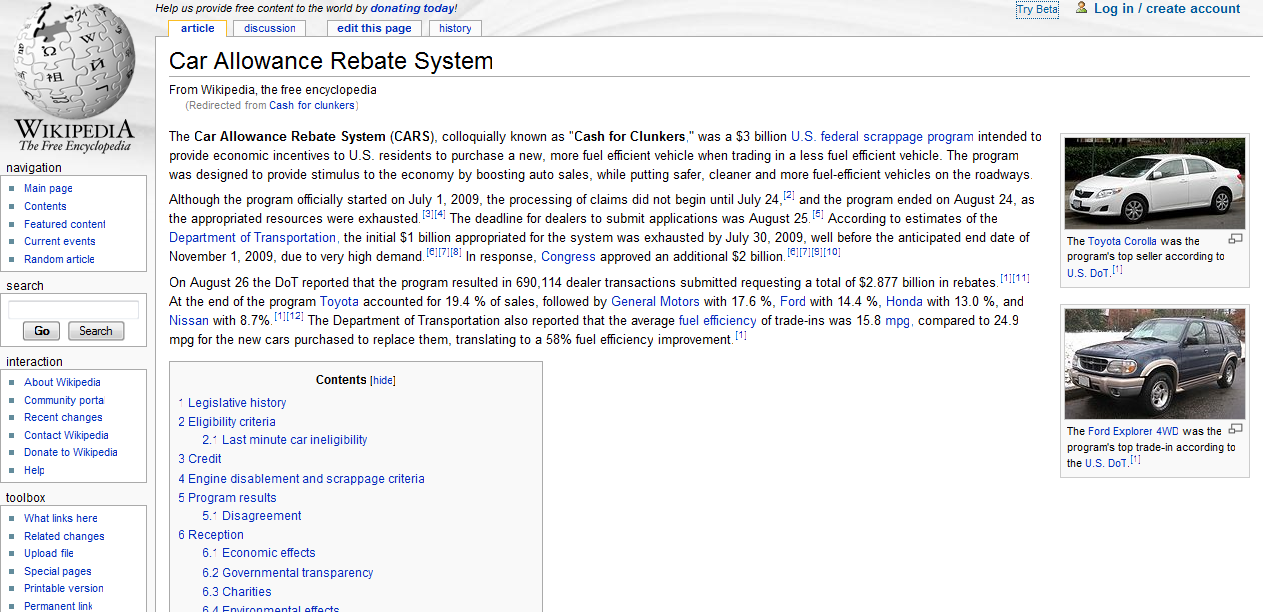
Some say it’s the topic and point to Wikipedia of all places as an example. Compare the Wikipedia page on Cash for Clunkers to the latest newspaper story on the program and you quickly see how much more information is on one Wikipedia page compared to one page on a news website. It’s unlikely you’re going to sit down and read all 4,500+ words in the Wikipedia story, though, and there are obvious accuracy issues. But some journalism scholars still point to the possibilities Wikipedia’s format has for news. Most of the information in the Wiki was probably reported at one time by most major newspapers who reported on Cash for Clunkers, but as journalists, we just don’t organize our information on the Web in a way that is as permanent, or as context-packed as a Wiki. If you want to see some attempts at this, check out Times Topics from the New York Times and also see how AP is looking at doing something similar. For a smaller example, look at Columbia Tomorrow, a project from Matt Thompson at the Reynolds Institute at Mizzou. Google thinks there’s value in “contextual news”; they’re experimenting with adding Wikipedia in Google News searches.

The story model also assumes regular readership, which is something that also may not exist in the online era like many thought it did in print. We can no longer assume someone who read about a crime one day heard about the arrest the next. Google’s Marissa Meyer compared the change in the “atomic consumption of news” to what iTunes and the mp3 has done to the music industry. “As with music and video, many people still consume physical newspapers in their original full-length format. But with online news, a reader is much more likely to arrive at a single article,” Meyer said during Congressional testimony in May.

Neither option can replace the story, though. Scan Wikipedia, and much of the source information points back to newspaper articles. That begs the question, could a newspaper such as the Detroit Free Press produce a great page on former mayor Kwame Kilpatrick? His Wikipedia page was viewed more than 500,000 times last year and most of the links are to Free Press stories. Could your newspaper do the same thing with a page on the local high school’s football team or your annual town festival? After all, most daily newspaper stories are written to last just one day. What are the monetization possibilities of topics pages that are built to last forever on the Web while being updated as a given topic evolves, all the while pointing readers to additional reading in the form of stories or documents hosted on a newspaper’s Web site?

This is a cross-post from Explorations in New Media, an ongoing project at the Schieffer School of Journalism at TCU.
Categories
Uncategorized

Persuasive argument for going tabloid

Alan Jacobson at Brass Tracks Design has written a pretty persuasive argument for going tab using one of his recent clients, the Bakersfield Californian, as an example. Jacobson’s suggestions could certainly apply to most community newspapers (minus the part about nixing feature photos). He outlines how a tab can save money and provide new revenue opportunities through both advertising upsells and single-copy sales.

Categories
Online news Social media

Community newspapers can learn from BusinessWeek’s online strategy

In a Q&A with an online digital marketing journal, BusinessWeek’s John Byrne elaborates on some of the company’s user engagement efforts, many of which would carry over well to community newspapers. He talks about how BusinessWeek leverages readers’ knowledge in creative ways from crowdsourcing questions to guest columns.

Categories
Online news Paid content

Newspapers who charge for content: How’s it working?

Check out this article in PaidContent. It surveys some newspapers who are charging for online content, including the Valley Morning Star in Harlingen. Here’s a quote: “The newspapers tend to be located in smaller, often rural markets; online-only subscriptions are typically priced at a substantial discount to the print edition (in general, about 75 percent of what the print product costs); where numbers are available, the number of online subscribers is still a tiny percentage of their print counterparts (less than 5 percent); and many of these papers say they began charging not so much to make money online, but rather to protect sales of their print editions.”

Categories
Future of news Online news

Is this a ‘golden age’ for community newspapers?

In less than a year, M.E. Sprengelmeyer has gone from being the Washington correspondent at the Rocky Mountain News — covering everything from 9/11 to the war in Iraq — to owning a community newspaper in a small New Mexico town. He writes about his experience on the Save the News blog, and about his optimism about the state of community journalism. “Think of a community newspaper as a bronze statue in the town square,” he writes. “Everybody in town can look up and see that it’s there.”

Categories
Online news Paid content

Making profits online: some suggestions

Successful managers are always looking for ideas. And sometimes, they find great ideas in articles – or from people – that they don’t always agree with. That’s why I want you to read Steve Outing’s piece on making online profits. There may be some things that don’t apply to you; there may be things you don’t think you can do right now; and there may be a few things you just disagree with you. But Steve gives 12 ideas, and I’ll bet that there are one or two that will work for you. It’s worth checking out.

Categories
Ask an Expert Questions and Answers

I was asked to run for City Council because I have so much knowledge about community issues. Do I have an ethical problem if I run?

Most definitely. It is called conflict of interest.

Editors of both large and small papers are often confronted with this dilemma. Louis Day, in his textbook Ethics in Media Communications, defines a conflict of interest as a “clash between professional loyalties and outside interests.”

In this case, the clash would be between your responsibilities as a city council member vs. your professional loyalties as a journalists. A fundamental duty of a journalists is to be an observers of events instead of participants.

In your case you would have the ultimate responsibility of the coverage of your city council. As a city council member, you would be acting on issues that have impact your community.

I think it is almost impossible to completely separate the two duties — there will come a time when your action as a city councilman will influence how you cover a story. None of us are totally objective creatures.

Categories
Online news Social media

Does your newspaper have a Facebook strategy?

A what, you ask? My newspaper needs a Facebook strategy? Yes, you do. And the fact that you do is symptomatic of the changes that are engulfing today’s community journalism. This article will take only a few minutes to read, but it overviews the issue, including some ideas on monetizing your Facebook presence.

Categories
Future of news Online advertising

Ads on the Net: We didn’t explore how to use the new medium to connect advertisers with customers

In this time of radical change for newspapers, you’ll find lots of folk trying to make sense of it all – especially in the blogosphere. These writers are trying to interpret the signs of the media times and to recommend what we should do next. You can’t read them all, but when I see Steve Buttry’s byline attached to something, I always take time to check it out. I hope you will read the entire blog post at the URL above. Talking about the free vs. paid content issue, Steve notes that many people see the Original Sin of newspapers as not beginning to charge for online content from the get-go. But in a typical (for Steve) flash of insight, he notes that the Original Sin was on the ad side. Here’s a brief sample: “The disastrous error that newspapers made early in our digital lives was treating online advertising as a throw-in or upsell for their print advertisers. Helping businesses connect with customers was always our business. We were facing new technology and new opportunities and we did next to nothing to explore how we might use this new technology to help businesses connect with customers. We just offered businesses the same old solutions that we offered in print, but pop-up ads and web banners somehow didn’t work as well as display ads. Which was just as well, because we told our business customers the ads weren’t worth much by the way we treated them.” If you agree with what Buttry is saying, you will definitely want to make plans to attend our Internet ad sales workshop on Oct. 29 with Chuck Nau. Mark your calendars now and watch for more details on the website and in your inbox soon.